

Sunday, October 25, 2026
Science
No Result
View All Result
  • Login
  • HOME
  • SCIENCE NEWS
  • CONTACT US
  • HOME
  • SCIENCE NEWS
  • CONTACT US
No Result
View All Result
Scienmag
No Result
View All Result
Home Science News Biology

Review links OAS1 regulation to HIV restriction and persistence

October 25, 2026
in Biology
Kristina Jarvis
By Kristina Jarvis Scienmag Editorial Profile - Infectious Disease Medicine
Reading Time: 2 mins read
0
Review links OAS1 regulation to HIV restriction and persistence

Review links OAS1 regulation to HIV restriction and persistence

65
SHARES
587
VIEWS
Share on FacebookShare on Twitter
ADVERTISEMENT

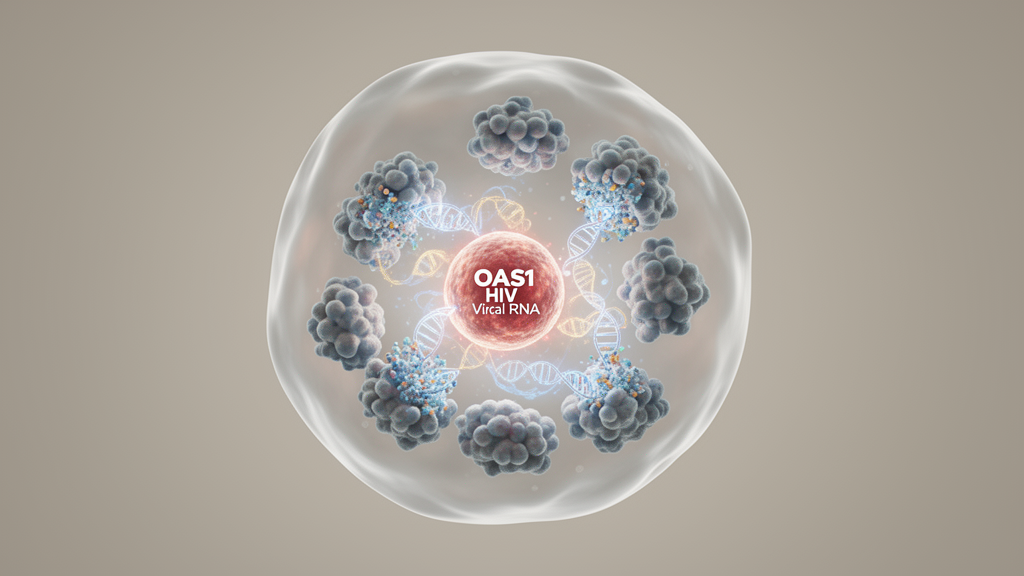
A 2026 review identifies 2′-5′-oligoadenylate synthetase 1 (OAS1) as a multifunctional component of host defence against HIV-1, linking its established antiviral role with possible effects on viral persistence, immune regulation, neuroinflammation and retroviral disease progression. The paper surveys the broader 2′-5′-oligoadenylate synthetase protein family but focuses on OAS1, an interferon-stimulated gene that senses viral double-stranded RNA and activates the OAS–RNase L pathway. Its scope is a synthesis of experimental and clinical evidence rather than a new experiment or clinical trial.

OAS1 acts within the innate immune mechanisms that can restrict HIV despite the virus’s ability to establish persistent infection during effective antiretroviral therapy. The review examines the genomic organization, structural diversity, isoform-specific functions, genetic variation and interferon-mediated regulation of OAS proteins. Alternative splicing and polymorphisms create functional diversity within OAS1 and may influence antiviral activity, individual susceptibility and clinical outcomes.

The evidence therefore should not be read as showing that every OAS1 variant has the same effect on viral replication or disease. Experimental and clinical studies summarized by the review report that type I and type III interferons induce OAS1 in macrophages, dendritic cells, epithelial and endothelial cells, microglia and lymphocytes. In this setting, OAS1 contributes to HIV restriction through RNase L activation and enhanced innate antiviral responses.

OAS signalling may also support antiviral defence at mucosal surfaces, influence viral burden and chronic immune activation, and affect interferon responsiveness during combination antiretroviral therapy. These are biological associations and potential roles in host defence, not evidence that activating OAS1 has demonstrated clinical benefit in people living with HIV. The review also examines the more complex relationship between OAS1, the central nervous system and HIV pathogenesis.

OAS signalling has been associated with central nervous system protection, whereas dysregulated OAS1 expression has been associated with HIV-associated neurocognitive disorders. The available evidence does not support a simple model in which increased OAS1 expression is uniformly beneficial: the review presents antiviral activity and abnormal regulation in a context-dependent framework. Its conclusions are constrained by the varied experimental systems, cellular responses, isoforms and genetic backgrounds represented across the studies it considers.

For viral scientists, the review positions OAS1 as both a restriction factor and a potential immunoregulatory node in persistent retroviral infection. It identifies investigation of OAS1 activation, genetic variation, isoform-specific functions and immune modulation as avenues that may facilitate biomarker discovery and the development of host-directed strategies against persistent retroviral infections. Its principal contribution is to organize current evidence on how this double-stranded-RNA sensor fits into interferon-driven immunity and may connect HIV replication, persistence, tissue-specific immune responses and disease-related inflammation.

Subject of Research: OAS1-mediated innate antiviral and immunoregulatory responses in HIV-1 infection

Article Title: The role of 2’-5’-oligoadenylate synthetase (OAS) proteins in HIV infection: innate antiviral immunity, viral persistence, and therapeutic opportunities

Article References: Akbarin, M. M., Farjami, Z., Soltani, M., & Álvarez, H. R. (2026). The role of 2’-5’-oligoadenylate synthetase (OAS) proteins in HIV infection: innate antiviral immunity, viral persistence, and therapeutic opportunities. Molecular Biology Reports, 53(1), Article 1781. https://doi.org/10.1007/s11033-026-13013-0

Image Credits: AI Generated

DOI: 10.1007/s11033-026-13013-0

Keywords: HIV-1, OAS1, innate immunity, RNase L, interferon, viral persistence, neuroinflammation, genetic variation, role, oligoadenylate, synthetase, proteins

Cite Scienmag News

Kristina Jarvis. (October 25, 2026). Review links OAS1 regulation to HIV restriction and persistence. Scienmag. https://scienmag.com/review-links-oas1-regulation-to-hiv-restriction-and-persistence/

Kristina Jarvis. "Review links OAS1 regulation to HIV restriction and persistence." Scienmag, 25 October 2026, https://scienmag.com/review-links-oas1-regulation-to-hiv-restriction-and-persistence/. Accessed 25 October 2026.

Kristina Jarvis. "Review links OAS1 regulation to HIV restriction and persistence." Scienmag. October 25, 2026. https://scienmag.com/review-links-oas1-regulation-to-hiv-restriction-and-persistence/


Tags: genetic variationHIV-1innate immunityinterferonneuroinflammationOAS1oligoadenylateproteinsRNase Lrolesynthetaseviral persistence
Share26Tweet16
Previous Post

Neural Network Decodes Heat and Flow of Hybrid Nanofluid Over Curved Stretching Surfaces

Next Post

The interpersonal ELIZA effect may explain persistent feelings of being understood

Related Posts

Research report: MicroRNA profiling of filtering and non-filtering regions of human trabecular meshwork: changes with ageing and in glaucoma
Biology

Research report: MicroRNA profiling of filtering and non-filtering regions of human trabecular meshwork: changes with ageing and in glaucoma

October 25, 2026
VPS13A-knockdown cells show iron-linked vesicles and oxidative vulnerability
Biology

VPS13A-knockdown cells show iron-linked vesicles and oxidative vulnerability

October 25, 2026
Review links mitochondrial dysfunction to inter-organellar aging network
Biology

Review links mitochondrial dysfunction to inter-organellar aging network

October 25, 2026
SP1-induced PDRG1 drives hepatocellular carcinoma growth via Wnt/β-catenin signaling
Biology

SP1-induced PDRG1 drives hepatocellular carcinoma growth via Wnt/β-catenin signaling

October 25, 2026
Review Finds Fungal Compounds Promising, but Skin-Cancer Trials Remain Limited
Biology

Review Finds Fungal Compounds Promising, but Skin-Cancer Trials Remain Limited

October 25, 2026
Flavonoids, not just diterpenoids, give South African medicinal spurflowers their chemical identities
Biology

Flavonoids, not just diterpenoids, give South African medicinal spurflowers their chemical identities

October 25, 2026
Next Post
The interpersonal ELIZA effect may explain persistent feelings of being understood

The interpersonal ELIZA effect may explain persistent feelings of being understood

  • Mothers who receive childcare support from maternal grandparents show more optimized

    Mothers who receive childcare support from maternal grandparents show more parental warmth, finds NTU Singapore study

    27656 shares
    Share 11059 Tweet 6912
  • University of Seville Breaks 120-Year-Old Mystery, Revises a Key Einstein Concept

    1061 shares
    Share 424 Tweet 265
  • Bee body mass, pathogens and local climate influence heat tolerance

    682 shares
    Share 273 Tweet 171
  • Researchers record first-ever images and data of a shark experiencing a boat strike

    546 shares
    Share 218 Tweet 137
  • Groundbreaking Clinical Trial Reveals Lubiprostone Enhances Kidney Function

    531 shares
    Share 212 Tweet 133
Science

Embark on a thrilling journey of discovery with Scienmag.com—your ultimate source for cutting-edge breakthroughs. Immerse yourself in a world where curiosity knows no limits and tomorrow’s possibilities become today’s reality!

RECENT NEWS

  • The interpersonal ELIZA effect may explain persistent feelings of being understood
  • Review links OAS1 regulation to HIV restriction and persistence
  • Neural Network Decodes Heat and Flow of Hybrid Nanofluid Over Curved Stretching Surfaces
  • Grammar of urgency: linguistics study dissects phishing texts to sharpen scam advisories

Categories

  • Agriculture
  • Anthropology
  • Archaeology
  • Athmospheric
  • Biology
  • Biotechnology
  • Blog
  • Bussines
  • Cancer
  • Chemistry
  • Climate
  • Earth Science
  • Editorial Policy
  • Marine
  • Mathematics
  • Medicine
  • Pediatry
  • Policy
  • Psychology & Psychiatry
  • Science Education
  • Science News
  • Social Science
  • Space
  • Technology and Engineering

Subscribe to Blog via Email

Enter your email address to subscribe to this blog and receive notifications of new posts by email.

Join 5,151 other subscribers

© 2025 Scienmag - Science Magazine

Welcome Back!

Login to your account below

Forgotten Password?

Retrieve your password

Please enter your username or email address to reset your password.

Log In
No Result
View All Result
  • HOME
  • SCIENCE NEWS
  • CONTACT US

© 2025 Scienmag - Science Magazine

Discover more from Science

Subscribe now to keep reading and get access to the full archive.

Continue reading