


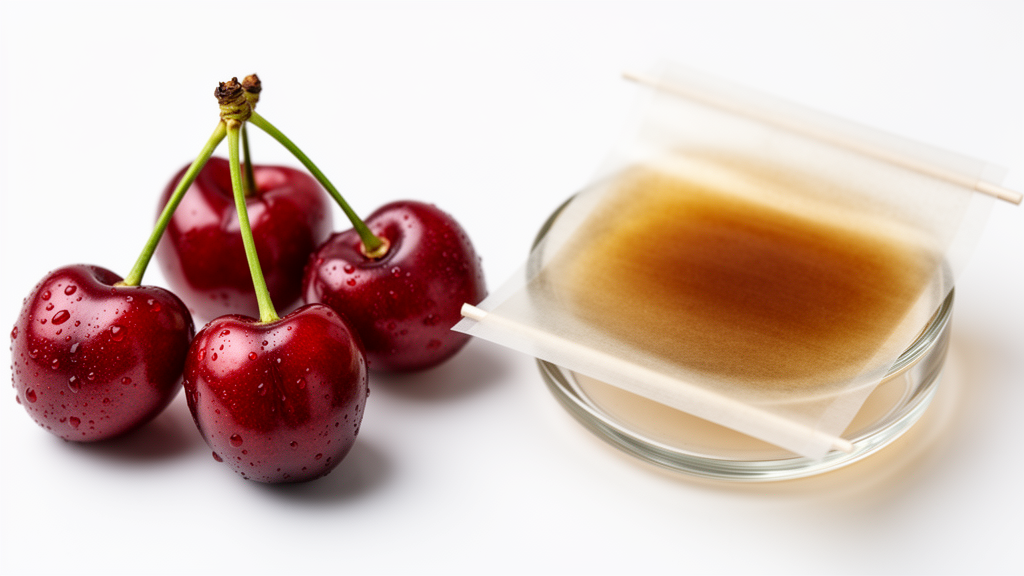
Sweet cherries are among the most perishable fruits on the market. Their thin skins, high water loss, and vulnerability to fungal infection mean that within days of harvest they can soften, brown, leak juice, and grow mold. A research team has now reported a biodegradable alternative to conventional plastic wrap that tackles this problem with chemistry rather than passive barrier properties: an electrospun membrane made of poly(l-lactide-co-caprolactone) and gelatin, coated with a metal-phenolic network built from ferric ions and tea polyphenols. By controlling the number of layer-by-layer assembly cycles used to deposit the coating, the researchers could tune nearly every functional property of the material, and a four-cycle coating emerged as the best overall performer, cutting the decay rate of stored yellow sweet cherries to just 1.85 percent after seven days, compared with roughly 50 percent for fruit wrapped in commercial polyethylene film.
The study, published as a laboratory investigation of active food packaging, set out to establish a layer-number-dependent relationship between coating structure and preservation performance. Conventional petroleum-based plastics act mainly as passive barriers: they block physical contact and slow moisture migration but do nothing to inhibit microbial growth, suppress oxidative browning, or regulate the storage microenvironment, and they persist in the environment after disposal. Active packaging, by contrast, incorporates functional components that interact with the food or the surrounding atmosphere, for example by releasing antimicrobial or antioxidant agents. Tea polyphenols are natural candidates for this role because they scavenge reactive oxygen species, inhibit lipid oxidation, and can damage bacterial cell membranes or interfere with intracellular metabolism. Their weakness is practical: high water solubility and rapid migration make them hard to retain in a packaging material for sustained use.
The researchers solved this retention problem through coordination chemistry. Mixing ferric ions with tea polyphenols forms a metal-phenolic network, or MPN, that assembles rapidly under mild conditions and holds the polyphenol in place while allowing controlled release. In their previous work, a single-layer ferric ion–tea polyphenol assembly had already improved sweet cherry preservation, but the effect of the number of assembly cycles on coating structure, release behavior, and preservation efficacy had not been systematically examined. To fill that gap, the team first fabricated PLCL/gelatin membranes by electrospinning, dissolving the two polymers in hexafluoroisopropanol at a 4:1 weight ratio and spinning them into fibrous mats. Electrospun membranes are attractive substrates because their high specific surface area and interconnected porous structure provide abundant sites for functional deposition and efficient contact with food surfaces, unlike dense films.
The coating was built by repeatedly dipping the membranes first in a tea polyphenol solution and then in a ferric chloride solution, with rinsing between steps; each dip pair counted as one cycle. Membranes receiving one, four, or eight cycles were designated Fe-TP/PLCL-Gel 1, 4, and 8. Scanning electron microscopy showed the fiber surfaces transforming from smooth to rough as cycles accumulated, and the average fiber diameter rose from about 886 nanometers for the uncoated membrane to roughly 1,470 nanometers after eight cycles. Cross-sectional imaging revealed that the coating deposited from the surface inward, growing denser with more cycles without changing the overall membrane width. Infrared spectroscopy confirmed coordination between iron and the polyphenols through a characteristic Fe–O absorption band, and X-ray photoelectron spectroscopy detected iron only on the coated membranes, in a mixed Fe2+/Fe3+ state in which the Fe2+ fraction rose from about 45 percent after one cycle to roughly 61 percent after eight, suggesting partial reduction of ferric ions by the polyphenols during assembly.
Loading measurements confirmed that the active content scaled with the number of cycles. Iron loading, quantified by inductively coupled plasma optical emission spectrometry, increased from 3.23 to 7.26 micrograms per milligram of membrane between one and eight cycles, while tea polyphenol loading, measured with a modified Folin–Ciocalteu assay after EDTA extraction, climbed from 2.92 to 28.94 milligrams per milligram. The coating also transformed the membrane surface from hydrophobic to strongly hydrophilic: the water contact angle fell from 115.3 degrees for the pristine membrane to 44.0, 33.4, and 18.0 degrees for the one-, four-, and eight-cycle versions. Mechanically, all coated membranes remained flexible, with elongation at break above 100 percent, though the pristine membrane’s 221.6 percent elongation declined with increasing coating. The four-cycle membrane showed the highest tensile stress and elastic modulus among the coated samples, at 23.33 megapascals, with a slight decrease to 22.02 megapascals at eight cycles, possibly linked to small surface cracks and local heterogeneity seen in microscopy.
Release behavior and degradation both followed clear layer-dependent patterns. In phosphate-buffered saline at 37 degrees Celsius, higher cycle numbers produced both faster initial release and larger cumulative release of tea polyphenols: the one-cycle membrane released 3.63 milligrams per milliliter in the first hour and 7.22 by 72 hours, while the eight-cycle membrane released 7.52 in the first hour and 12.21 by 72 hours. In soil burial tests at 25 degrees Celsius and 60 percent relative humidity, the pristine membrane lost more than half its mass within ten days and had completely degraded by day 20, whereas the coated membranes retained 91 to 95 percent of their mass at day 10 and 72 to 83 percent at day 30, with higher cycle numbers generally slowing degradation further. The denser network coating appears to act as a barrier against soil microorganisms and degradative enzymes, allowing the membranes to hold together during use while retaining the potential for natural breakdown afterward.
Functional testing showed that the coating delivered the antioxidant and antimicrobial activity the polyphenols promise. In DPPH radical scavenging assays, the pristine membrane managed only about 8 percent scavenging, while all coated membranes reached roughly 80 percent, and hydroxyl radical scavenging rose in a layer-dependent manner from about 6 percent to 15 percent. Against Escherichia coli and Staphylococcus aureus, antibacterial efficiency increased with cycle number, with the eight-cycle membrane inhibiting both species by approximately 90 percent or more. Crystal violet staining showed biofilm inhibition rising with cycles, reaching about 71.5 percent against S. aureus and 63.9 percent against E. coli for the four-cycle membrane, and live/dead fluorescence staining confirmed a growing proportion of dead bacteria at higher loadings. Microscopy and leakage assays provided evidence consistent with cell-envelope damage: treated bacteria showed shrinkage, surface rupture, and structural collapse, accompanied by increasing release of nucleic acids and proteins, with nucleic acid leakage from S. aureus reaching about 75 percent after five hours of exposure to the eight-cycle membrane. The authors caution that these assays do not establish membrane disruption as the exclusive bactericidal mechanism.
Preliminary biosafety checks supported the material’s suitability for food contact. In CCK-8 assays with L929 mouse fibroblasts, extracts of the coated membranes maintained relatively high cell viability, although the eight-cycle sample dropped to about 76 percent on day 3, still above commonly used cytotoxicity thresholds. Hemolysis rates for all samples fell far below the 5 percent safety threshold. The decisive test came with real fruit: yellow sweet cherries were packaged in direct contact with the membranes, commercial polyethylene film, or the pristine membrane and stored for seven days. Decay appeared in the polyethylene and pristine groups by day 2 and spread with browning, softening, mold growth, and juice leakage. The coated membranes substantially delayed this deterioration, and the four-cycle membrane performed best, holding the decay rate to 1.85 percent at day 7 versus 50 percent for polyethylene and 5.56 percent for the eight-cycle membrane, whose decay rate began rising after day 5. Weight retention told the same story: the four-cycle group kept 90.19 percent of initial fruit mass at day 7, compared with 66.11 percent for polyethylene.
The central lesson of the study is that more coating is not automatically better. Although the eight-cycle membrane showed the strongest antibacterial activity and hydrophilicity, its cytocompatibility was lower and its late-stage preservation stability slightly inferior, while the four-cycle membrane achieved the most favorable balance among mechanical properties, release behavior, safety, and preservation efficacy using roughly half the active loading. The researchers attribute the differences between the two to quantitative variations in active reservoir, release kinetics, hydrophilicity, and mechanical properties rather than any fundamentally different mechanism. They also note important limitations before practical deployment: sensory quality and physicochemical attributes of preserved fruit need systematic evaluation, food-contact safety requires migration and toxicological validation, the antibacterial mechanism needs direct confirmation, and the study evaluated only two bacterial strains rather than the spoilage fungi and yeasts that actually threaten cherries, with performance under realistic cold-chain conditions and at industrial scale still untested. Within those bounds, the work demonstrates that simply counting assembly cycles offers a practical dial for tuning biodegradable active packaging, and that a moderate setting may preserve delicate fruit better than the maximum one.
Subject of Research: Layer-number-controlled iron–tea polyphenol metal-phenolic network coatings on PLCL/gelatin electrospun membranes for active preservation of yellow sweet cherries
Article Title: Layer-number-controlled Fe-tea polyphenol metal-phenolic network-coated PLCL/gelatin electrospun membranes for active preservation of yellow sweet cherries
Article References: Liu, J., Yan, T., Wang, Q., Bao, J., Li, Y., Piao, J., Chai, H., & Zhou, G. (2026). Layer-number-controlled Fe-tea polyphenol metal-phenolic network-coated PLCL/gelatin electrospun membranes for active preservation of yellow sweet cherries. Food Chemistry: X, 40, Article 104602. https://doi.org/10.1016/j.fochx.2026.104602
Image Credits: AI Generated
DOI: 10.1016/j.fochx.2026.104602
Keywords: active food packaging, metal-phenolic network, tea polyphenols, electrospinning, sweet cherry preservation, biodegradable membranes, antimicrobial coatings, antioxidant activity, layer-by-layer assembly, postharvest losses, PLCL, gelatin
Cite Scienmag News
Bethany Barker. (October 25, 2026). Iron–Tea Polyphenol Coatings Tune Biodegradable Membranes That Keep Cherries Fresh. Scienmag. https://scienmag.com/iron-tea-polyphenol-coatings-tune-biodegradable-membranes-that-keep-cherries-fresh/
Bethany Barker. "Iron–Tea Polyphenol Coatings Tune Biodegradable Membranes That Keep Cherries Fresh." Scienmag, 25 October 2026, https://scienmag.com/iron-tea-polyphenol-coatings-tune-biodegradable-membranes-that-keep-cherries-fresh/. Accessed 25 October 2026.
Bethany Barker. "Iron–Tea Polyphenol Coatings Tune Biodegradable Membranes That Keep Cherries Fresh." Scienmag. October 25, 2026. https://scienmag.com/iron-tea-polyphenol-coatings-tune-biodegradable-membranes-that-keep-cherries-fresh/


