


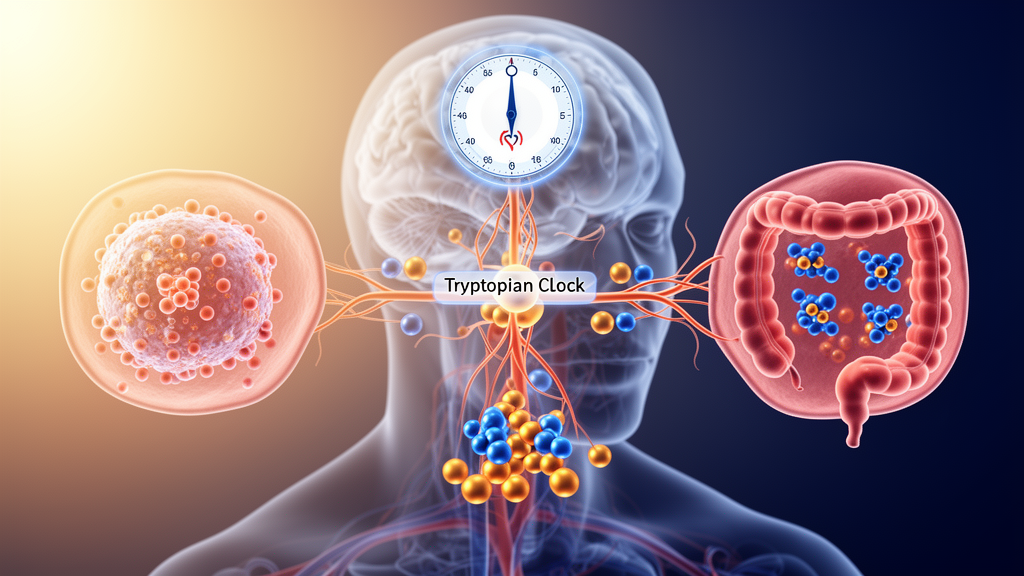
A mini review of mechanistic and clinical evidence argues that the body’s circadian clock regulates tryptophan metabolism while the resulting metabolites feed back into immune, neurological and metabolic rhythms. Most of the supporting evidence comes from experimental models, and the review stresses that direct confirmation of tissue-specific timing in humans remains limited. The findings nevertheless identify a potentially important source of biological variation that could affect how tryptophan metabolites are measured, how circadian disruptions are interpreted and how experimental treatments are eventually timed.
More than 95% of dietary tryptophan is processed through the kynurenine pathway, according to the review, while about 1%–2% enters the serotonin and melatonin pathway and a portion is converted by host and microbial enzymes into indole derivatives. These routes compete for the same substrate and generate molecules with distinct effects on metabolism, immune responses and neural signaling. The kynurenine pathway begins with the conversion of tryptophan to N-formylkynurenine by tryptophan 2,3-dioxygenase, or TDO, and the indoleamine 2,3-dioxygenases IDO1 and IDO2. TDO is constitutively expressed mainly in the liver and is influenced by glucocorticoids and substrate availability, whereas inflammatory signals can induce IDO1 in immune and epithelial cells.
Circadian rhythms are endogenous oscillations of roughly 24 hours that are synchronized primarily by light. The suprachiasmatic nucleus in the hypothalamus acts as the principal pacemaker and sends timing signals to peripheral tissues, most of which contain molecular clock machinery built from interconnected transcriptional and translational feedback loops. Disruption or misalignment of these rhythms is associated with sleep disorders, metabolic dysfunction, cardiovascular disease, immune dysregulation and mood disorders. In the tryptophan system, the connection is particularly direct because serotonin and melatonin are themselves central to sleep-wake timing, but the review describes a broader bidirectional network involving enzymes, metabolites, receptors, NAD+ and the aryl hydrocarbon receptor, or AhR.
Experimental evidence indicates that the clock controls the activity of key tryptophan-processing enzymes and therefore the timing of metabolite production. In mice, hepatic TDO activity and plasma kynurenine rise during the active phase under the influence of feeding and circadian glucocorticoid release. These rhythms help sustain time-of-day variation in AhR activity, which is relevant to barrier maintenance, epithelial repair, mucosal immunity and xenobiotic metabolism. In mouse lung and intestine, IDO1 messenger RNA and enzyme activity also follow diurnal patterns under basal and inflammatory conditions. Disrupting the core clock gene Bmal1 abolishes that timing, while daily variation in cytokine release, leukocyte movement and inducible IDO1 expression appears to gate when tryptophan is diverted into kynurenine.
The kynurenine pathway may also connect daily timing to cellular energy and redox regulation because it is a major source of NAD+ used in biosynthesis. NAD+ availability can oscillate and influence SIRT1, a deacetylase that acts with the clock proteins CLOCK and BMAL1 to regulate clock-gene transcription. SIRT1 also deacetylates BMAL1 and PER2, making it both a component of the clock network and a potential recipient of metabolic feedback. This relationship is not merely one-way: kynurenine and its derivatives can alter immune signaling, while pathway imbalance can favor neurotoxic over neuroprotective products. Kynurenic acid inhibits excitatory neurotransmission, whereas 3-hydroxykynurenine and quinolinic acid promote oxidative stress and act as NMDA-receptor agonists.
Human evidence for the same enzyme-level rhythms is much thinner. An indirect study from 1968 found time-dependent differences in urinary kynurenine metabolites after tryptophan administration, but it did not directly measure hepatic TDO. Later metabolomic studies have produced conflicting results, with some reporting rhythmic plasma concentrations of tryptophan metabolites and others finding no daily change. A plasma profile reflects the combined activity of the liver, immune cells, gut microbiota, kidneys and other tissues, so a circulating rhythm cannot by itself establish that TDO in the liver follows a specific schedule. The review therefore treats the strongly rhythmic results from rodents as mechanistic evidence while cautioning against direct extrapolation to people, whose sleep, feeding, light exposure, physiology and microbiomes differ substantially from those of experimental animals.
The serotonin–melatonin pathway is also organized by the clock. In experimental models, serotonin synthesis in the central nervous system varies across the day, partly through rhythmic control of the neuronal tryptophan hydroxylase Tph2. A binding site for the clock protein REV-ERBα has been identified in the Tph2 promoter, and deleting Rev-erbα in serotonin neurons increased serotonin synthesis and reduced depression-like behavior in mice. Peripheral Tph1, which is found especially in gut enterochromaffin cells and the pineal gland, also displays rhythmic expression in several tissues. In the gut, microbial activity influences this pattern, connecting feeding schedules and microbiota behavior with peripheral serotonin production.
Host and gut microbes convert tryptophan into indole derivatives in a rhythm shaped by feeding, intestinal motility, bile secretion and epithelial gene activity. In experimental systems, microbial composition and functional gene expression oscillate over the day, changing the availability of AhR ligands such as indole-3-acetic acid, indole-3-aldehyde and indole-3-propionic acid. Their activation of AhR can promote IL-22 production, antimicrobial peptides, epithelial regeneration and barrier integrity. AhR and its dimerization partner ARNT belong to the same protein families as core clock components, and AhR activation can alter the amplitude or phase of peripheral clock genes. Human studies also show daily variation in microbial composition and microbial-derived metabolites, but it remains unclear whether those oscillations causally entrain human tryptophan metabolism or peripheral clocks.
These pathways intersect in infectious, metabolic and neuropsychiatric disease, but the review distinguishes associations and experimental effects from established clinical applications. Time-dependent IDO1 induction has been shown to modulate immune defense in experimental fungal infection. Circadian disruption can alter feeding-entrained hepatic metabolism, NAD+ biosynthesis, SIRT1 activity, mitochondrial function and insulin sensitivity, while peripheral serotonin influences insulin secretion, adipogenesis and energy expenditure. In mood and cognitive disorders, sleep disturbance and circadian misalignment can coincide with inflammation, greater kynurenine-pathway activity, oxidative stress and reduced serotonin availability. The review describes these as plausible links and model-based findings, not proof that timing tryptophan metabolism prevents or treats disease in patients.
The temporal dimension also raises questions about biomarkers and treatment. A single untimed measurement of tryptophan, kynurenine or serotonin may capture a different phase of a fluctuating system, and the widely used kynurenine-to-tryptophan ratio may be influenced by clock phase and feeding even if robust rhythmicity is confirmed in humans. Repeated sampling at standardized times could therefore improve interpretation. The review also considers three broad circadian-medicine strategies: administering drugs at a biologically favorable time, aligning sleep, meals, activity and light exposure to train the clock, and using small molecules to target clock components. Proposed tryptophan-directed approaches include timed administration of pathway modulators, timed AhR ligands, dietary or microbiome interventions, and combination with light therapy or time-restricted feeding.
None of these interventions has yet demonstrated that targeting a particular circadian phase improves therapeutic efficacy in a clinical study, the review emphasizes. TDO and IDO1 inhibitors remain attractive candidates in neurodegeneration, autoimmunity and cancer, but no clinical trial has established the optimal phase for their use. Microbiome-directed measures, including diet, prebiotics and probiotics, also face reproducibility questions in people. Responses may differ with sex, age, chronotype, sleep behavior, diet, meal timing and microbiome composition. The immediate translational priority is therefore not a specific drug schedule but controlled human research that defines sampling times, distinguishes tissues and cell types, and tests whether timed interventions can reproducibly alter tryptophan metabolism and meaningful clinical outcomes.
Subject of Research: Circadian regulation of tryptophan metabolism and its clinical and pharmacological implications
Article Title: Tryptophan metabolism circadian regulation: clinical and pharmacological implications
Article References: Fabi, C., Balucchi, S., & Bellet, M. M. (2026). Tryptophan metabolism circadian regulation: clinical and pharmacological implications. Frontiers in Pharmacology, 17, Article 1943534. https://doi.org/10.3389/fphar.2026.1943534
Image Credits: AI Generated
DOI: 10.3389/fphar.2026.1943534
Keywords: circadian rhythms, tryptophan metabolism, kynurenine pathway, serotonin, melatonin, aryl hydrocarbon receptor, immune regulation, metabolic health, chronotherapy, Tryptophan, metabolism, circadian
Cite Scienmag News
Daisy Hatcher. (October 25, 2026). Circadian control of tryptophan metabolism links immunity, brain function and metabolism. Scienmag. https://scienmag.com/circadian-control-of-tryptophan-metabolism-links-immunity-brain-function-and-metabolism/
Daisy Hatcher. "Circadian control of tryptophan metabolism links immunity, brain function and metabolism." Scienmag, 25 October 2026, https://scienmag.com/circadian-control-of-tryptophan-metabolism-links-immunity-brain-function-and-metabolism/. Accessed 25 October 2026.
Daisy Hatcher. "Circadian control of tryptophan metabolism links immunity, brain function and metabolism." Scienmag. October 25, 2026. https://scienmag.com/circadian-control-of-tryptophan-metabolism-links-immunity-brain-function-and-metabolism/


