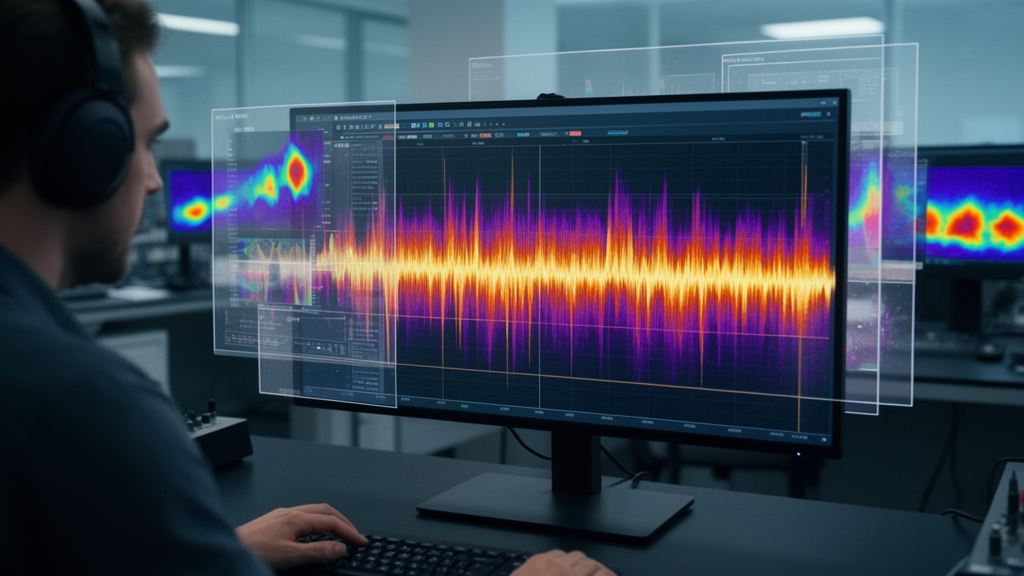
Artificially generated voices have become convincing enough that even trained listeners struggle to separate them from genuine recordings, and researchers have now unveiled a detection system that not only spots these synthetic clips with high accuracy but also explains which parts of the audio spectrum gave them away. The new model, called a Frequency-Aware Transformer, or FAT, was evaluated on the widely used ASVspoof 2019 Logical Access benchmark, where it reached an accuracy of 94.6 plus or minus 0.3 percent and an equal error rate of 6.3 plus or minus 0.2 percent. Those figures outperformed the strongest conventional baseline in the study, ECAPA-TDNN, which achieved 91.3 percent accuracy and a 9.7 percent equal error rate, meaning the new architecture improved accuracy by 3.3 percentage points while cutting the error rate by 3.4 points.
The study, published as open access research in Discover Artificial Intelligence, addresses a problem that has grown sharply with the rise of modern text-to-speech systems. Tools built on diffusion models and transformer architectures, such as VALL-E, Tacotron 2 and WaveNet, can produce audio that is nearly indistinguishable from real human speech. That realism powers legitimate applications in customer service, accessibility and education, but it also enables voice phishing scams, impersonation, bypassing of biometric voice security and the spread of disinformation. As synthesis tools become easier to obtain, the window for misuse widens, making reliable and trustworthy detection a research priority.
Traditional detection approaches have relied on handcrafted acoustic features such as Mel-frequency cepstral coefficients, pitch variation and phase inconsistencies, which can flag artifacts left by synthesis models. These methods, however, tend to struggle when confronted with new generative techniques or with audio that has been altered or degraded by noise. Deep learning models, including convolutional networks applied to spectrograms and transformer architectures that model long-range dependencies in audio, have improved detection considerably. Yet most of these systems treat spectrograms as generic two-dimensional images or rely on large-scale pretrained representations without explicitly modeling the frequency-band structure where synthesis artifacts often live. They also tend to operate as black boxes, a serious drawback in forensic settings where investigators need to know why a clip was flagged as fake.
The Frequency-Aware Transformer was designed specifically to close both gaps. Its pipeline begins with a frequency encoding module that converts an input Mel-spectrogram into high-dimensional embeddings using a two-dimensional convolutional layer, then adds frequency-aware positional encodings that bias the network toward frequency bands where synthetic artifacts are known to appear, notably the 0 to 4 kHz and 6 to 10 kHz ranges. The core of the model is a spectral-temporal transformer encoder with six layers and eight attention heads per layer, in which a learnable frequency bias matrix is added directly to the attention computation. This matrix modulates how strongly the model attends to different spectral regions based on their similarity, allowing attention to emphasize spectro-temporal areas associated with synthesis artifacts while still modeling global context across time and frequency.
A learnable class token, prepended to the input sequence and updated through every transformer layer, aggregates a global summary of the entire spectrogram, and a classification head of fully connected layers with a sigmoid activation converts that summary into a probability that the audio is fake. Training used binary cross-entropy loss, the Adam optimizer with an initial learning rate of 1 times 10 to the minus 4, a batch size of 64, and up to 50 epochs with early stopping. All audio was resampled to 16 kHz, and augmentation during training included pitch shifting of plus or minus two semitones, time masking, random gain changes and added background noise at signal-to-noise ratios between 10 and 20 dB. Every experiment was repeated across three random seeds, and all baselines were retrained from scratch under identical conditions so that performance differences could be attributed to architecture rather than implementation.
The benchmark results placed FAT ahead of both conventional and newer competitors. Alongside its accuracy and equal error rate, the model recorded precision of 94.3 plus or minus 0.3 percent, recall of 94.7 plus or minus 0.2 percent and an F1-score of 94.5 plus or minus 0.2 percent. Against recent transformer-based and self-supervised approaches such as AASIST, RawGAT-ST and Wav2Vec2-based spoofing detectors, FAT delivered competitive and slightly superior results across all metrics. The authors note that the confidence intervals describe stability across the three runs rather than formal statistical significance, since no hypothesis testing was performed. The training and validation curves declined smoothly and tracked each other closely, which the researchers interpret as stable optimization with limited evidence of overfitting.
An ablation study quantified how much each architectural component contributed. Removing the self-attention mechanism caused the largest drop, cutting accuracy by 5.1 percentage points, which underscores the importance of modeling long-range spectral-temporal dependencies. Removing the frequency encoding module cost 3.8 points, the frequency bias matrix 2.9 points, and the frequency-aware positional encoding 2.5 points. The pattern indicates that the model’s performance arises from the combined effect of frequency-aware representation learning and transformer-based contextual modeling rather than from any single component.
What distinguishes FAT most sharply from prior systems is its built-in explainability. An attention rollout mechanism recursively aggregates attention maps across all layers to identify influential spectral-temporal regions, while SHAP values, computed after training as a post-hoc analysis rather than during optimization, quantify how much each frequency bin contributed to the final prediction. The attention heatmaps showed that the model concentrated its focus in the 0 to 4 kHz and 6 to 10 kHz bands, which align with known artifact zones in AI-generated audio, and that attention was diffuse and balanced for real samples but concentrated in synthetic frequency regions for fake ones. The consistency between the SHAP attributions and the attention visualizations suggests the model keys on meaningful spectral structure rather than spurious correlations, a property the authors consider essential for building trust in audio forensics.
Generalization and robustness tests added important caveats alongside encouraging signals. In cross-dataset evaluations using additional corpora, including FakeAVCeleb for cloned celebrity voices and WaveFake for audio from neural vocoders such as WaveGlow, MelGAN and Parallel WaveGAN, FAT retained discriminative performance under the evaluated dataset shifts, though some degradation occurred on unseen conditions, and confusion matrices showed more misclassifications on unseen data. Under controlled artificial noise corruption of the ASVspoof 2019 LA test set, accuracy fell from 94.6 percent in clean conditions to 93.5 percent at 20 dB SNR, 91.2 percent at 10 dB and 88.0 percent at 5 dB, while remaining higher than the evaluated baselines at every level. The researchers stress that this artificial-noise experiment does not validate performance on genuine field recordings, which involve reverberation, codec compression, microphone and channel effects, distance-related degradation and overlapping speech.
The authors also acknowledge practical limits. FAT carries 26.3 million parameters, requires 16.1 GFLOPs per inference, takes about 33.0 milliseconds per sample and uses roughly 410 MB of memory, a moderate overhead that remains more efficient than Wav2Vec2-based detectors but may constrain edge or high-throughput deployment. The interpretability mechanisms, while informative, have not yet been evaluated with human users or forensic practitioners, and no quantitative measures of explanation faithfulness were reported. Future work outlined in the study includes lightweight variants through pruning and knowledge distillation, robustness testing under realistic recording conditions, few-shot adaptation to new synthesis techniques, and quantitative assessment of explanation reliability. For now, the results make a concrete case that teaching transformers to reason about frequency, and to show their work, can make the fight against AI-generated voices both more accurate and more transparent.
Subject of Research: Explainable detection of AI-generated fake voices using a frequency-aware transformer architecture
Article Title: Explainable fake voice detection in AI-generated audio using frequency-aware transformers
Article References: Olaniyan, J., Akinpelu, S., Olaniyan, D., Kogeda, O., & Thanni, A. (2026). Explainable fake voice detection in AI-generated audio using frequency-aware transformers. Discover Artificial Intelligence, 6(1), Article 1639. https://doi.org/10.1007/s44163-026-02586-1
Image Credits: AI Generated
DOI: 10.1007/s44163-026-02586-1
Keywords: deepfake audio, fake voice detection, frequency-aware transformer, ASVspoof 2019, explainable AI, SHAP, attention rollout, speech synthesis, audio forensics, machine learning, spectral artifacts, voice cloning
Cite Scienmag News
Denise Maddox. (October 25, 2026). Frequency-aware transformer spots AI-generated fake voices and shows its reasoning. Scienmag. https://scienmag.com/frequency-aware-transformer-spots-ai-generated-fake-voices-and-shows-its-reasoning/
Denise Maddox. "Frequency-aware transformer spots AI-generated fake voices and shows its reasoning." Scienmag, 25 October 2026, https://scienmag.com/frequency-aware-transformer-spots-ai-generated-fake-voices-and-shows-its-reasoning/. Accessed 25 October 2026.
Denise Maddox. "Frequency-aware transformer spots AI-generated fake voices and shows its reasoning." Scienmag. October 25, 2026. https://scienmag.com/frequency-aware-transformer-spots-ai-generated-fake-voices-and-shows-its-reasoning/