


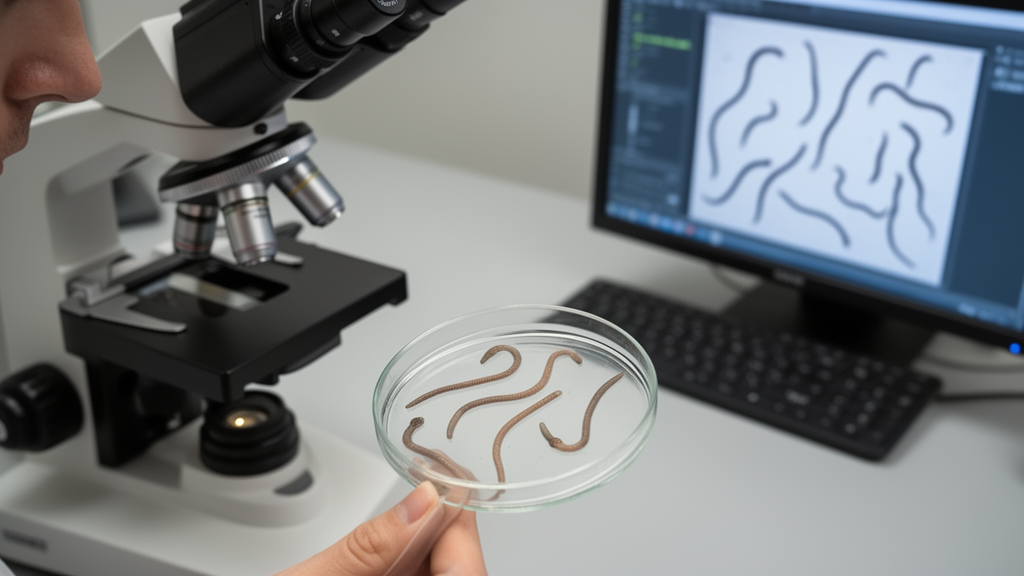
Root-knot nematodes are among the most destructive crop pests on Earth, and telling their species apart has long required a trained expert peering through a microscope. Researchers now report a hybrid artificial intelligence framework that fuses expert-style measurements of nematode body shape with deep-learning image analysis to identify two of the most economically damaging species, Meloidogyne graminicola and M. incognita, at their infective juvenile stage. The study, published in Discover Artificial Intelligence, shows that combining handcrafted morphological descriptors with convolutional neural network features substantially improves classification accuracy compared with either approach alone, while keeping the model light enough for resource-constrained settings.
The stakes are considerable. Plant-parasitic nematodes, microscopic soil-dwelling roundworms, are estimated to cause more than 157 billion US dollars in annual crop losses worldwide. Among more than 4,100 described species, the genus Meloidogyne stands out for its breadth of hosts, infecting thousands of plants including tomato, potato, soybean and cotton. Of roughly 100 identified root-knot nematode species, M. incognita and M. graminicola are the two most economically significant. M. incognita, which thrives in both temperate and tropical regions, attacks around 3,000 plant species and can cause yield losses of up to 60 percent. M. graminicola, the rice root-knot nematode, can cut yields by as much as 70 percent, and infections are known to reduce chlorophyll content, transpiration and net photosynthetic rate, contributing to fewer tillers and lower biomass accumulation.
The damage begins with the second-stage juvenile, or J2, the only motile and infective stage of the nematode’s life cycle. J2 worms penetrate host roots through cortical cells and establish a feeding site inside the vascular cylinder, using secretions from specialized esophageal glands to induce surrounding root cells to redifferentiate into giant cells. These nutrient sinks divert water and photoassimilates away from the plant, producing stunting, chlorosis, reduced vigor and premature wilting, and in severe cases plant death. The wounds also invite secondary infections by fungi and bacteria, creating complex disease syndromes. Because above-ground symptoms are frequently mistaken for nutrient deficiencies or water stress, infestations can go undetected while incorrect management practices are applied, allowing nematode populations to grow.
Distinguishing the two species at the J2 stage is notoriously difficult. The juveniles display very similar morphological characteristics, and diagnostic features such as perineal patterns often overlap, with oval to rounded shapes common to both. Traditional identification relies on microscopic and morphometric examination by specialists, which is time-consuming, subjective and hard to scale. Molecular methods such as PCR can improve accuracy but demand resources that make them unsuitable for routine use in many agricultural settings. The authors argue that more objective, automated approaches are needed to complement traditional taxonomy and support early intervention within integrated pest management.
The new framework addresses a gap the researchers identified in prior work: automated nematode identification has generally pursued either handcrafted morphological descriptors analyzed with classical machine learning, or end-to-end deep learning on raw images, but rarely both together. Machine learning classifiers such as support vector machines and random forests can encode taxonomic knowledge through quantitative traits and work reasonably well with limited data, but their performance is sensitive to which features are selected. Deep learning models learn discriminative visual features directly from images and perform strongly, but they act as black boxes, need large labeled datasets and offer little insight into the biological traits driving their predictions. The hybrid approach was designed to capture the strengths of both while avoiding their weaknesses.
To build the dataset, the team prepared J2 specimens using a modified Whitehead tray method, in which a plastic filter tray lined with tissue paper served as the filtering medium; the simplified protocol excluded isolation from the soil rhizosphere and infected root tissue and yielded roughly 50 milliliters of nematode suspension over 48 hours. Individual J2 specimens were examined on a counting dish under a light microscope, collected with a fine hook, mounted permanently in glycerin on glass slides, and imaged at 400-times magnification. Microscopic images were captured of the diagnostically relevant anterior and posterior regions of each worm. The final dataset comprised 244 images of J2 M. graminicola and 95 images of J2 M. incognita, a small and imbalanced collection that shaped many of the study’s methodological choices.
The pipeline runs in two parallel branches. In the first, each image is converted to grayscale and binarized with Otsu’s thresholding, then cleaned with morphological opening and closing operations so that the largest contour, representing the nematode body, can be isolated. From this mask the system computes 11 shape descriptors: area, perimeter, eccentricity, solidity and seven Hu moments, the latter providing rotation-, scale- and translation-invariant shape measures. These features are standardized before training. In the second branch, a pretrained convolutional network, either MobileNetV2 or DenseNet121, extracts spatial visual embeddings from the same images. The convolutional embeddings are concatenated with the 11 morphological descriptors and passed through a newly designed classification head consisting of a 256-neuron fully connected layer with ReLU activation, 0.5 dropout and a two-unit output. The pretrained backbones were kept frozen, so only the lightweight head was optimized, with training capped at 25 epochs using the Adam optimizer and early stopping based on validation macro F1-score.
The evaluation was deliberately conservative given the dataset’s size. The team used five-fold stratified cross-validation within the training set, applied the synthetic minority over-sampling technique (SMOTE) only to training folds to counter the class imbalance, and reserved an independent held-out test set for final assessment. Performance was estimated with 1,000 bootstrap iterations to derive 95 percent confidence intervals for accuracy, precision, recall and macro F1-score. The results were striking: the MobileNetV2-based hybrid model achieved the highest accuracy of 0.9561 (95 percent CI 0.8971 to 1.0000) and a macro F1-score of 0.9434 (95 percent CI 0.8700 to 1.0000). Relative to the corresponding class-balanced MobileNetV2 configuration, this represented gains of roughly 16.0 percentage points in accuracy and 16.5 percentage points in macro F1. The DenseNet121-based hybrid reached an accuracy of 0.8500 and macro F1 of 0.8301, improvements of about 7.0 and 6.8 percentage points over its balanced baseline.
The baselines told an instructive story. Among classical machine learning models, the random forest outperformed the support vector machine, achieving an accuracy of 0.838 and macro F1 of 0.784, and even beat the lightweight MobileNetV2 deep learning baseline, suggesting handcrafted morphology provides a stronger inductive bias than data-driven learning in shallow networks. Yet the deeper DenseNet121 outperformed the random forest, indicating that larger CNNs can learn discriminative traits on their own. Class balancing alone proved insufficient: the balanced MobileNetV2 improved recall to 0.8422, but overall accuracy and macro F1 stayed below 0.76, and DenseNet121 actually performed worse after imbalance-aware training. Confusion matrices showed the hybrid framework cut M. graminicola misclassifications from 14 to just one sample in the MobileNetV2 configuration. McNemar’s test confirmed the improvement over the MobileNetV2 baseline was statistically significant (p = 0.039), though differences against the balanced model, the DenseNet121 hybrid, random forest and SVM were not significant, likely because the small test set of 68 specimens limited statistical power. Failure cases traced misclassifications to low contrast, small object scale, inconsistent illumination and multiple worms in one frame.
Practicality and interpretability were central design goals. Adding the morphology branch increased the MobileNetV2 model from 2.23 to 2.56 million parameters and DenseNet121 from 6.96 to 7.22 million, while computational load in GFLOPs stayed unchanged and inference latency shifted only marginally, from 6.00 to 6.07 milliseconds per image for MobileNetV2 and from 17.61 to 17.42 for DenseNet121. Gradient-weighted class activation mapping (Grad-CAM) showed the hybrid model attending to biologically relevant regions such as the head, mid-body and tail, and an energy-in-mask analysis found 2.1 percent and 7.9 percent of activation intensity fell within the segmented worm region for representative M. graminicola and M. incognita samples, a meaningful concentration given that the worm occupies less than 1 to 2 percent of each image. The authors caution that the study’s limitations are real: only two species imaged under controlled laboratory conditions were tested, no external validation across laboratories was possible because no public benchmark dataset of annotated J2 specimens exists, and morphological features were extracted from clean, manually segmented images rather than debris-filled field samples. They call for multicenter datasets, diverse imaging conditions, multiple developmental stages and validation on low-power edge devices before the framework can move from laboratory prototype to field-deployable diagnostic tool for precision agriculture.
Subject of Research: A hybrid deep learning framework for species-level identification of root-knot nematode juveniles
Article Title: Morphology guided hybrid deep learning for species identification of root knot nematodes
Article References: Shabrina, N. H., Indarti, S., Kusumo, A. T., Purnomo, A. T., Suputa, S., Padilla, W. P., & Chai, R. (2026). Morphology guided hybrid deep learning for species identification of root knot nematodes. Discover Artificial Intelligence, 6(1), Article 1610. https://doi.org/10.1007/s44163-026-02402-w
Image Credits: AI Generated
DOI: 10.1007/s44163-026-02402-w
Keywords: root-knot nematodes, Meloidogyne, deep learning, machine learning, morphology, plant-parasitic nematodes, MobileNetV2, DenseNet121, agriculture, pest identification, computer vision, crop protection
Cite Scienmag News
Alan Morgan. (October 25, 2026). AI Reads Nematode Body Shapes to Identify Devastating Crop Parasites. Scienmag. https://scienmag.com/ai-reads-nematode-body-shapes-to-identify-devastating-crop-parasites/
Alan Morgan. "AI Reads Nematode Body Shapes to Identify Devastating Crop Parasites." Scienmag, 25 October 2026, https://scienmag.com/ai-reads-nematode-body-shapes-to-identify-devastating-crop-parasites/. Accessed 25 October 2026.
Alan Morgan. "AI Reads Nematode Body Shapes to Identify Devastating Crop Parasites." Scienmag. October 25, 2026. https://scienmag.com/ai-reads-nematode-body-shapes-to-identify-devastating-crop-parasites/


