


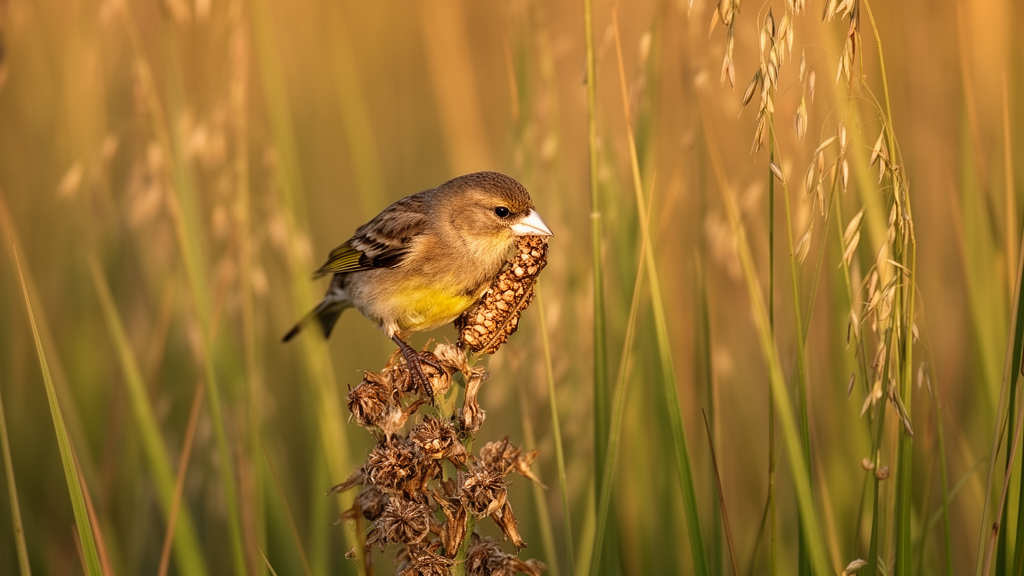
In the semi-arid woodlands of central Queensland, one of Australia’s most imperilled granivores is proving to be a far pickier diner than its dwindling range might suggest. A four-year field study of the southern black-throated finch (Poephila cincta cincta) in the Desert Uplands Bioregion has found that the birds do not simply eat whatever grass seeds are most abundant around them. Instead, they disproportionately target a small suite of grasses whose seeds pack the highest metabolisable energy and crude protein, and whose short seeds can be handled quickly by a small bill. The findings, drawn from 425 foraging plots, 220 systematic vegetation surveys and laboratory analysis of seeds from dozens of grass species, reveal what this threatened subspecies actually needs from its habitat.
The southern black-throated finch has suffered a large reduction in both range and abundance over the past three decades, a decline attributed to habitat clearing and fragmentation, pastoralism, agriculture, the spread of exotic pasture grasses and altered fire regimes. More than half of the subspecies’ potential habitat in the Galilee Basin sits under mining leases, and the Desert Uplands mark the southern edge of its current known distribution. Yet most previous dietary research had concentrated on the Townsville Plains and the Atherton Tablelands, regions whose vegetation, climate and water availability differ substantially from the Desert Uplands. Understanding what the birds eat in this little-studied part of their range matters because food quality and availability are pivotal drivers of offspring development, adult fitness and, ultimately, population persistence.
Between March 2020 and November 2023, researchers conducted eight seasonal surveys across roughly 70,000 hectares centred about 150 kilometres north-west of Clermont, within the Alice Tablelands subregion. The study area, dominated by eucalypt woodlands on low-fertility sandy soils, includes both an environmental offset area and part of the Carmichael Coal Mine mining lease, with active mining zones excluded. Each survey spanned four to six weeks, timed to capture both the wet season from December to May and the dry season from June to November. The team recorded direct observations of foraging behaviour, placed 2 by 1 metre quadrats centred on feeding locations, and ran randomly stratified vegetation surveys along 100-metre transects within habitat predicted as suitable by a MaxEnt model.
Of 425 observations of birds foraging, 204 allowed the researchers to identify the specific grass species being consumed, mostly during the wet season when birds feed directly from seed heads, sometimes jumping up to pull an inflorescence to the ground and holding it down with a foot while pecking. Thirty-three grass species featured in these observations, but the diet was heavily concentrated: Digitaria ciliaris, a non-native summer grass, accounted for 33.3 per cent of records, followed by Paspalidium rarum at 12.9 per cent, Panicum effusum at 5.3 per cent, Digitaria brownii at 4.5 per cent, and the introduced Cenchrus ciliaris, Urochloa mosambicensis and Urochloa subquadripara each at around 4 per cent. Seven grass genera together contributed almost 68 per cent of the observed diet. In one striking aside, six finches were photographed and filmed in the 2022 wet season sipping nectar from the open flowers of Grevillea pteridifolia for about five minutes, with no insects observed on the flowers and an abundance of nectar present, a documented case of opportunistic nectarivory in this species.
To test whether these records reflected genuine preference rather than simple availability, the researchers calculated Jacobs’ selectivity index, which ranges from minus one, indicating avoidance, to plus one, indicating strong preference, by comparing each species’ share of foraging observations with its share of ground cover across the landscape. Of 28 grass species assessed from wet-season observations, 24 scored positive, and 14 showed strong preference above 0.8. Digitaria ciliaris, Paspalidium rarum and Urochloa subquadripara each scored 0.99, with Panicum effusum at 0.68. Meanwhile, the dominant grasses of the study area, including Heteropogon contortus, Themeda triandra and Aristida species, scored low, with Themeda triandra actively avoided at minus 0.85. Foraging plots also held significantly more bare ground, 54.4 per cent on average versus 22.7 per cent in systematic plots, consistent with birds seeking open patches where fallen seeds are accessible.
The question then became why these particular grasses were preferred. Seeds collected from foraged and widespread grasses were dried at 60 degrees Celsius for 12 hours, dehusked and analysed for crude protein, crude fat, fibre, water-soluble carbohydrates, ash, carbohydrate content, metabolisable energy and amino acid suite, including the essential amino acids threonine and tyrosine. Across the 19 grass species with complete data, Jacobs’ index correlated positively with metabolisable energy, Spearman’s rho of 0.62 and p of 0.005, and with crude protein, rho of 0.50 and p of 0.03. Digitaria ciliaris stood out on both measures, delivering the highest metabolisable energy of any analysed grass at 11.5 megajoules per kilogram of dry matter and the highest crude protein at 13.8 per cent. Grasses with higher preference scores typically exceeded 7 megajoules per kilogram, while less preferred species mostly fell below that threshold.
Seed morphology told a complementary story. Preference correlated negatively with seed length, rho of minus 0.56 and p of 0.009, but showed no relationship with seed width, rho of minus 0.18 and p of 0.436. This pattern fits a time-minimisation strategy well established in granivorous birds: bill size and shape determine how efficiently a seed can be positioned, dehusked and cracked, and smaller seeds can be processed faster by small-billed birds. The abundant, large-seeded grasses that the finches largely ignored, such as Themeda triandra, Aristida pruinosa and Sehima nervosum, would demand longer handling times. By choosing short, energy-dense, protein-rich seeds, the birds maximise energy gained relative to effort, freeing time for nest construction, territory defence, predator avoidance and travel between water sources and foraging grounds, exactly the trade-off predicted by optimal foraging theory.
Seasonality shaped the picture in ways the observational method could only partly capture. During the dry season, grasses drop their seed and birds feed mainly from the ground, making species identification from observations nearly impossible; only Digitaria ciliaris and Digitaria brownii were seen being foraged directly in that period. Just 11 species were recorded in dry-season observations against 31 in the wet season. The authors note that complementary DNA analysis of crop and faecal samples, reported separately, found the diet broadened in the dry season as birds consumed more common grasses, a pattern consistent with earlier work in Townsville and with the well-documented seasonal decline of grass seed availability across northern Australian savannas, where most viable seeds germinate rapidly after the first warm wet-season rains. The dry-season shift appears to be a genuine dietary response to resource scarcity rather than a sampling artefact, though visual observation bias remains a limitation of the present study.
For conservation managers, the practical message is that protecting black-throated finch habitat means protecting the right grasses, not just grassland in general. The study points to Eucalyptus melanophloia woodland containing higher cover of Digitaria species, Paspalidium rarum and Panicum effusum as particularly valuable, and notes that the introduced buffel grass, Cenchrus ciliaris, which was significantly less covered in foraging plots than in the wider landscape, cannot substitute for the preferred species even though it appeared occasionally in the diet. Because preferred grasses occur at low densities and never dominate the landscape, habitat quality depends on maintaining a diversity of native grasses rather than maximising total cover. The authors call for further research into how grazing and fire affect these key food plants and the finches’ response, knowledge that will be essential for managing the offset areas, mining leases and remnant woodlands on which the subspecies’ remaining populations now depend.
Subject of Research: Forage preferences and seed selection drivers of the threatened southern black-throated finch in the Desert Uplands Bioregion, Australia
Article Title: Forage Preferences of Southern Black‐Throated Finch (Poephila cincta cincta) in the Desert Uplands Bioregion of Australia
Article References: Dreis, B., van Osta, J., Richardt, S., Smoll, L., & Castley, J. G. (2026). Forage Preferences of Southern Black‐Throated Finch ( Poephila cincta cincta ) in the Desert Uplands Bioregion of Australia. Ecology and Evolution, 16(10), Article e74425. https://doi.org/10.1002/ece3.74425
Image Credits: AI Generated
DOI: 10.1002/ece3.74425
Keywords: black-throated finch, granivory, seed selection, Jacobs' selectivity index, metabolisable energy, crude protein, Desert Uplands, optimal foraging, grass seeds, threatened species, habitat management, Queensland
Cite Scienmag News
Alan Morgan. (October 25, 2026). Threatened Finch Picks Protein-Rich, Short Seeds Over Abundant Grasses. Scienmag. https://scienmag.com/threatened-finch-picks-protein-rich-short-seeds-over-abundant-grasses/
Alan Morgan. "Threatened Finch Picks Protein-Rich, Short Seeds Over Abundant Grasses." Scienmag, 25 October 2026, https://scienmag.com/threatened-finch-picks-protein-rich-short-seeds-over-abundant-grasses/. Accessed 25 October 2026.
Alan Morgan. "Threatened Finch Picks Protein-Rich, Short Seeds Over Abundant Grasses." Scienmag. October 25, 2026. https://scienmag.com/threatened-finch-picks-protein-rich-short-seeds-over-abundant-grasses/


