

Saturday, October 24, 2026
Science
No Result
View All Result
  • Login
  • HOME
  • SCIENCE NEWS
  • CONTACT US
  • HOME
  • SCIENCE NEWS
  • CONTACT US
No Result
View All Result
Scienmag
No Result
View All Result
Home Science News Technology and Engineering

Footstep Sounds Could Identify People, But Microphone Distance and Footwear Complicate It

October 24, 2026
in Technology and Engineering
Denise Maddox
By Denise Maddox Scienmag Editorial Profile - Mechanical Engineering
Reading Time: 3 mins read
0
Footstep Sounds Could Identify People, But Microphone Distance and Footwear Complicate It

Footstep Sounds Could Identify People, But Microphone Distance and Footwear Complicate It

65
SHARES
587
VIEWS
Share on FacebookShare on Twitter
ADVERTISEMENT

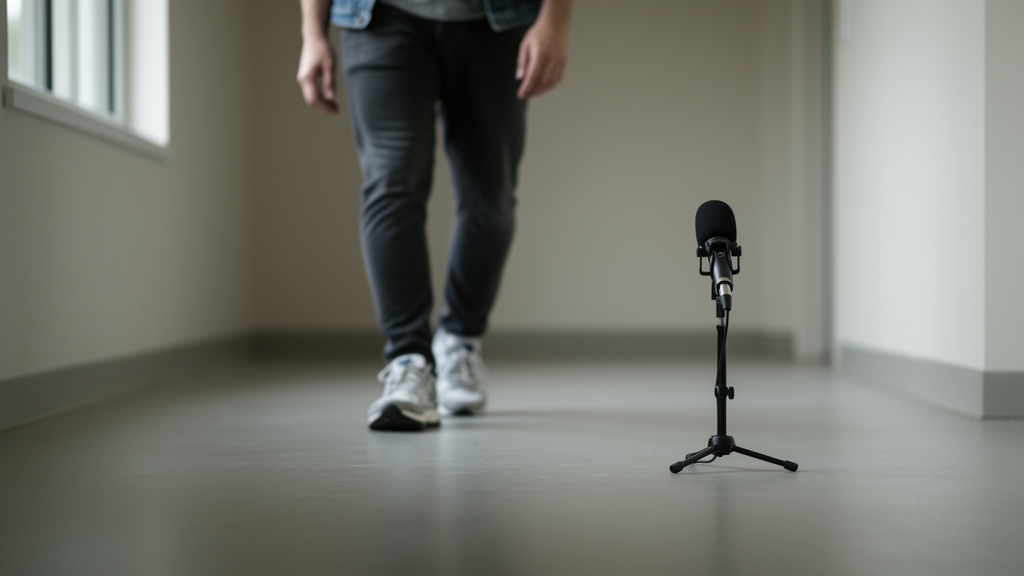
Every footstep carries a signature. A new experimental study published in Cluster Computing by Muhannad Quwaider, Rasha Obeidat, and Taymaa Obeidat examines whether the sounds people make while walking can be used to identify them as individuals, and what real-world conditions complicate that ability. Acoustic gait recognition is a relatively new biometric technique based on signals acquired from individuals walking on a sensing area, relying on the analysis of footstep sounds captured by a microphone.

The premise rests on a simple observation: human footstep patterns exhibit distinctive and individual characteristics that can contribute to biometric identification. If those variations are consistent and measurable, a recording device placed near a walking surface could distinguish one person’s gait from another’s without the walker carrying a device.

The researchers caution that real-life acoustic footsteps rarely arrive clean. They are typically accompanied by background noise and other sounds generated by shoes, walking surfaces, and clothing. These variations pose a challenge to accurate acoustic-based identification, which is why the team set out to systematically study the factors that influence gait sounds and the identification process that depends on them.

To do this, the researchers collected multiple small datasets based on specific experimental scenarios, allowing them to examine individual variables. They applied several preprocessing techniques to clean the recorded data before classification and used a simple customized K-nearest neighbors (KNN) classifier to perform identification.

Among the variables examined were the type of footwear worn by subjects, the distance between the walking subject and the recording microphone, and the length of the audio sample analyzed. Each factor shaped the acoustic signal in distinct ways, and each had measurable consequences for identification performance.

One of the findings concerned footwear. The experimental results indicate that having different people wear various types of footwear helped the system accurately identify and distinguish them in the tested conditions. Mixed footwear conditions did not prevent identification in this setup; subjects remained distinguishable when footwear varied.

Distance produced a more predictable effect. The greater the distance between the microphone and the walking subject, the greater the signal attenuation, meaning the footstep sounds grew weaker by the time they reached the recording device.

Sample length presented a trade-off. According to the study, signal length affects the amount of gait information retained in each analyzed frame. Longer frames can preserve more footstep information, while shorter frames generally provide more consistent identification results.

The researchers frame their findings as a contribution toward developing a system aimed at individual identification based on walking patterns, but they emphasize that further validation is necessary. The study, published as article number 892 in Volume 29 of Cluster Computing on 23 October 2026, remains an experimental investigation rather than a demonstration of a deployable biometric technology, and its conclusions rest on small, scenario-specific datasets analyzed with a simple customized classifier.

Subject of Research: Acoustic gait recognition and the factors affecting identification from footstep sounds

Article Title: Acoustic gait recognition: an experimental study of footstep sound variability and identification performance

Article References: Quwaider, M., Obeidat, R., & Obeidat, T. (2026). Acoustic gait recognition: an experimental study of footstep sound variability and identification performance. Cluster Computing, 29(16), Article 892. https://doi.org/10.1007/s10586-026-06722-5

Image Credits: AI Generated

DOI: 10.1007/s10586-026-06722-5

Keywords: acoustic gait recognition, biometrics, footstep sounds, KNN classifier, signal attenuation, footwear, microphone distance, sample length, identification performance, Cluster Computing, Acoustic, gait

Cite Scienmag News

Denise Maddox. (October 24, 2026). Footstep Sounds Could Identify People, But Microphone Distance and Footwear Complicate It. Scienmag. https://scienmag.com/footstep-sounds-could-identify-people-but-microphone-distance-and-footwear-complicate-it/


Denise Maddox. "Footstep Sounds Could Identify People, But Microphone Distance and Footwear Complicate It." Scienmag, 24 October 2026, https://scienmag.com/footstep-sounds-could-identify-people-but-microphone-distance-and-footwear-complicate-it/. Accessed 24 October 2026.

Denise Maddox. "Footstep Sounds Could Identify People, But Microphone Distance and Footwear Complicate It." Scienmag. October 24, 2026. https://scienmag.com/footstep-sounds-could-identify-people-but-microphone-distance-and-footwear-complicate-it/

Tags: acousticacoustic gait recognitionacoustic signal processing for biometric authenticationbackground noise interference in acoustic biometric systemsbiometric identification using footstep soundsbiometric security using walking sound signaturesBiometricschallenges in footstep-based person identificationCluster Computingeffects of footwear on acoustic gait analysisfootstep soundsfootweargaitidentification performancekNN classifierlimitations of footstep sound-based identificationmachine learning for gait-based identificationmicrophone distancemicrophone placement impact on gait recognitionreal-world conditions affecting footstep sound analysissample lengthsensing surface influence on gait sound signaturessignal attenuation
Share26Tweet16
Previous Post

Delayed umbilical catheter migration linked to respiratory decline in preterm neonate

Next Post

Improved Swarm Algorithm Targets Convergence and Solution Spread in Benchmarks

Related Posts

Improved Swarm Algorithm Targets Convergence and Solution Spread in Benchmarks
Technology and Engineering

Improved Swarm Algorithm Targets Convergence and Solution Spread in Benchmarks

October 24, 2026
3D-Printed Modular Accessory Brings Low-Cost Magnetic Field Testing to Standard Rheometers
Technology and Engineering

3D-Printed Modular Accessory Brings Low-Cost Magnetic Field Testing to Standard Rheometers

October 24, 2026
Neural network restores color and clarity in sandstorm images
Technology and Engineering

Neural network restores color and clarity in sandstorm images

October 24, 2026
MyGPT: Open-Source AI Platform Brings Private, Local Knowledge Search to Sensitive Data
Technology and Engineering

MyGPT: Open-Source AI Platform Brings Private, Local Knowledge Search to Sensitive Data

October 24, 2026
Dual-Loaded MOF Nanocontainers Teach Epoxy Coatings to Heal Their Own Scratches
Technology and Engineering

Dual-Loaded MOF Nanocontainers Teach Epoxy Coatings to Heal Their Own Scratches

October 24, 2026
CuNi-SDC Catalyst Boosts CO2 Reduction in CO2-Air/H2 Fuel Cell
Technology and Engineering

CuNi-SDC Catalyst Boosts CO2 Reduction in CO2-Air/H2 Fuel Cell

October 24, 2026
Next Post
Improved Swarm Algorithm Targets Convergence and Solution Spread in Benchmarks

Improved Swarm Algorithm Targets Convergence and Solution Spread in Benchmarks

  • Mothers who receive childcare support from maternal grandparents show more optimized

    Mothers who receive childcare support from maternal grandparents show more parental warmth, finds NTU Singapore study

    27656 shares
    Share 11059 Tweet 6912
  • University of Seville Breaks 120-Year-Old Mystery, Revises a Key Einstein Concept

    1061 shares
    Share 424 Tweet 265
  • Bee body mass, pathogens and local climate influence heat tolerance

    682 shares
    Share 273 Tweet 171
  • Researchers record first-ever images and data of a shark experiencing a boat strike

    546 shares
    Share 218 Tweet 137
  • Groundbreaking Clinical Trial Reveals Lubiprostone Enhances Kidney Function

    531 shares
    Share 212 Tweet 133
Science

Embark on a thrilling journey of discovery with Scienmag.com—your ultimate source for cutting-edge breakthroughs. Immerse yourself in a world where curiosity knows no limits and tomorrow’s possibilities become today’s reality!

RECENT NEWS

  • Soil Bunds Boost Farm Income in Ethiopia’s Upper Blue Nile Basin, Study Finds
  • Improved Swarm Algorithm Targets Convergence and Solution Spread in Benchmarks
  • Footstep Sounds Could Identify People, But Microphone Distance and Footwear Complicate It
  • Delayed umbilical catheter migration linked to respiratory decline in preterm neonate

Categories

  • Agriculture
  • Anthropology
  • Archaeology
  • Athmospheric
  • Biology
  • Biotechnology
  • Blog
  • Bussines
  • Cancer
  • Chemistry
  • Climate
  • Earth Science
  • Editorial Policy
  • Marine
  • Mathematics
  • Medicine
  • Pediatry
  • Policy
  • Psychology & Psychiatry
  • Science Education
  • Science News
  • Social Science
  • Space
  • Technology and Engineering

Subscribe to Blog via Email

Enter your email address to subscribe to this blog and receive notifications of new posts by email.

Join 5,152 other subscribers

© 2025 Scienmag - Science Magazine

Welcome Back!

Login to your account below

Forgotten Password?

Retrieve your password

Please enter your username or email address to reset your password.

Log In
No Result
View All Result
  • HOME
  • SCIENCE NEWS
  • CONTACT US

© 2025 Scienmag - Science Magazine

Discover more from Science

Subscribe now to keep reading and get access to the full archive.

Continue reading