

Saturday, October 24, 2026
Science
No Result
View All Result
  • Login
  • HOME
  • SCIENCE NEWS
  • CONTACT US
  • HOME
  • SCIENCE NEWS
  • CONTACT US
No Result
View All Result
Scienmag
No Result
View All Result
Home Science News Technology and Engineering

Freezing Shifts Serum Neurofilament Light Chain Results Differently Across Four Immunoassays

October 24, 2026
in Technology and Engineering
Denise Maddox
By Denise Maddox Scienmag Editorial Profile - Mechanical Engineering
Reading Time: 3 mins read
0
Freezing Shifts Serum Neurofilament Light Chain Results Differently Across Four Immunoassays

Freezing Shifts Serum Neurofilament Light Chain Results Differently Across Four Immunoassays

65
SHARES
587
VIEWS
Share on FacebookShare on Twitter
ADVERTISEMENT

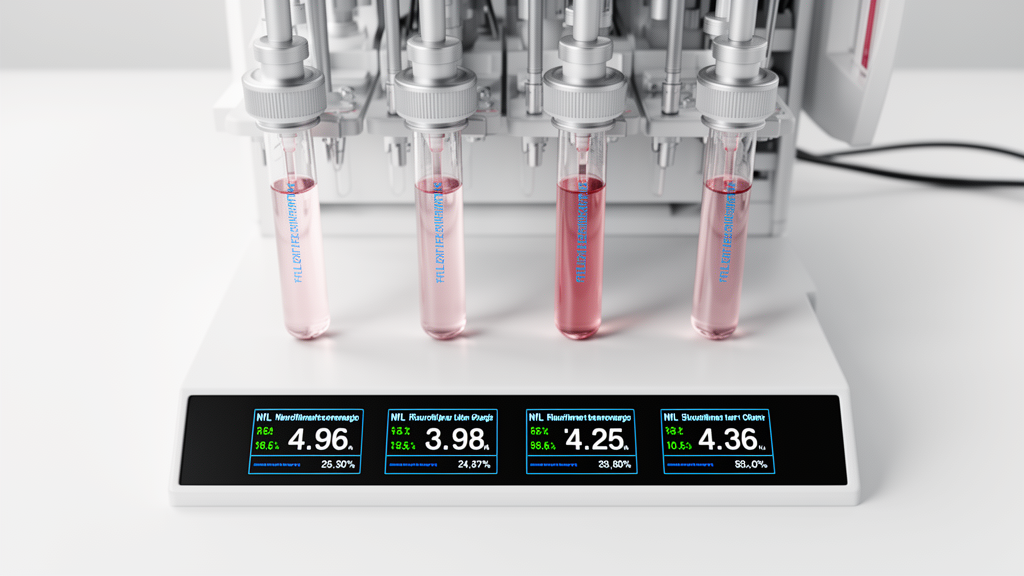
Serum neurofilament light chain, a widely used marker of neuroaxonal injury in multiple sclerosis, does not behave identically before and after freezing, and the size of the shift depends on which immunoassay platform is used to measure it. That is the central finding of a new study published in Scientific Reports, in which researchers compared paired fresh and frozen serum samples from 20 patients with multiple sclerosis across four commercial immunoassays: Simoa, Elecsys, Atellica, and ELISA.

The experimental design was deliberately simple. Matched aliquots of serum from each patient were analyzed fresh, then stored at −70 °C for 10 days, subjected to a single freeze–thaw cycle, and measured again on the same four platforms. Because every sample served as its own control, the researchers could isolate the effect of freezing itself from biological variation between patients.

The results showed that fresh-to-frozen differences varied significantly across platforms. A Friedman test produced χ² = 24.06 (p < 0.001) with Kendall’s W of 0.401, indicating meaningful disagreement among the assays in how freezing affected measured concentrations. Median sNfL levels decreased after freezing by 12.8 percent on Simoa, 5.4 percent on Elecsys, and 9.7 percent on ELISA, while Atellica showed almost no change, with a median difference of just +0.9 percent.

Agreement between platforms was moderate to strong in both sample states. Spearman correlations between assays ranged from 0.663 to 0.877 in fresh samples and from 0.677 to 0.931 in frozen samples, even though the absolute concentrations reported by the different platforms differed substantially. When the researchers converted results to assay-specific Z-scores, the Simoa and Elecsys platforms correlated strongly in both fresh (ρ = 0.886) and frozen samples (ρ = 0.923; both p < 0.001), yet systematic differences between the two assays persisted.

The authors conclude that fresh-to-frozen differences in sNfL measurement are assay-dependent, and they recommend keeping both the analytical immunoassay and the sample-processing conditions consistent when monitoring sNfL longitudinally in patients. For clinical practice and research alike, the message is that a value obtained on one platform from a fresh sample cannot be freely interchanged with a value from another platform or from frozen material without accounting for these systematic effects.

Several limitations frame the findings. The study involved only 20 patients and a single freeze–thaw cycle after a 10-day storage period, so the results speak to short-term frozen storage rather than long-term biobanking. The measurements were also confined to four immunoassays and one disease population, and the article was released as a version subject to further editorial edits before the final Version of Record. Even so, the work offers a concrete, quantified warning: for a biomarker increasingly used to track disease activity in multiple sclerosis, how a sample is handled and where it is measured can shift the number as much as the biology itself.

Subject of Research: Fresh-to-frozen comparability of serum neurofilament light chain measurements across four immunoassays in multiple sclerosis

Article Title: Fresh-to-frozen comparability of serum neurofilament light chain across four immunoassays

Article References: Kusnierova, P., Svub, K. D., Zeman, D., Sobkova, M., Maresova, S., Vilimova, K., Slepcanova, H., Stejskal, D., & Zondra Revendova, K. (2026). Fresh-to-frozen comparability of serum neurofilament light chain across four immunoassays. Scientific Reports. https://doi.org/10.1038/s41598-026-77730-z

Image Credits: AI Generated

DOI: 10.1038/s41598-026-77730-z

Keywords: neurofilament light chain, multiple sclerosis, biomarkers, immunoassays, Simoa, Elecsys, Atellica, ELISA, sample handling, freeze-thaw, laboratory comparability, neuroaxonal injury

Cite Scienmag News

Denise Maddox. (October 24, 2026). Freezing Shifts Serum Neurofilament Light Chain Results Differently Across Four Immunoassays. Scienmag. https://scienmag.com/freezing-shifts-serum-neurofilament-light-chain-results-differently-across-four-immunoassays/


Denise Maddox. "Freezing Shifts Serum Neurofilament Light Chain Results Differently Across Four Immunoassays." Scienmag, 24 October 2026, https://scienmag.com/freezing-shifts-serum-neurofilament-light-chain-results-differently-across-four-immunoassays/. Accessed 24 October 2026.

Denise Maddox. "Freezing Shifts Serum Neurofilament Light Chain Results Differently Across Four Immunoassays." Scienmag. October 24, 2026. https://scienmag.com/freezing-shifts-serum-neurofilament-light-chain-results-differently-across-four-immunoassays/

Tags: analytical performance of Simoaand ELISA platforms in biomarkerassay-specific shifts in serum neurofilament measurementsAtellicaBiomarkerscomparison of immunoassay platforms for neurofilament detectioneffects of freeze-thaw cycles on neurofilament light chain levelsElecsysELISAfreeze-thawimmunoassaysimpact of freezing on neuroaxonal injury biomarkerslaboratory comparabilitymethodological differences in multiple sclerosis biomarker analysisMultiple Sclerosisneuroaxonal injuryneurofilament light chainsample handlingSerum neurofilament light chain measurementSimoavariability in serum biomarker stability across different immunoassays
Share26Tweet16
Previous Post

AI Reads the Hidden Shape of the Optic Nerve to Spot Glaucoma in Highly Myopic Eyes

Next Post

FA-PPO Method Helps Drones Dodge Obstacles in Cluttered Skies

Related Posts

Hybrid swarm algorithm sharpens green segmentation of field maize seedling images
Technology and Engineering

Hybrid swarm algorithm sharpens green segmentation of field maize seedling images

October 24, 2026
FA-PPO Method Helps Drones Dodge Obstacles in Cluttered Skies
Technology and Engineering

FA-PPO Method Helps Drones Dodge Obstacles in Cluttered Skies

October 24, 2026
Curriculum-guided AI framework boosts semi-supervised chest X-ray disease classification
Technology and Engineering

Curriculum-guided AI framework boosts semi-supervised chest X-ray disease classification

October 24, 2026
Fighting AI Fake News With a Five-Minute Chatbot Conversation
Technology and Engineering

Fighting AI Fake News With a Five-Minute Chatbot Conversation

October 24, 2026
Multimodal AI system turns regional music into visual classroom cues
Technology and Engineering

Multimodal AI system turns regional music into visual classroom cues

October 24, 2026
Anxiety symptoms rise during perimenopause, meta-analysis finds
Technology and Engineering

Anxiety symptoms rise during perimenopause, meta-analysis finds

October 24, 2026
Next Post
FA-PPO Method Helps Drones Dodge Obstacles in Cluttered Skies

FA-PPO Method Helps Drones Dodge Obstacles in Cluttered Skies

  • Mothers who receive childcare support from maternal grandparents show more optimized

    Mothers who receive childcare support from maternal grandparents show more parental warmth, finds NTU Singapore study

    27656 shares
    Share 11059 Tweet 6912
  • University of Seville Breaks 120-Year-Old Mystery, Revises a Key Einstein Concept

    1061 shares
    Share 424 Tweet 265
  • Bee body mass, pathogens and local climate influence heat tolerance

    682 shares
    Share 273 Tweet 171
  • Researchers record first-ever images and data of a shark experiencing a boat strike

    546 shares
    Share 218 Tweet 137
  • Groundbreaking Clinical Trial Reveals Lubiprostone Enhances Kidney Function

    531 shares
    Share 212 Tweet 133
Science

Embark on a thrilling journey of discovery with Scienmag.com—your ultimate source for cutting-edge breakthroughs. Immerse yourself in a world where curiosity knows no limits and tomorrow’s possibilities become today’s reality!

RECENT NEWS

  • Ethiopian dry mountain forest holds 57 woody species under growing human pressure
  • Hybrid swarm algorithm sharpens green segmentation of field maize seedling images
  • Chlamydophila psittaci jumps from broiler chickens to turkeys, ducks, pigeons, and quails
  • FA-PPO Method Helps Drones Dodge Obstacles in Cluttered Skies

Categories

  • Agriculture
  • Anthropology
  • Archaeology
  • Athmospheric
  • Biology
  • Biotechnology
  • Blog
  • Bussines
  • Cancer
  • Chemistry
  • Climate
  • Earth Science
  • Editorial Policy
  • Marine
  • Mathematics
  • Medicine
  • Pediatry
  • Policy
  • Psychology & Psychiatry
  • Science Education
  • Science News
  • Social Science
  • Space
  • Technology and Engineering

Subscribe to Blog via Email

Enter your email address to subscribe to this blog and receive notifications of new posts by email.

Join 5,152 other subscribers

© 2025 Scienmag - Science Magazine

Welcome Back!

Login to your account below

Forgotten Password?

Retrieve your password

Please enter your username or email address to reset your password.

Log In
No Result
View All Result
  • HOME
  • SCIENCE NEWS
  • CONTACT US

© 2025 Scienmag - Science Magazine

Discover more from Science

Subscribe now to keep reading and get access to the full archive.

Continue reading