


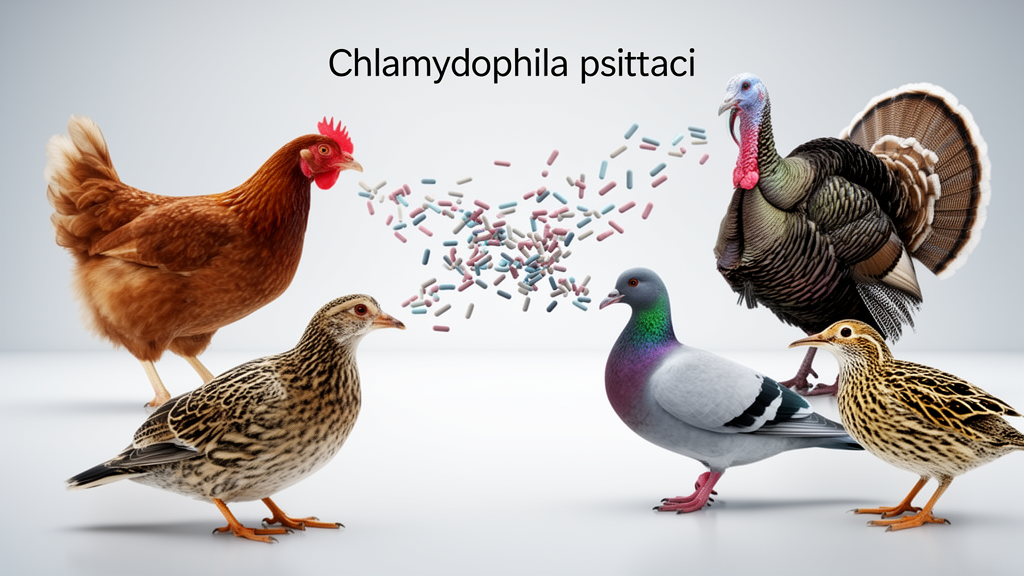
An experimentally infected broiler chick can pass its chlamydial burden to four other domestic bird species under ordinary co-housing conditions, and the consequences are strikingly uneven. In a controlled transmission study published in Frontiers in Veterinary Science, researchers in Egypt and Saudi Arabia housed day-old ducks, turkeys, pigeons, and quails alongside broiler chickens deliberately inoculated with Chlamydophila psittaci, the obligate intracellular bacterium behind avian chlamydiosis, or psittacosis. Clinical signs appeared in the contact species within three to five days of exposure, confirming that the pathogen moved efficiently between species without any artificial delivery. Turkeys emerged as the most vulnerable birds in the room, developing depression in 14 of 15 animals and respiratory distress in 13 of 15, while ducks, pigeons, and quails showed the lowest clinical susceptibility, with only 5 of 15 birds affected in each species. The findings carry direct weight for mixed-species poultry operations, where silent shedding by one flock can seed outbreaks across an entire farm and, because the bacterium is zoonotic, threaten the humans who tend it.
C. psittaci is a Gram-negative bacterium of the family Chlamydiaceae with a developmental strategy unlike that of any free-living relative. Its life cycle alternates between elementary bodies, which are infectious but metabolically inert, and reticulate bodies, which are metabolically active but non-infectious. Elementary bodies survive outside host cells and initiate infection by attaching to and entering the epithelial cells of the respiratory and gastrointestinal tracts. Once internalized, they transform into reticulate bodies that replicate inside a membrane-bound vacuole known as an inclusion, then reorganize back into elementary bodies for release and dissemination. The bacterium lacks peptidoglycan but carries a major outer membrane protein that governs its antigenicity and host immune recognition, and several genotypes with variable host specificity, pathogenicity, and zoonotic potential have been described. Transmission among birds occurs primarily through inhalation of aerosolized droppings and respiratory secretions, and the infectious elementary bodies can persist in the environment for extended periods, facilitating spread through contaminated feed, water, fomites, and close contact.
The experimental design was deliberately simple. Ninety one-day-old birds from five species were randomly divided into six groups of 15: a challenged chicken positive control, an unchallenged chicken negative control, and one group each of ducks, turkeys, pigeons, and quails. All birds were reared on a straw-bedded deep-litter system under species-specific temperature, humidity, and lighting regimens with ad libitum feed and water. Oropharyngeal and cloacal swabs from three randomly selected birds per species were tested by quantitative real-time polymerase chain reaction during the first week to confirm the absence of C. psittaci before any challenge. At seven days of age, the positive control chickens received 0.2 milliliters of a field isolate originally recovered from naturally infected Cobb broilers in Sharqia governorate, Egypt, delivered intranasally at a concentration of 10^6 inclusion-forming units per milliliter. Once clinical signs such as ruffled feathers, lethargy, depression, diarrhea, nasal discharge, and conjunctivitis appeared in the inoculated chicks, three infected birds were transferred into each of the four contact groups to permit horizontal transmission, while investigators scoring outcomes remained blinded to group assignments.
The clinical picture that unfolded was strongly species-dependent. Turkeys were the first to sicken and the most severely affected, with depression recorded in 93.3 percent of the group and respiratory signs in 86.7 percent, associations that were statistically significant with species type at P = 0.002 and P = 0.01, respectively. Chickens, ducks, and pigeons occupied an intermediate category, with depression and respiratory signs in roughly 33 to 40 percent of birds. Diarrhea showed a broader distribution, with ducks, pigeons, and turkeys all displaying higher prevalence at 66.7 percent compared with chickens and quails, an association significant at P = 0.04. Quails exhibited the mildest signs overall. Supplementary analyses emphasized the disproportionate burden in turkeys, whose cohort accounted for 39 percent of all depression cases and 38 percent of all respiratory observations across the study. Notably, ducks developed nervous signs, including paddling, at 14 days post-infection, adding a neurological dimension to the clinical spectrum. No mortality occurred in any group throughout the 35-day observation period, and the negative control chickens remained entirely free of signs.
Postmortem examination told the same story with greater anatomical resolution. Gross lesions included hepatomegaly with marked congestion, renal congestion, pericarditis, air sacculitis, pulmonary congestion, splenomegaly, and enteritis, and species differences were highly significant across all evaluated lesions at P < 0.001. Turkeys stood apart with 100 percent prevalence of liver lesions, spleen lesions, and air sacculitis, and a 66.7 percent incidence of enteritis. Chickens and ducks showed air sacculitis as the predominant lesion at 66.7 percent, while splenic involvement was least frequent in quails at 20 percent. Standardized Pearson residual analyses confirmed that these associations were driven primarily by the disproportionate disease burden in turkeys and the complete absence of lesions in the negative control group; turkeys accounted for up to 41 percent of all observed splenic lesions. The authors caution that lesion scoring categories were tailored to each species to capture the full spectrum of pathological changes, so direct cross-species comparisons of histopathological scores should be interpreted with care.
Under the microscope, the infection produced predominantly mild to moderate, reversible tissue damage whose severity rose to a maximum between 7 and 10 days post-infection and then subsided substantially by 14 days. The heart showed pericardial thickening, vascular congestion, interstitial edema, inflammatory cell infiltration, and occasional hyaline degeneration of cardiomyocytes, changes most evident in chickens, turkeys, and ducks and following a biphasic temporal pattern with peak severity at 10 days post-infection. The lungs generally exhibited mild, transient alterations, although ducks developed the most severe pulmonary pathology at 10 days post-infection, including focal pneumonia, before lung architecture approached normality by 14 days. The liver was among the most consistently affected organs, with hepatocellular degeneration, vascular congestion, Kupffer cell activation, and focal necrosis; pigeons and ducks sustained the most severe hepatic damage, while quails showed only mild changes. Renal lesions, characterized by tubular epithelial degeneration, necrosis, luminal dilatation, and congestion, were most pronounced in ducks, pigeons, and turkeys. The spleen remained the least affected organ, preserving intact white and red pulp structures throughout the experiment.
Molecular detection quantified the shedding dynamics behind these lesions. Quantitative real-time polymerase chain reaction targeting the 23S rRNA gene of C. psittaci was performed on oropharyngeal swabs collected at 7, 10, and 14 days post-infection, with samples run in duplicate or triplicate and a 151-base-pair amplification product deemed positive. Cycle threshold values for all four contact species were minimal around 10 days post-infection, marking the peak phase of maximum bacterial proliferation and shedding. Turkeys exhibited the most orderly upward trend in cycle threshold values over time, suggesting progressive clearance of the infection as the host immune response developed. Quails and ducks showed relatively stable cycle threshold values across the study period with no clear reduction, while pigeons displayed more variable values, reflecting greater inter-individual variation in bacterial shedding patterns. These molecular profiles align with the clinical and pathological severity rankings and indicate species-related differences in susceptibility, immune response, and bacterial persistence that shape how long each species remains a shedding reservoir.
Why turkeys fare so much worse than their co-housed neighbors remains biologically unresolved, but the authors propose plausible mechanisms. Variations in host immune responses could influence each species’ ability to control bacterial replication, while differences in cellular receptor expression and epithelial cell susceptibility may affect bacterial attachment, entry, and replication within host tissues. Such species-specific physiological and immunological factors may underlie the heightened vulnerability observed in turkeys, which the study suggests could act either as primary reservoirs or as uniquely susceptible hosts. The carrier state carries particular danger: chronically infected birds often exhibit mild or unapparent clinical signs, especially in the chronic stage, yet can intermittently shed the pathogen through feces and respiratory secretions, particularly under stressors such as transportation, overcrowding, or concurrent infections. These reservoirs sustain transmission within and between flocks and to humans, in whom psittacosis can be a serious respiratory disease, hampering eradication efforts and contributing to recurrent outbreaks, economic losses, and occupational risk to poultry workers, veterinarians, and bird handlers.
The study’s conclusion is a practical blueprint for mixed-species poultry systems, where chickens may serve as a potential reservoir for C. psittaci dissemination. The authors recommend enhanced biosecurity protocols on farms housing multiple avian species, prioritized surveillance of turkeys given their heightened vulnerability, routine molecular monitoring by quantitative real-time polymerase chain reaction to detect infections early, and segregation of avian species during outbreaks to interrupt transmission. They further call for molecular and immunological analyses of host immune responses and pathogen-host interactions to clarify the mechanisms behind variable susceptibility, conducted in parallel with vaccine development to explore effective vaccination strategies or immunomodulatory interventions. Because transmission incidence among domestic birds is high, particularly in turkeys, the authors urge further zoonotic risk assessments evaluating transmission from various avian species to humans, especially among poultry-farm workers, live-bird-market workers, and pet-bird handlers, framing avian chlamydiosis squarely within the One Health agenda that connects animal, human, and environmental health.
Subject of Research: Inter-species transmission of Chlamydophila psittaci from broiler chickens to ducks, turkeys, pigeons, and quails: an experimental study
Article Title: Inter-species transmission of Chlamydophila psittaci from broiler chickens to ducks, turkeys, pigeons, and quails: an experimental study
Article References: Hegazy, A. M. E., Morsy, A. M., Salem, H. M., Almutairi, J. A., Alkathiry, H., Mostafa, Y. S., Alanazi, I. M. M., Almasoudi, S. H., El-Tarabily, K. A., & Tolba, H. M. N. (2026). Inter-species transmission of Chlamydophila psittaci from broiler chickens to ducks, turkeys, pigeons, and quails: an experimental study. Frontiers in Veterinary Science, 13, Article 1870801. https://doi.org/10.3389/fvets.2026.1870801
Image Credits: AI Generated
DOI: 10.3389/fvets.2026.1870801
Keywords: Inter-species, transmission, Chlamydophila, psittaci, broiler, chickens, ducks, turkeys, pigeons, quails, experimental, scientific research
Cite Scienmag News
Kristina Jarvis. (October 24, 2026). Chlamydophila psittaci jumps from broiler chickens to turkeys, ducks, pigeons, and quails. Scienmag. https://scienmag.com/chlamydophila-psittaci-jumps-from-broiler-chickens-to-turkeys-ducks-pigeons-and-quails/
Kristina Jarvis. "Chlamydophila psittaci jumps from broiler chickens to turkeys, ducks, pigeons, and quails." Scienmag, 24 October 2026, https://scienmag.com/chlamydophila-psittaci-jumps-from-broiler-chickens-to-turkeys-ducks-pigeons-and-quails/. Accessed 24 October 2026.
Kristina Jarvis. "Chlamydophila psittaci jumps from broiler chickens to turkeys, ducks, pigeons, and quails." Scienmag. October 24, 2026. https://scienmag.com/chlamydophila-psittaci-jumps-from-broiler-chickens-to-turkeys-ducks-pigeons-and-quails/


