


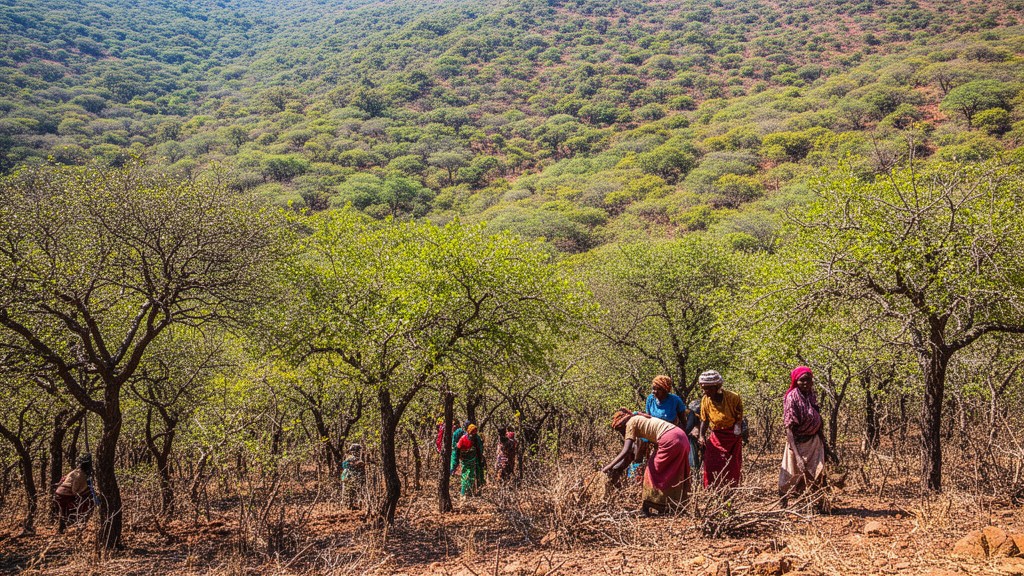
A systematic plot survey of the Getete Natural Forest in central Ethiopia has documented fifty-seven woody plant species belonging to fifty-three genera and thirty-six families, in one of the region's remaining dry afromontane forest patches. The study, published open access by Mikiyas Abebe and Ermias Lulekal in BMC, assessed woody plant composition, diversity, regeneration, endemic species, and the environmental factors and threats associated with the forest. Ethiopia harbors high biodiversity overall, but increasing anthropogenic pressures threaten its forest ecosystems, and information on woody plant diversity, regeneration, and environmental relationships remains limited in many forest patches.
The researchers established five transects spaced 400 meters apart, running systematically from the upper to the lower slope of the forest. A total of 48 plots, each measuring 20 by 20 meters, were positioned at 100-meter intervals along these transects. Within the plots, the team recorded species abundance, cover, diameter at breast height, height, and a range of environmental variables.
The data were analyzed using R statistical packages, yielding measures of the Shannon-Wiener diversity index, evenness, density, frequency, and the importance value index. The diversity and evenness of woody species in Getete Forest came out at 3.34 and 0.83, respectively. Among the recorded species, 5.26 percent were identified as endemic to Ethiopia, while 3.51 percent were classified as near-endemic.
Eight families were equally represented in the survey, each with three species, or 5.26 percent of the total: Lamiaceae, Rubiaceae, Oleaceae, Myrtaceae, Fabaceae, Anacardiaceae, Asteraceae, and Solanaceae. The total density of woody plant individuals with a diameter at breast height of at least 2 centimeters was 1,839.06 individuals per hectare. The diameter distribution of the vegetation formed an inverted "J" shape, a pattern in which many small individuals taper off into relatively few large ones.
The study reports this as a measured observation of the forest's size-class distribution. The authors also tested which environmental variables tracked variation in species composition across the forest. Altitude and aspect were significantly associated with compositional differences, at a significance threshold of p less than 0.05.
Alongside the ecological measurements, the study documented pressures on the forest. Getete Forest supports diverse indigenous and endemic woody plants, but it is subject to anthropogenic pressures including grazing, agricultural expansion, and tree cutting. The findings highlight the need for coordinated conservation actions involving government institutions, local communities, forest protection personnel, and other stakeholders.
The authors frame such coordination as the route to reducing anthropogenic threats, strengthening forest protection and monitoring, conserving biodiversity, and promoting the sustainable use of forest resources. As a single-forest assessment, the study documents the composition, structure, and environmental associations of one dry afromontane patch in central Ethiopia; its contribution lies in filling a documented information gap for a forest patch where woody plant diversity, regeneration, and environmental relationships had not previously been characterized in detail.
Subject of Research: Woody species diversity, floristic composition, vegetation structure, and environmental associations in Getete dry afromontane forest, Central Ethiopia
Article Title: Woody species diversity, floristic composition, vegetation structure, and environmental associations in Getete dry afromontane forest, Central Ethiopia
Article References: Abebe, M., & Lulekal, E. (2026). Woody species diversity, floristic composition, vegetation structure, and environmental associations in Getete dry afromontane forest, Central Ethiopia. BMC Plant Biology. https://doi.org/10.1186/s12870-026-10260-y
Image Credits: AI Generated
DOI: 10.1186/s12870-026-10260-y
Keywords: Woody, species, diversity, floristic, composition, vegetation, structure, environmental, associations, Getete, afromontane, forest
Cite Scienmag News
Margaret Porter. (October 24, 2026). Ethiopian dry mountain forest holds 57 woody species under growing human pressure. Scienmag. https://scienmag.com/ethiopian-dry-mountain-forest-holds-57-woody-species-under-growing-human-pressure/
Margaret Porter. "Ethiopian dry mountain forest holds 57 woody species under growing human pressure." Scienmag, 24 October 2026, https://scienmag.com/ethiopian-dry-mountain-forest-holds-57-woody-species-under-growing-human-pressure/. Accessed 24 October 2026.
Margaret Porter. "Ethiopian dry mountain forest holds 57 woody species under growing human pressure." Scienmag. October 24, 2026. https://scienmag.com/ethiopian-dry-mountain-forest-holds-57-woody-species-under-growing-human-pressure/


