


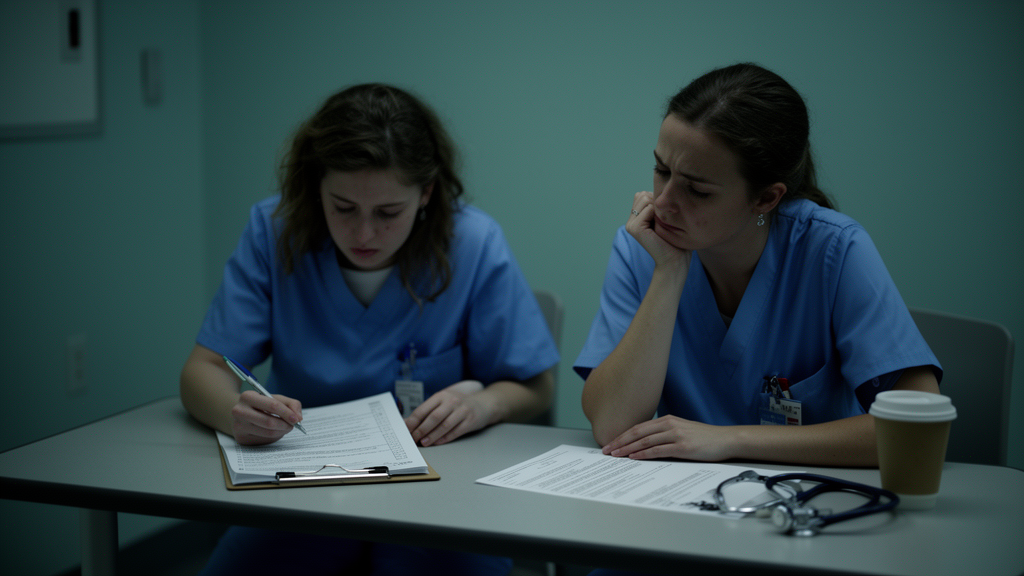
When nurses were rushed from Fujian province to the COVID-19 epicentre in Hubei, China, in early 2020, the sleep problems they carried home turned out to depend on which questionnaire asked about them. A secondary cross-sectional analysis, published in BMC Nursing, re-examined archived survey data from 414 emergency-deployed nurses who completed questionnaires between 19 March and 15 April 2020. The researchers combined two widely used screening tools, the Pittsburgh Sleep Quality Index (PSQI) and the Epworth Sleepiness Scale (ESS), into four joint classifications and asked how often the two instruments agreed. The answer, they report, is that they agreed only partially: the questionnaires identified incompletely overlapping groups of nurses, and the degree of overlap shifted depending on which cutoff scores were applied.
The numbers tell the story. A majority of the deployed nurses, 221 out of 414, or 53.4 percent, scored below the thresholds on both instruments, indicating neither poor sleep quality nor excessive daytime sleepiness. Another 124 nurses, 30.0 percent, exceeded the sleep-quality cutoff only, with a PSQI score above 7. Thirty-one nurses, 7.5 percent, exceeded the sleepiness cutoff only, with an ESS score of 10 or higher, and 38 nurses, 9.2 percent, exceeded both. The continuous scores themselves were only weakly correlated, with a Spearman rank correlation of 0.289 (95 percent confidence interval 0.195 to 0.374), and the descriptive Cohen’s kappa of 0.124 (0.039 to 0.212) confirmed that the two screening classifications captured far from identical groups. The discordance was most visible in one direction: among the 69 nurses flagged as excessively sleepy by the ESS, 31, or 44.9 percent, still scored at or below the standard PSQI cutoff of 7. Even when the researchers lowered the sleep-quality threshold to a PSQI above 5, 14 of these 69 nurses, or 20.3 percent, remained below the cutoff.
The analysis also explored which personal and occupational characteristics tracked with each outcome. In exploratory regression models that jointly modeled the standardized PSQI and ESS scores using generalized estimating equations with false discovery rate correction, frequent night shifts and a prior history of sleep disorders were associated with higher sleep-quality scores, while snoring was associated with higher sleepiness scores. Two factors, a morningness chronotype and psychological distress, were associated with both outcomes. Notably, none of the 13 between-outcome differences survived false discovery rate correction, so the authors treat these between-outcome contrasts as exploratory rather than established distinctions. Sensitivity analyses addressed a data-quality concern: eight archived PSQI component values exceeded the standard scoring range, but capping those values did not change any of the primary classifications. The reported proportions come with Wilson confidence intervals, and the correlations and kappa values with bootstrap intervals, reflecting the team’s attention to the precision of each estimate.
The authors are careful about what the study can and cannot support. Because the design is cross-sectional and relies entirely on self-report, and because the PSQI values came from archived records with some scoring uncertainty, the findings do not establish diagnostic accuracy for either instrument, causal pathways, or patient-safety benefits. The researchers frame their practical suggestion as a prospective next step rather than a proven intervention: evaluating, in similar emergency nursing settings, a staged and nonpunitive occupational-health pathway that combines domain-specific assessment with review of work schedules, recovery opportunities, safety-sensitive symptoms, and referral when indicated, while measuring outcomes, staff burden, referral yield, and unintended consequences. They also emphasize that the discordance between the two questionnaires is threshold-dependent, so any such pathway would need to specify in advance which cutoffs trigger which follow-up.
For occupational health planners, the study’s central contribution is descriptive but consequential. Sleep quality and daytime sleepiness, though related in everyday language, capture distinct aspects of sleep health, and the two questionnaires flagged only partly overlapping groups in this deployed workforce. In the specific context of emergency deployment during a pandemic, where unfamiliar settings and intensive schedules constrained recovery, the finding that psychological distress and morningness were associated with both outcomes suggests some shared correlates, even though the between-outcome differences themselves did not survive statistical correction. The historical timing matters too: the data were collected during the initial COVID-19 response in 2020, and the authors present this as an analysis of archived records from that period rather than a newly conducted survey. Whether the same discordance appears in routine, non-emergency nursing settings, and whether a staged screening pathway would reduce missed cases without adding punitive burden, remain questions for future prospective research.
Subject of Research: Agreement between sleep-quality and daytime-sleepiness screening classifications among emergency-deployed nurses
Article Title: Joint sleep-quality and daytime-sleepiness screening classifications among emergency-deployed nurses: a secondary cross-sectional analysis
Article References: Zhu, X.-J., Xie, X.-L., Chen, J.-Q., Wu, A.-J., & Wu, Y.-X. (2026). Joint sleep-quality and daytime-sleepiness screening classifications among emergency-deployed nurses: a secondary cross-sectional analysis. BMC Nursing. https://doi.org/10.1186/s12912-026-05561-4
Image Credits: AI Generated
DOI: 10.1186/s12912-026-05561-4
Keywords: sleep quality, daytime sleepiness, nurses, emergency deployment, COVID-19, PSQI, Epworth Sleepiness Scale, screening discordance, occupational health, cross-sectional analysis, China, shift work
Cite Scienmag News
Ophelia Keating. (October 24, 2026). Two Sleep Questionnaires Flag Different Nurses After Emergency Deployment. Scienmag. https://scienmag.com/two-sleep-questionnaires-flag-different-nurses-after-emergency-deployment/
Ophelia Keating. "Two Sleep Questionnaires Flag Different Nurses After Emergency Deployment." Scienmag, 24 October 2026, https://scienmag.com/two-sleep-questionnaires-flag-different-nurses-after-emergency-deployment/. Accessed 24 October 2026.
Ophelia Keating. "Two Sleep Questionnaires Flag Different Nurses After Emergency Deployment." Scienmag. October 24, 2026. https://scienmag.com/two-sleep-questionnaires-flag-different-nurses-after-emergency-deployment/


