


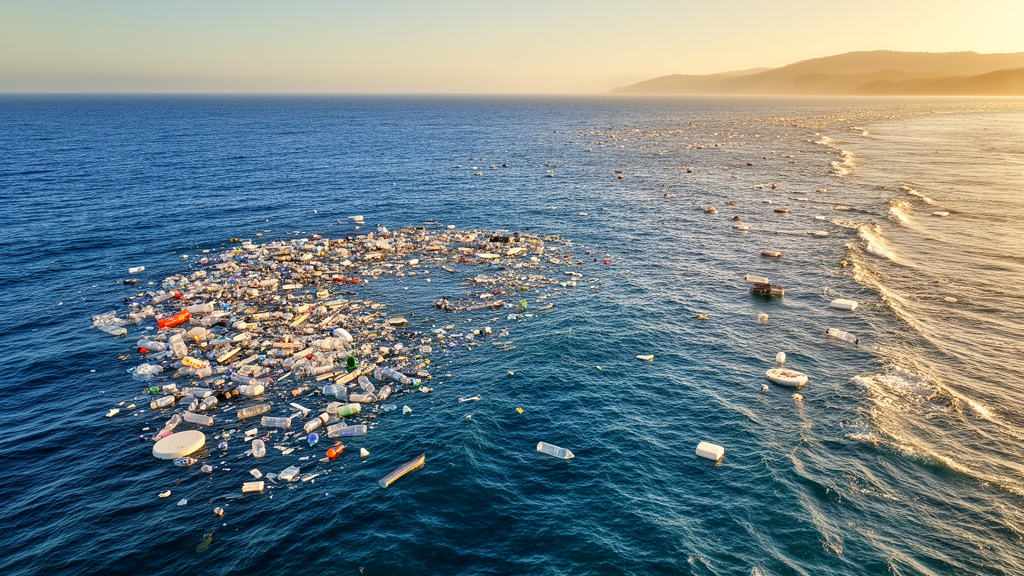
A modeling study published in Ocean Dynamics on 24 October 2026 reports that the fate of floating ocean debris depends strongly on particle density, with the heaviest buoyant particles preferentially accumulating in the Great Pacific Garbage Patch (GPGP) while lighter particles are carried westward, some of them beaching on the coasts of Asia. The work, by A. Camilo Espinosa-Ramírez and Azucena H. Durán Colmenares, addresses a persistent puzzle in marine plastic research: why man-made garbage, particularly hard-to-break-down plastic, concentrates in specific ocean regions even as the overall problem continues to grow despite mapping and cleanup efforts.
The researchers used the Maxey-Riley equations, a mathematical framework describing the motion of inertial particles at the air-sea interface, to simulate how debris accumulates and spreads across the North Pacific Ocean. In this framework, the particles are spherical and can have a density different from that of either water or air, which means their trajectories respond to the interplay between ocean currents, winds and their own buoyancy. By varying particle density, the team could trace how objects of different physical character separate from one another as they drift, rather than treating floating debris as a single uniform tracer.
The simulations produced a clear density-based sorting. Particles with a density just below that of seawater, the heaviest of the buoyant classes considered, tended to gather in the GPGP. Less-dense spheres accumulated in smaller quantities in the patch and were instead transported westward, with some of them beaching on the coasts of Asia. This partitioning suggests that the composition of debris reaching the GPGP is not random but filtered by buoyancy, with lighter material following a different route toward Asian shorelines.
Beyond the central Pacific, the model reproduced an accumulation of garbage in the Gulf of Alaska, a region where previous observations have reported relatively high concentrations of micro- and mesoplastics. Matching a modeled convergence zone to an independently documented debris hotspot supports the idea that the density-resolved particle dynamics capture real accumulation patterns in the North Pacific, although the study’s findings are model-based and the abstract does not report direct field validation of the simulated trajectories.
The study also reaffirmed a seasonal pattern in the location and dispersion of the GPGP. Seasonality linked to the weakening of the atmosphere’s anticyclonic circulation over the Pacific Ocean had been noticed before, and the new simulations indicate that in some winters the particles leave the location of the GPGP. Such episodic excursions mean the patch is not a fixed repository but a dynamic feature whose boundaries and population shift with atmospheric forcing over the year.
According to the authors, the Maxey-Riley formulation for particles at the air-sea interface is an effective tool for carrying out and optimizing actions to clean up floating debris pollution in the ocean. Because the approach sorts debris by density, it could in principle help cleanup operations anticipate where different classes of floating material will concentrate, and when seasonal circulation changes might disperse them. The work frames the GPGP as one node in a broader density-sorted transport system that also feeds coastal accumulation zones, offering a physics-based basis for targeting both offshore and shoreline interventions.
Subject of Research: Density-dependent transport of floating inertial particles and the formation of the Great Pacific Garbage Patch
Article Title: Distribution of floating inertial particles in the ocean by their density: formation and evolution of the Great Pacific Garbage Patch
Article References: Espinosa-Ramírez, A. C., & Durán Colmenares, A. H. (2026). Distribution of floating inertial particles in the ocean by their density: formation and evolution of the Great Pacific Garbage Patch. Ocean Dynamics, 76(11), Article 117. https://doi.org/10.1007/s10236-026-01873-w
Image Credits: AI Generated
DOI: 10.1007/s10236-026-01873-w
Keywords: Great Pacific Garbage Patch, Maxey-Riley equations, inertial particles, ocean plastic pollution, air-sea interface, North Pacific Ocean, particle density, Gulf of Alaska, seasonal variability, ocean modeling, marine debris, Ocean Dynamics
Cite Scienmag News
Violet Maxwell. (October 24, 2026). Particle density decides whether ocean debris joins the Great Pacific Garbage Patch or drifts to Asia. Scienmag. https://scienmag.com/particle-density-decides-whether-ocean-debris-joins-the-great-pacific-garbage-patch-or-drifts-to-asia/
Violet Maxwell. "Particle density decides whether ocean debris joins the Great Pacific Garbage Patch or drifts to Asia." Scienmag, 24 October 2026, https://scienmag.com/particle-density-decides-whether-ocean-debris-joins-the-great-pacific-garbage-patch-or-drifts-to-asia/. Accessed 24 October 2026.
Violet Maxwell. "Particle density decides whether ocean debris joins the Great Pacific Garbage Patch or drifts to Asia." Scienmag. October 24, 2026. https://scienmag.com/particle-density-decides-whether-ocean-debris-joins-the-great-pacific-garbage-patch-or-drifts-to-asia/


