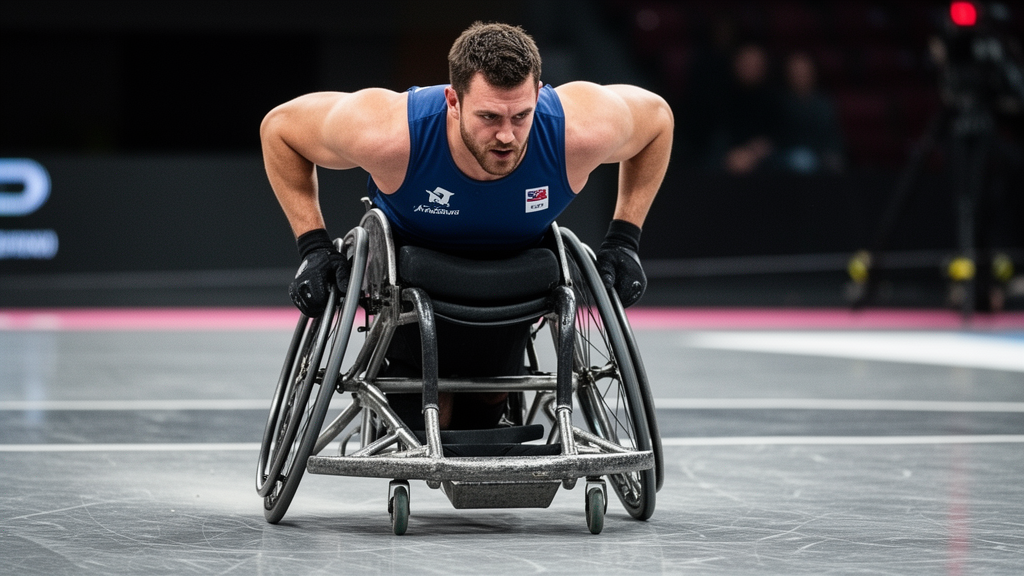
A preliminary study of nine elite Brazilian wheelchair rugby athletes with cervical spinal cord injuries has found that the force-generating capacity of the shoulder, rather than the size of the difference between the two arms, is what tracks with sprint performance on the court. Shoulder extension peak torque measured on an isokinetic dynamometer was significantly and positively associated with mean sprint speed over 20 meters, while neither bilateral asymmetry nor the balance between opposing shoulder muscle groups showed significant associations with performance in this sample. The work, published in Frontiers in Sports and Active Living, was conducted by researchers at the State University of Campinas together with a collaborator at North Paraná University.
The question matters for a sport built on collision, propulsion, and rapid acceleration. Wheelchair rugby is a Paralympic sport practiced by athletes with impairments affecting the upper and lower limbs, including reduced voluntary muscle strength, limb length, passive range of motion, or coordination. Athletes are assigned functional classes ranging from 0.5 to 3.5 points, reflecting differences in functional ability that shape their tactical roles and wheelchair configurations. Match play is characterized by repeated short-duration, high-intensity efforts, with athletes typically performing 20 to 40 brief sprints of 2 to 4 seconds per game, interspersed with collisions and rapid directional changes. The ability to generate force rapidly is therefore considered essential for gaining positional advantage.
The shoulder joint complex plays a central role in wheelchair propulsion, although propulsion strategies vary with functional profile. The authors note that high-class players predominantly use pushing movements supported by trunk and triceps function, whereas low- and middle-class players tend to rely more on pulling patterns involving the biceps. These individual adaptations raise questions about the role of bilateral muscle symmetry in performance. Although greater bilateral symmetry has been associated with improved propulsion characteristics such as speed, acceleration, and mechanical efficiency, inter-limb asymmetry is increasingly recognized as a task-specific phenomenon, and the authors argue that bilateral differences should not automatically be interpreted as performance deficits in athletes whose movement patterns are shaped by impairment-related constraints.
The interpretation of asymmetry is further complicated by how it is measured. Fixed thresholds, such as the 10 to 15 percent cutoffs widely adopted in able-bodied sports, may overlook individual and task-specific characteristics. The authors cite longitudinal research in elite youth tennis players reporting asymmetry magnitudes ranging from 2.0 to 15.9 percent across unilateral strength, power, speed, and agility assessments, with the direction of asymmetry more consistent in the dominant upper limb than in the lower limbs. Because no universally accepted cutoff exists for interpreting inter-limb asymmetry across athletic populations, the research team retained asymmetry as a continuous measure of the percentage difference in peak torque between limbs rather than classifying athletes as symmetrical or asymmetrical.
The study was an exploratory, cross-sectional preliminary investigation with a convenience sample of nine highly trained national-level wheelchair rugby athletes with cervical spinal cord injuries at neurological levels C5 to C7. Seven athletes had complete injuries and two had incomplete injuries, resulting in heterogeneous preservation of upper-limb muscle function. Most participants retained functional triceps activation, whereas two lacked effective triceps function, a profile commonly observed among lower-point players. Functional classification ranged from 0.5 to 3.5 points, and all participants trained regularly, completing approximately three two-hour on-court sessions per week. No a priori sample-size calculation was performed, so the analyses were interpreted as exploratory.
Testing took place over two days in the same week with a one-day interval. Shoulder flexion, extension, abduction, and adduction were evaluated on a Biodex System 4 dynamometer at an angular velocity of 180 degrees per second, an intermediate condition between maximal strength and muscular power chosen to align with the fast, repetitive demands of the sport. The trunk was stabilized with straps to prevent compensatory movements, and range of motion was adjusted individually to accommodate each athlete’s functional limitations. Peak torque normalized by body weight and agonist/antagonist ratios were extracted for each movement and limb. On the second day, sprint performance was assessed with a 20-meter test using a four-photocell system; athletes propelled their wheelchairs as fast as possible, and the best of two attempts separated by five minutes of rest was used for analysis.
The results showed that the magnitude of bilateral peak torque differences varied across athletes and shoulder movements. Adduction displayed the highest asymmetry, with a mean of 25.78 percent (standard deviation 13.54), followed by extension at 17.01 percent (12.75) and flexion at 14.69 percent (7.24), while abduction showed the lowest magnitude at 9.03 percent (5.87). An analysis of variance indicated a significant difference in asymmetry levels between movements, and Tukey’s post-hoc test revealed that asymmetry in adduction was significantly greater than in abduction by 16.75 percentage points. No other comparison between movements reached statistical significance.
Muscle balance told a story of pronounced deviation from normative values. For the flexion/extension movement, the observed average agonist/antagonist ratio was 1.69 (standard deviation 0.43), a positive deviation of 0.98 from the central value of the reference range of approximately 0.66 to 0.75, indicating a marked predominance of flexors over extensors. In the abduction/adduction movement, the average ratio was even higher at 2.26 (0.32), a deviation of 1.26 from the reference value of 1.00 within a reference range of approximately 0.8 to 1.2, demonstrating a predominance of abductors over adductors. All athletes demonstrated these marked imbalances, which the authors consider compatible with the functional profile of tetraplegic athletes and the neuromuscular adaptations following cervical spinal cord injury.
When the researchers examined which variables tracked with sprint performance, the findings pointed toward raw strength. Shoulder extension peak torque normalized by body weight, averaged across both limbs, was significantly and positively associated with mean sprint speed, with a Spearman correlation coefficient of 0.812 (p = 0.008). No other isokinetic variable showed a significant correlation with sprint performance. In the univariate regression models, shoulder flexion peak torque was the only variable significantly associated with mean sprint speed (standardized coefficient of negative 0.68, p = 0.049), and only when examined alongside the flexion-extension agonist/antagonist ratio. Neither bilateral asymmetry nor muscle balance showed significant main effects or interaction effects with peak torque in any model. A post hoc power analysis indicated adequate statistical power for the significant associations, with power of 0.88 for the extension correlation and 0.85 for the flexion regression coefficient.
The authors interpret the extension association in light of propulsion mechanics. The latissimus dorsi and posterior deltoid, primary extensors of the shoulder, contribute to controlling the terminal portion of the push and to repositioning the arm during the recovery phase, which is essential for maintaining propulsion cadence at high speeds. Although shoulder flexion is also involved in forward propulsion, its contribution may be partly overshadowed by the stabilizing and control demands placed on the extensors during high-speed propulsion. The authors also note that when the hand is fixed on the rim, shoulder flexor activation contributes to forward translation of the arm-trunk segment and indirectly facilitates the elbow extension required to complete the push phase.
Despite the marked imbalances, these structural deviations did not translate into measurable effects on sprint performance. The authors suggest that athletes with cervical spinal cord injury rely heavily on compensatory strategies that redistribute mechanical demands across available muscle groups, allowing them to maintain propulsion effectiveness even in the presence of substantial imbalances. They also cite previous observations that high-point wheelchair court athletes, who are typically the fastest and most powerful, tend to exhibit greater asymmetries than low-point athletes, a pattern thought to arise because having more functional muscle mass increases the potential for strength differences between the upper limbs.
The study has limitations the authors acknowledge directly. The small sample of nine athletes substantially limits statistical power and increases the likelihood of both type I and type II errors, so non-significant results cannot be interpreted as evidence of no effect, and significant associations should be interpreted cautiously. The convenience sample from a single elite team restricts generalizability, the absence of athletes from all functional classes prevented stratified analyses, and isokinetic testing does not fully capture the mechanical and neuromuscular demands of high-speed wheelchair propulsion. The lack of information on shoulder injury history also precluded exploration of relationships between asymmetry, imbalance, and injury risk. The authors emphasize that the absence of significant associations between asymmetry and sprint performance indicates only that the specific asymmetry metrics investigated were not associated with this particular performance task.
From a practical perspective, the authors conclude that strength and conditioning programs for these athletes should prioritize functional torque production while interpreting asymmetries within each athlete’s impairment-specific neuromuscular profile, rather than treating symmetry restoration as a universal training target. They suggest that the presence and magnitude of asymmetry should be interpreted alongside functional performance and the individual profile, distinguishing potentially maladaptive asymmetries from stable neuromuscular adaptations associated with cervical spinal cord injury and long-term sport participation. Because of the small and functionally heterogeneous sample, the conclusions remain exploratory, and the authors call for larger, classification-stratified and longitudinal studies to determine whether specific asymmetry patterns become relevant under different performance tasks, fatigue conditions, or injury-risk contexts.
Subject of Research: Bilateral upper limb asymmetry, isokinetic shoulder function, and sprint performance in wheelchair rugby athletes with cervical spinal cord injury
Article Title: Interactions between upper limb asymmetry, isokinetic shoulder function, and sprint performance in wheelchair rugby: a preliminary study
Article References: de Sá, K. S. G., de Oliveira Silva, H. V., Cavalari, E. R., Cavaglieri, C. R., & Gorla, J. I. (2026). Interactions between upper limb asymmetry, isokinetic shoulder function, and sprint performance in wheelchair rugby: a preliminary study. Frontiers in Sports and Active Living, 8, Article 1890052. https://doi.org/10.3389/fspor.2026.1890052
Image Credits: AI Generated
DOI: 10.3389/fspor.2026.1890052
Keywords: wheelchair rugby, isokinetic strength, bilateral asymmetry, agonist/antagonist ratio, sprint performance, cervical spinal cord injury, shoulder biomechanics, peak torque, Paralympic sport, wheelchair propulsion, tetraplegia, preliminary study
Cite Scienmag News
Cassandra Pierce. (October 24, 2026). Shoulder strength, not asymmetry, tracks sprint speed in wheelchair rugby athletes. Scienmag. https://scienmag.com/shoulder-strength-not-asymmetry-tracks-sprint-speed-in-wheelchair-rugby-athletes/
Cassandra Pierce. "Shoulder strength, not asymmetry, tracks sprint speed in wheelchair rugby athletes." Scienmag, 24 October 2026, https://scienmag.com/shoulder-strength-not-asymmetry-tracks-sprint-speed-in-wheelchair-rugby-athletes/. Accessed 24 October 2026.
Cassandra Pierce. "Shoulder strength, not asymmetry, tracks sprint speed in wheelchair rugby athletes." Scienmag. October 24, 2026. https://scienmag.com/shoulder-strength-not-asymmetry-tracks-sprint-speed-in-wheelchair-rugby-athletes/