


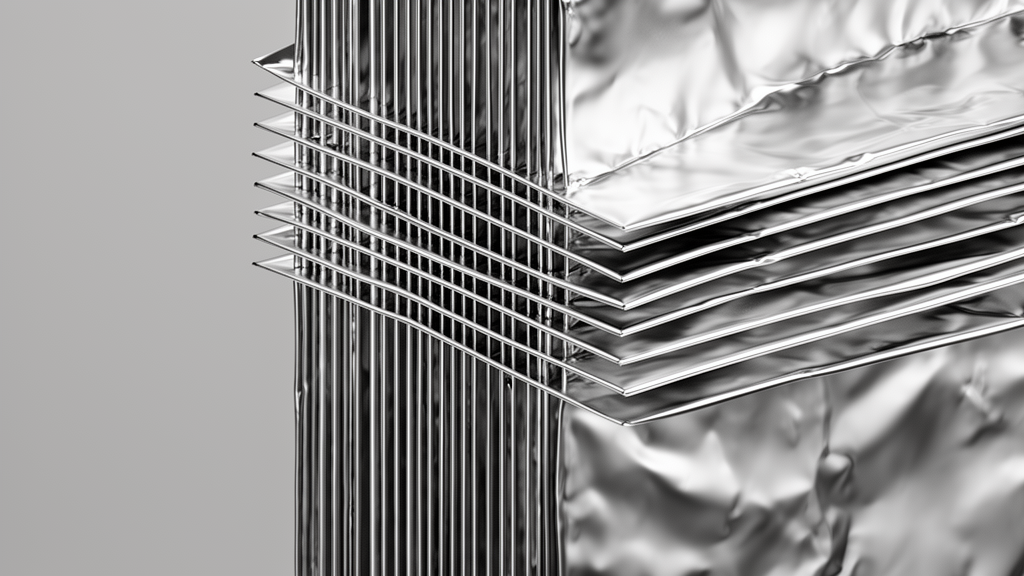
Engineers at the University of Pennsylvania have developed a novel thermal insulator by stacking hundreds of sheets of Mylar, a material commonly known for its use in household food wrap and emergency blankets. This innovation, termed hybrid layered insulating film stacks or HyLIFS, addresses a critical challenge for future lunar infrastructure: the need for insulation that is both thermally efficient and mechanically robust. Published in ACS Applied Materials & Interfaces, the study demonstrates that this simple assembly of polymer films can withstand significant compression and bending while maintaining high insulating performance in a vacuum. The research suggests a pathway toward inexpensive, durable, and reusable materials that could protect lunar habitats, spacesuits, and other equipment from the extreme temperature fluctuations of the moon.
The moon presents a hostile environment for human habitation, with surface temperatures ranging from hundreds of degrees below zero to boiling levels. Effective insulation is therefore essential to maintain habitable conditions inside lunar structures. However, many materials that excel at slowing heat transfer are not designed to withstand the physical stresses of construction and maintenance in a low-gravity, high-risk environment. Aerogels, for instance, are lightweight and excellent insulators due to their porous structure, but they are fragile and prone to mechanical damage. Similarly, traditional multilayer insulation used in space applications relies on reflective films separated by spacers; while effective at limiting radiative heat transfer, these systems are not designed to bear significant loads and can tear easily when handled. This creates a fundamental trade-off in material science: enhancing mechanical strength often comes at the expense of thermal performance, a dilemma that the Penn team sought to resolve.
The researchers turned to biaxially oriented polyethylene terephthalate, or BoPET, commonly known as Mylar, a polymer already widely used in aerospace applications. When coated with a thin layer of aluminum, Mylar blocks infrared radiation, effectively trapping heat. The team tested films of various thicknesses, coating some with an extremely thin layer of aluminum oxide, or alumina, to increase stiffness. The assembly process is currently manual and delicate. As first author Danielle R. Levin, a recent doctoral graduate in chemistry and master’s graduate in Mechanical Engineering and Applied Mechanics, noted, the process is time-consuming, requiring the use of tweezers and small weights to handle the delicate films. Even breathing near the stack can disturb the layers, highlighting the precision required in the current laboratory setup.
When tested in a vacuum, the stacked Mylar films exhibited an unusual combination of properties. Under compression conditions simulating a lunar habitat with atmospheric pressure indoors, the best-performing stacks achieved thermal conductivity comparable to other high-performance vacuum insulation technologies while remaining flexible. In separate mechanical tests, the coated stacks maintained their thermal performance even under the highest compressive stresses achievable with the lab’s equipment. This indicates that the material does not suffer from the typical trade-off between insulation and durability. Senior author Igor Bargatin, Associate Professor in Mechanical Engineering and Applied Mechanics, emphasized that these stacks can bend, withstand substantial compression, and maintain insulating performance, potentially allowing them to be packed, transported, and survive rough treatment over many years of use.
The durability of the HyLIFS material was further demonstrated in repeated stress tests. The researchers compressed samples to approximately 20 megapascals, a pressure roughly equivalent to concentrating 200 pounds onto the area of a fingertip. Levin recalled that the team was concerned about the material failing under such high compressive stress. However, the stacks did not just survive a single high-stress cycle; they withstood ten consecutive cycles without losing their insulating properties. This resilience is crucial for lunar infrastructure, where materials must endure the rigors of transport and the inevitable accidents that occur during construction and maintenance. Bargatin noted that astronauts will inevitably bump into insulation materials, making toughness a vital characteristic for long-term habitation on the moon.
A key finding of the study revealed that microscopic “antiblocking” particles, which are standard in commercial Mylar to prevent sheets from sticking together, play a central role in the material’s thermal performance. These particles protrude slightly from the film surface, creating microscopic points of contact between adjacent layers. The researchers developed models of heat transfer across these interfaces and compared them with experimental data. Their results suggest that, in a vacuum, heat primarily crosses from one sheet to another at these microscopic contact points. This insight challenges the conventional view of multilayer insulation, which focuses primarily on limiting radiative heat transfer. By understanding the role of these particles in conductive heat transfer, future materials could be engineered with specific particle sizes, numbers, and distributions to optimize thermal performance.
The study also uncovered a counterintuitive result regarding film thickness. Initially, the team expected the thinnest films to provide the best insulation, as thinner films allow for more layers and interfaces within the same space, thereby limiting heat transfer. However, the thinnest successfully characterized films and those of medium thickness performed similarly when coated with alumina. The researchers attribute this to the antiblocking particles in the thinner films, which create more contact points between neighboring layers, providing additional pathways for heat to flow. Levin explained that optimizing insulation is more complex than simply minimizing film thickness. As the layers are compressed, the contact landscape changes, and the films deform. Therefore, film thickness, stiffness, and the distribution of embedded particles all influence the final thermal performance, requiring a holistic approach to material design.
Currently, the HyLIFS samples are small, approximately one square centimeter in area, and the production process is labor-intensive, taking hours for manual cutting and stacking. Scaling this technology to the meter-sized sheets required for practical insulation will require new manufacturing techniques. The researchers point to methods such as continuously coating large rolls of Mylar as potential solutions. In the future, it may be possible to tune film thickness, coating, and antiblocking particle distribution before winding the material into large stacks. While questions remain about how the films will behave at larger scales, including their ability to survive multiple bending cycles and physical impacts in real-life applications, the small-scale results are promising. If the material’s properties hold at scale, it could prove invaluable for insulating lunar habitats, rovers, and electronic systems.
This work, conducted at the University of Pennsylvania School of Engineering and Applied Science, highlights how much can still be learned from materials that engineers believe they understand well. The simplicity of the configuration—stacking familiar polymer films—yielded a robust solution to a complex engineering problem. The research was supported by the National Science Foundation Division of Chemical, Bioengineering, Environmental and Transport Systems. The findings suggest that by re-evaluating the properties of existing materials and understanding the microscopic mechanisms at play, it is possible to create durable, high-performance insulation for the demanding conditions of space exploration. As humanity prepares for long-term presence on the moon, materials that combine thermal efficiency with mechanical resilience will be essential for building safe and sustainable habitats.
Subject of Research: Development of durable Mylar-based thermal insulation for lunar habitats
Article Title: Penn Engineers turn everyday Mylar into a promising insulator for the moon
Article References: Penn Engineers turn everyday Mylar into a promising insulator for the moon. Original publication (Bibliographic details unavailable.)
Image Credits: AI Generated
DOI: Not provided
Keywords: Mylar, Lunar insulation, Thermal conductivity, Polymer films, Space engineering, Mechanical durability, Vacuum insulation, Penn Engineering, Penn, Engineers, turn, everyday
Cite Scienmag News
Grant Pearson. (October 23, 2026). Penn Engineers Stack Mylar for Durable Lunar Insulation. Scienmag. https://scienmag.com/penn-engineers-stack-mylar-for-durable-lunar-insulation/
Grant Pearson. "Penn Engineers Stack Mylar for Durable Lunar Insulation." Scienmag, 23 October 2026, https://scienmag.com/penn-engineers-stack-mylar-for-durable-lunar-insulation/. Accessed 23 October 2026.
Grant Pearson. "Penn Engineers Stack Mylar for Durable Lunar Insulation." Scienmag. October 23, 2026. https://scienmag.com/penn-engineers-stack-mylar-for-durable-lunar-insulation/


