


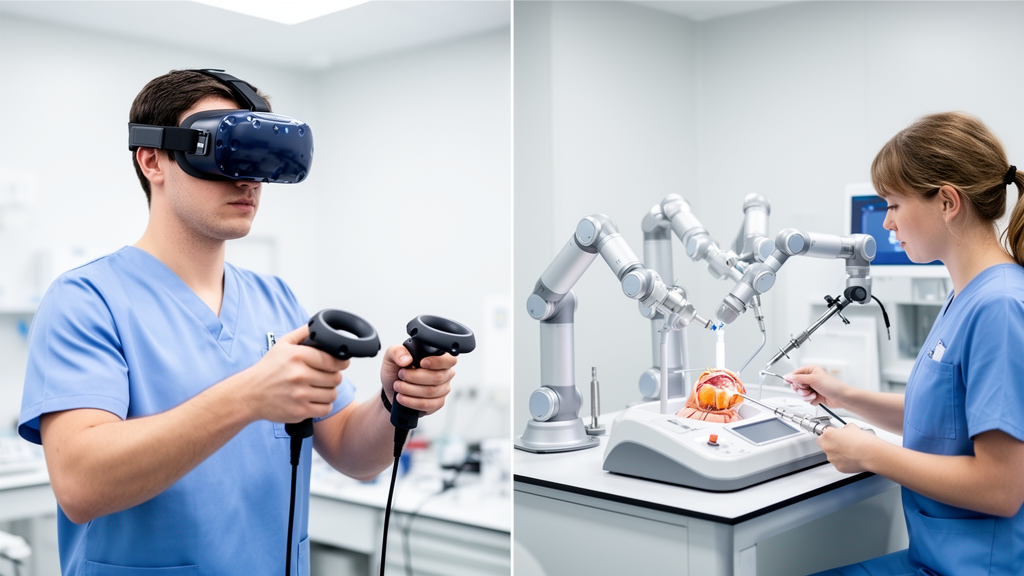
A randomized controlled trial published in BMC Medical Education reports that immersive virtual reality (IVR) training and traditional physical arthroscopy simulator training did not produce statistically significant differences in final performance assessments for arthroscopy-naive medical trainees. The study, conducted as a single-center trial, directly compared the efficacy of these two modalities in teaching foundational skills for diagnostic knee arthroscopy. While both methods offered distinct advantages, the primary outcome indicated that neither approach demonstrated superior technical proficiency over the other when measured by blinded evaluators.
The findings suggest that the choice between digital and physical simulation may depend on factors beyond immediate technical score, such as accessibility and specific learning objectives. The research involved novice medical students with no prior experience in arthroscopic procedures, who were randomly allocated into four distinct groups to ensure a rigorous comparison. The first group, designated IVR3, underwent three separate sessions of immersive virtual reality training.
The second group, IVR1, received a single session of IVR training. A third group utilized a non-anatomic physical arthroscopy simulator for one session, while the final group served as a control with no specific training. This design allowed the researchers to isolate the effects of training frequency and the type of simulator on skill acquisition, providing a structured framework for evaluating the impact of repeated exposure versus single-session practice.
During the training phase, specific metrics were recorded for the virtual reality participants to track their progress. The system monitored precision, scope manipulation, and object-tracking capabilities across their respective sessions. The data revealed that the IVR3 group, which received repeated exposure, demonstrated significant within-group improvement in these technical metrics.
The statistical analysis indicated that these improvements were highly significant, with p-values less than 0.001. Following the training period, all participants performed a standardized diagnostic knee arthroscopy on an anatomical model, which served as the primary endpoint for the study. A blinded evaluator, who did not know which training group each participant belonged to, assessed the performance using a Global Rating Scale (GRS).
The researchers also measured task completion time and collected participant-reported data on confidence and experience. This multi-faceted approach aimed to capture both objective technical performance and subjective learner perceptions, providing a comprehensive view of the training outcomes across different dimensions of surgical skill. The primary finding of the trial was that no statistically significant differences were detected between the IVR groups and the physical simulator groups across all domains of the Global Rating Scale.
This indicates that, for the specific task of diagnostic knee arthroscopy, training on an immersive virtual reality system did not result in better or worse technical scores compared to training on a physical simulator. However, a notable difference emerged when comparing the physical simulator group to the untrained controls. Task completion time provided another layer of insight into the efficacy of the training methods.
The IVR3 cohort, which underwent three sessions of virtual reality training, completed the assessment faster than both the IVR1 group and the untrained participants. This difference was statistically significant, suggesting that repeated exposure to the virtual environment enhances efficiency and speed in performing the procedure. In contrast, self-reported confidence levels did not differ significantly between the groups.
This implies that while trainees may become faster and more precise in their movements with repeated IVR practice, they do not necessarily feel more confident in their abilities compared to peers who used physical simulators or received no training. Qualitative feedback from the participants highlighted the perceived strengths of each training modality. Trainees noted that physical simulators offered a higher degree of realism.
Conversely, the immersive virtual reality system was praised for its accessibility and repeatability. The ability to practice the same procedure multiple times in the virtual environment was identified as a key advantage. This feedback underscores the complementary nature of the two technologies, suggesting that they may serve different educational purposes within a surgical curriculum, with physical simulators potentially better suited for realism and IVR for frequent, accessible practice.
The study authors emphasized the limitations of the trial, noting that it was small in scale and not designed as an equivalence study. Therefore, the absence of a statistically significant difference between the IVR and physical simulator groups should be interpreted as the lack of a detectable difference rather than proof that the two methods are equivalent. The researchers also pointed out challenges related to task comparability and anatomic fidelity.
The physical simulator used was non-anatomic, which may limit the direct transferability of skills to real human anatomy. Furthermore, the absence of validated arthroscopy-specific assessment tools for virtual reality training complicates the interpretation of comparative effectiveness. These factors must be considered when evaluating the potential role of IVR in surgical education.
Despite these limitations, the findings support the potential role of immersive virtual reality as a scalable adjunct for early arthroscopic skill development.
Subject of Research: Comparison of immersive virtual reality and physical simulators in arthroscopic surgical training
Article Title: Comparing the efficacy of immersive virtual reality and traditional physical arthroscopy simulators in arthroscopic training: a randomized controlled trial
Article References: Koucheki, R., Raleigh, M. J., Hauer, T. M., Wolfstadt, J. I., Larouche, J., Backstein, D. J., Chahal, J., Ravi, B., Ferguson, P. C., & Lex, J. R. (2026). Comparing the efficacy of immersive virtual reality and traditional physical arthroscopy simulators in arthroscopic training: a randomized controlled trial. BMC Medical Education. https://doi.org/10.1186/s12909-026-10595-y
Image Credits: AI Generated
DOI: 10.1186/s12909-026-10595-y
Keywords: virtual reality, surgical education, arthroscopy, medical simulation, randomized controlled trial, skill acquisition, knee arthroscopy, training efficacy, Comparing, efficacy, immersive, virtual
Cite Scienmag News
Courtney Benton. (October 23, 2026). VR and Physical Simulators Show Similar Arthroscopy Training Results. Scienmag. https://scienmag.com/vr-and-physical-simulators-show-similar-arthroscopy-training-results/
Courtney Benton. "VR and Physical Simulators Show Similar Arthroscopy Training Results." Scienmag, 23 October 2026, https://scienmag.com/vr-and-physical-simulators-show-similar-arthroscopy-training-results/. Accessed 23 October 2026.
Courtney Benton. "VR and Physical Simulators Show Similar Arthroscopy Training Results." Scienmag. October 23, 2026. https://scienmag.com/vr-and-physical-simulators-show-similar-arthroscopy-training-results/


