


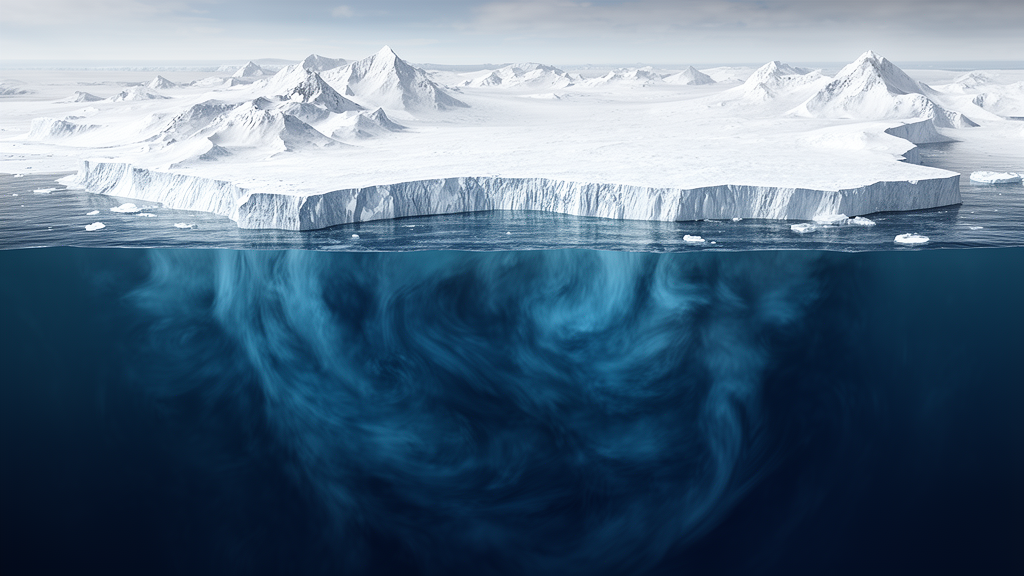
A new modelling study from the University of St Andrews has identified a previously unknown process that may have helped drive Earth into its past ice ages, by linking the growth of ice sheets in the Northern Hemisphere to carbon-storing changes in ocean circulation and sea ice in the faraway Southern Hemisphere. The research, published in the Journal of Climate, addresses one of the long-standing puzzles of ice age science: how these two key features of glacial periods, separated by the entire width of the planet, could have been connected.
Scientists have long understood that Earth was mainly pushed into ice ages by more carbon dioxide being stored in the ocean, a process largely driven by changes in the Southern Ocean around Antarctica. Natural cycles in Earth’s orbit triggered the initial growth of large ice sheets in the Northern Hemisphere, but how that northern ice growth then led to changes in the distant Southern Ocean that drew CO2 down from the atmosphere was unknown. The new paper proposes a mechanism: once northern ice sheets begin growing, they cool nearby North Atlantic waters, which eventually circulate all the way down to the Southern Ocean. If the cooling of the northern waters is strong enough, the researchers argue, it could induce significant circulation changes in the south of the kind known to lead to more CO2 being stored in the ocean.
To test this hypothesis, the team ran ocean model simulations in which they cooled only the far northern latitudes, mimicking the effect of a large ice sheet, and then measured whether this affected the Southern Ocean. The results were striking. Cooling the northern latitudes alone caused nearly the same amount of CO2 drawdown, 74 percent, as a simulation in which the researchers cooled the entire planet. According to the authors, this result firmly supports the idea that ice sheets can cool northern waters, which eventually make their way south and cause changes in the Southern Ocean, forming an important part of the sequence that drove Earth into its past ice ages.
Lead author Dr Madison Shankle, from the School of Earth and Environmental Sciences at the University of St Andrews, said the study provides evidence of a plausible mechanism connecting two far-flung puzzle pieces that had been difficult to reconcile. “Essentially, we’ve produced evidence of a plausible mechanism connecting these two far-flung puzzles pieces – Northern Hemisphere ice sheets and Southern Hemisphere ocean circulation changes leading to CO2 drawdown – which has been a tricky thing to explain in our theory of Earth’s past ice ages,” she said. “Our study takes the step of actually demonstrating them working in model simulations, which is a big step forward for this field.”
The findings also reflect a shift in how ice age research is approached. Historically, scientists studying glacial cycles have focused heavily on the Southern Ocean, and it is only recently that the influence of other, remote parts of the ocean has begun to be more fully appreciated. By showing that a perturbation confined to the high northern latitudes can propagate through the global ocean circulation and produce glacial-like features and substantial carbon storage in the south, the study adds a remote Northern Hemisphere driver to the established Southern Ocean picture.
Beyond reconstructing the past, the ice ages serve as natural case studies of how carbon moves in and out of the atmosphere. The more researchers understand about these periods, the better they can comprehend how Earth naturally redistributes carbon within the carbon cycle. That knowledge, the authors note, is critical for considering how the planet will respond to the additional CO2 now being added to the Earth system. The study, titled “Isolated Northern Hemisphere Cooling in an Idealized Model Promotes Ocean Carbon Storage and Glacial-like Ocean Features,” was published on 22 October 2026.
Subject of Research: Model simulation of how Northern Hemisphere ice sheet cooling drives Southern Ocean circulation changes and ocean carbon storage during past ice ages
Article Title: New discovery links hemispheres in the mystery of Earth’s past ice ages
Article References: New discovery links hemispheres in the mystery of Earth’s past ice ages. Original publication (Bibliographic details unavailable.)
Image Credits: AI Generated
DOI: Not provided
Keywords: ice ages, Northern Hemisphere ice sheets, Southern Ocean, ocean circulation, carbon dioxide drawdown, climate modelling, North Atlantic, carbon cycle, sea ice, glacial cycles, University of St Andrews, Journal of Climate
Cite Scienmag News
Violet Maxwell. (October 23, 2026). Northern ice sheets may have triggered Southern Ocean carbon storage in past ice ages. Scienmag. https://scienmag.com/northern-ice-sheets-may-have-triggered-southern-ocean-carbon-storage-in-past-ice-ages/
Violet Maxwell. "Northern ice sheets may have triggered Southern Ocean carbon storage in past ice ages." Scienmag, 23 October 2026, https://scienmag.com/northern-ice-sheets-may-have-triggered-southern-ocean-carbon-storage-in-past-ice-ages/. Accessed 23 October 2026.
Violet Maxwell. "Northern ice sheets may have triggered Southern Ocean carbon storage in past ice ages." Scienmag. October 23, 2026. https://scienmag.com/northern-ice-sheets-may-have-triggered-southern-ocean-carbon-storage-in-past-ice-ages/


