


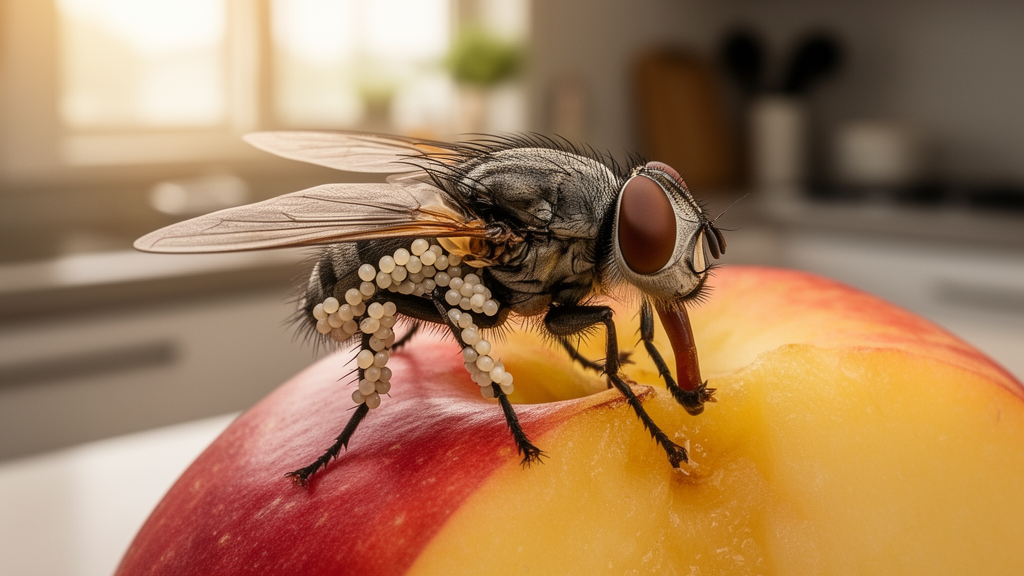
House flies are notorious visitors to filth, but how many parasite eggs do they actually pick up and carry? A controlled laboratory study now offers some of the clearest numbers yet. Researchers exposed 48 house flies (Musca domestica) to faeces spiked with eggs of two parasitic worms, the large roundworm Ascaris suum and the beef tapeworm Taenia saginata, and then counted exactly where the eggs ended up on the insects. The findings, published in Parasites & Vectors, show that most flies acquired helminth eggs within hours, and that the vast majority of those eggs were swallowed rather than stuck to the body.
The experiment was designed to mimic favourable transmission conditions. Forty-eight flies were allocated to eight cages, each containing faeces from non-human primates dosed with 10,000 A. suum eggs and 5,000 T. saginata eggs per gram. The cages were held at 30 degrees Celsius and 60 percent relative humidity, conditions that support fly activity. After three hours of exposure, the researchers recovered and microscopically counted eggs from two compartments of each fly: the exoskeleton, representing contamination on body surfaces, and the digestive tract, representing ingested eggs. They also recorded how long flies in each cage stayed in contact with the faeces and collected eggs from the interior cage surfaces.
The headline result was striking: 75 percent of the flies, 36 of 48, carried at least one helminth egg after the brief exposure window. In total, the researchers recovered 227 eggs from the insects. But the distribution of those eggs matters as much as the total. Only four flies had eggs on their exoskeletons, amounting to just five eggs, while 33 flies carried eggs in their digestive tracts, accounting for 222 eggs. Egg presence and median egg counts were both significantly higher in the gut than on the outer body, pointing to ingestion as the dominant route by which house flies pick up helminth eggs under these conditions.
The two parasite species did not fare equally on or in the flies. Taenia saginata eggs were detected more often and in greater numbers, found in 33 flies with 181 eggs recovered, compared with 20 flies and 46 eggs for Ascaris suum. The study reports this contrast but was not designed to establish the mechanisms behind it.
Sex also made a difference for one of the two parasites. Female flies showed significantly increased presence and counts of A. suum eggs in the digestive tract, with 13 of 21 females carrying 35 eggs, compared with 5 of 27 males carrying 9 eggs. For T. saginata, however, the sexes were comparable: females carried 103 eggs across 14 of 21 flies, while males carried 75 eggs across 17 of 27 flies. The study reports these associations without identifying their cause.
Contamination was not confined to the flies themselves. Across the eight cages, the researchers recovered 65 eggs from the interior cage surfaces, including 17 A. suum and 48 T. saginata eggs. Fly contact durations with the faeces ranged widely, from 29 to 207 minutes at the cage level, a reminder that even within controlled conditions, behaviour varies considerably between groups and shapes how much exposure each fly receives.
What do these numbers mean for human and animal health? House flies have long been suspected of mechanically transmitting faecal-borne helminth diseases, carrying infective stages on their bodies or in their guts from faeces to food and surfaces. This study confirms the first link in that chain: under favourable laboratory conditions, flies readily acquire helminth eggs, and they do so primarily by swallowing them. The emphasis on ingested eggs shifts attention from the often-cited image of flies contaminating surfaces with their feet and body hairs toward their digestive tract as the main egg reservoir.
At the same time, the authors are explicit about the limits of what this experiment shows. A three-hour exposure to heavily spiked faeces is a best-case scenario, and the study does not demonstrate that flies actually deposit viable eggs onto relevant surfaces afterwards, nor how long eggs remain attached or retained. Clarifying the flies’ real contribution to disease transmission will require future research on the duration of egg carriage and the subsequent deposition of ingested eggs, as well as field studies assessing the significance of mechanical transmission under natural conditions.
Those caveats aside, the work provides a quantified foundation for a question that has often lacked direct measurement. With three-quarters of exposed flies carrying eggs and more than 97 percent of recovered eggs located internally, the study reframes the house fly less as a flying contamination source on its surface and more as a potential internal courier of parasite eggs, one whose onward role now needs to be tested in the field rather than assumed in the laboratory.
Subject of Research: Experimental assessment of Ascaris suum and Taenia saginata egg carriage by house flies
Article Title: Assessment of helminth egg carriage by house flies following experimental exposure to Ascaris suum and Taenia saginata eggs
Article References: De Bock, S., Levecke, B., & Gabriël, S. (2026). Assessment of helminth egg carriage by house flies following experimental exposure to Ascaris suum and Taenia saginata eggs. Parasites & Vectors. https://doi.org/10.1186/s13071-026-07753-y
Image Credits: AI Generated
DOI: 10.1186/s13071-026-07753-y
Keywords: house flies, Musca domestica, helminth eggs, Ascaris suum, Taenia saginata, mechanical transmission, parasitology, digestive tract, exoskeleton, faecal-borne disease, experimental exposure, Assessment
Cite Scienmag News
Drew Townsend. (October 23, 2026). House Flies Swallow More Parasite Eggs Than They Carry on Their Bodies. Scienmag. https://scienmag.com/house-flies-swallow-more-parasite-eggs-than-they-carry-on-their-bodies/
Drew Townsend. "House Flies Swallow More Parasite Eggs Than They Carry on Their Bodies." Scienmag, 23 October 2026, https://scienmag.com/house-flies-swallow-more-parasite-eggs-than-they-carry-on-their-bodies/. Accessed 23 October 2026.
Drew Townsend. "House Flies Swallow More Parasite Eggs Than They Carry on Their Bodies." Scienmag. October 23, 2026. https://scienmag.com/house-flies-swallow-more-parasite-eggs-than-they-carry-on-their-bodies/


