


A black hole built on a spacetime where coordinates refuse to commute turns out to be a study in subtlety. In a theoretical analysis published in The European Physical Journal C, researchers examined a Schwarzschild-like black hole constructed within non-commutative gauge gravity, using a Moyal twist involving the time and polar-angle directions. Their central finding is a striking split: the Hawking temperature and the horizon emerge completely unscathed by the non-commutativity parameter, yet the black hole’s shadow, its radiative output, and its total evaporation lifetime all shift in measurable ways within the model.
Non-commutative geometry is one of several quantum-gravity-motivated frameworks suggesting that distances cannot be resolved below some fundamental scale, typically tied to the Planck length. In such approaches, the coordinates of spacetime satisfy an algebra in which their commutator is not zero but an antisymmetric tensor, whose components encode the scale and structure of the deformation. When gravity is brought into this picture, the deformation is commonly implemented through the Seiberg–Witten map, which deforms the symmetry content of the geometry while preserving gauge consistency. Starting from a de Sitter-type group and mapping it onto the Poincaré group, earlier work by Chaichian and collaborators produced a Schwarzschild-like solution reflecting these corrections.
A crucial ingredient of the new study is a corrected construction procedure. A recent reassessment demonstrated that the original method for building black hole solutions in non-commutative gauge theory was incomplete, omitting a necessary contribution in the non-commutative sector. That omission propagated into the tetrad sector, modifying the vierbein fields and, consequently, the metric components themselves. For diagonal metrics, the corrected procedure yields three distinct Schwarzschild-like solutions depending on the choice of Moyal twist. Only one of these, the twist involving the time and angle directions, leads to a well-defined surface gravity, which is why the authors adopted precisely that configuration. Without a well-defined surface gravity, quantities such as thermodynamic functions, evaporation lifetime, and emission rate cannot be consistently determined.
The resulting geometry carries corrections of second order in the non-commutativity parameter in every metric component, and the twist explicitly breaks the original spherical symmetry of the spacetime. Nevertheless, two features survive untouched. The event horizon remains fixed at its classical radius, and the surface gravity, evaluated at the horizon, reduces exactly to its Schwarzschild value because the correction proportional to the square of the deformation parameter drops out identically. Since the Hawking temperature is tied directly to the surface gravity, the temperature also coincides with that of an ordinary Schwarzschild black hole at the perturbative order considered. The authors are careful to note that this cancellation is established only through second order; whether it persists at fourth order remains an open question, because the underlying geometry has only been constructed to second order.
Particle creation was then analyzed for both bosonic and fermionic fields using two complementary techniques. The first is the tunneling method, in which the geometry is recast into a Painlevé–Gullstrand-type form that is regular across the horizon, and the emission probability is governed by the imaginary part of the particle’s action along a classically forbidden trajectory. Energy conservation and backreaction are incorporated by letting the black hole mass decrease as the escaping quantum carries energy away. The second is the near-horizon method, which solves the curved-spacetime Klein–Gordon equation for scalars and the Dirac equation for spinors in a semiclassical WKB approximation on a fixed background.
The outcome is remarkably clean. In the tunneling calculation, the correction to the radial integrand contributes no pole residue at the instantaneous horizon, so the emission probability acquires no dependence on the non-commutativity parameter. Both the bosonic and fermionic exponents take the same form, containing a standard thermal term plus a nonthermal correction proportional to the square of the emitted energy, which arises purely from the backreaction prescription and disappears when the emitted energy is small compared with the black hole mass. The occupation numbers differ only through the statistical sign in the denominator, Bose–Einstein for bosons and Fermi–Dirac for fermions. The near-horizon calculation independently confirms the cancellation: the second-order corrections to the two metric derivatives that determine the surface gravity are equal in magnitude and opposite in sign, so their product is uncorrected.
Where the deformation does leave fingerprints is in the way the black hole absorbs and emits radiation at high frequencies. The photon shadow of this axisymmetric spacetime is not circular: for an observer in the equatorial plane, the horizontal and vertical intercepts of the shadow boundary receive different second-order corrections. The equatorial shadow radius expands as the classical value plus a positive correction proportional to the square of the deformation parameter. Through the geometric-optics limit, this enlarged critical impact parameter translates into a larger effective absorption cross section. Because the Hawking temperature is unchanged, the enhanced emission rate stems entirely from this geometric modification: the spectrum differs from its Schwarzschild counterpart by a multiplicative factor that raises the amplitude without shifting the frequency of the spectral maximum.
These changes feed directly into the evaporation history. Using a Stefan–Boltzmann-type mass-loss relation with the corrected absorption cross section, the authors integrate the mass-loss equation analytically and find that increasing the non-commutativity parameter shortens the total evaporation time, a trend consistent with other non-commutative black hole models. Within the perturbative semiclassical regime, neither the temperature nor the mass-loss rate vanishes at a finite positive mass, so no finite-mass evaporation endpoint is found at this order. The authors stress that this does not constitute a proof that no stable remnant exists: the approximation requires the square of the deformation parameter divided by the mass squared to be much less than one, and it breaks down precisely when the mass becomes comparable to the non-commutativity scale. The extrapolation to zero final mass is therefore a formal extension of the semiclassical law rather than a statement about the true endpoint of evaporation.
Finally, the team placed observational bounds on the deformation parameter using classical solar-system tests: the perihelion precession of Mercury, the deflection of light grazing the solar limb, and the Shapiro time delay measured by the Cassini mission. In this geometry, the corrections are suppressed by large area quantities, the orbital angular momentum of Mercury, the solar radius, or a combination involving an astronomical unit, which weakens the constraints compared with other scenarios. The strongest bound comes from Mercury’s perihelion precession, limiting the square of the parameter to about 1.862 times ten to the ten square meters, followed by light deflection and then the Shapiro delay. Since the non-commutativity scale is generally expected to be of the order of the Planck area, roughly ten to the minus seventy square meters, these bounds illustrate how severely solar-system tests struggle to probe quantum-gravity effects directly.
The broader lesson is one of controlled expectations. In this framework, the most iconic quantum feature of a black hole, its Hawking temperature, is robust against the spacetime deformation at the order accessible to calculation, while observable imprints migrate instead to optical and thermodynamic quantities such as the shadow radius, the luminosity, and the evaporation lifetime. The authors point to primordial and microscopic black holes as the more natural arena for such effects, since their characteristic scales may approach the non-commutativity scale during evaporation, potentially leaving imprints on primordial black hole populations. That regime, however, lies beyond the reach of the perturbative approximation employed here and remains an open frontier connecting quantum gravity, astrophysics, and cosmology.
Subject of Research: Quantum features of a non-commutative gauge-gravity Schwarzschild black hole, including Hawking radiation, evaporation, and solar-system bounds on the non-commutativity parameter
Article Title: Quantum features of a non-commutative Schwarzschild black hole
Article References: Araújo Filho, A. A., Lobo, I. P., Barros, P. H. M., & Queiroz, A. R. (2026). Quantum features of a non-commutative Schwarzschild black hole. The European Physical Journal C, 86(10), Article 1217. https://doi.org/10.1140/epjc/s10052-026-16471-9
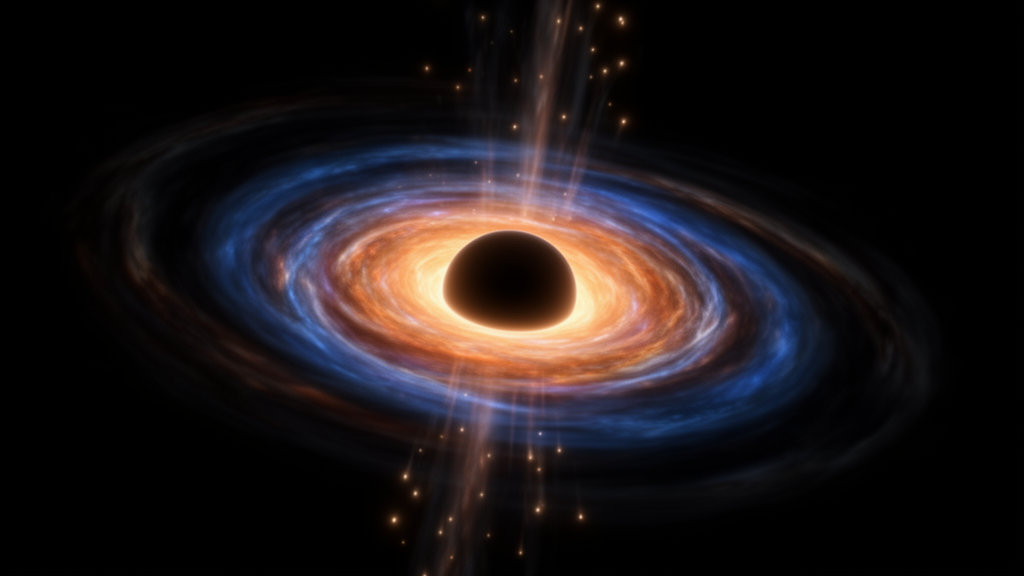
Image Credits: AI Generated
DOI: 10.1140/epjc/s10052-026-16471-9
Keywords: black holes, non-commutative geometry, Hawking radiation, quantum gravity, Schwarzschild black hole, Moyal twist, Seiberg-Witten map, black hole evaporation, surface gravity, solar-system tests, theoretical physics, Quantum
Cite Scienmag News
Grant Pearson. (October 23, 2026). Quantum Spacetime Twist Leaves Black Hole Temperature Untouched but Speeds Up Evaporation. Scienmag. https://scienmag.com/quantum-spacetime-twist-leaves-black-hole-temperature-untouched-but-speeds-up-evaporation/
Grant Pearson. "Quantum Spacetime Twist Leaves Black Hole Temperature Untouched but Speeds Up Evaporation." Scienmag, 23 October 2026, https://scienmag.com/quantum-spacetime-twist-leaves-black-hole-temperature-untouched-but-speeds-up-evaporation/. Accessed 23 October 2026.
Grant Pearson. "Quantum Spacetime Twist Leaves Black Hole Temperature Untouched but Speeds Up Evaporation." Scienmag. October 23, 2026. https://scienmag.com/quantum-spacetime-twist-leaves-black-hole-temperature-untouched-but-speeds-up-evaporation/


