

Thursday, October 22, 2026
Science
No Result
View All Result
  • Login
  • HOME
  • SCIENCE NEWS
  • CONTACT US
  • HOME
  • SCIENCE NEWS
  • CONTACT US
No Result
View All Result
Scienmag
No Result
View All Result
Home Science News Earth Science

Modeled Seismic Interaction Alters Fragility of Adjacent Masonry Building Clusters

October 22, 2026
in Earth Science
Violet Maxwell
By Violet Maxwell Scienmag Editorial Profile - Natural Hazards
Reading Time: 3 mins read
0
Modeled Seismic Interaction Alters Fragility of Adjacent Masonry Building Clusters

Modeled Seismic Interaction Alters Fragility of Adjacent Masonry Building Clusters

65
SHARES
587
VIEWS
Share on FacebookShare on Twitter
ADVERTISEMENT

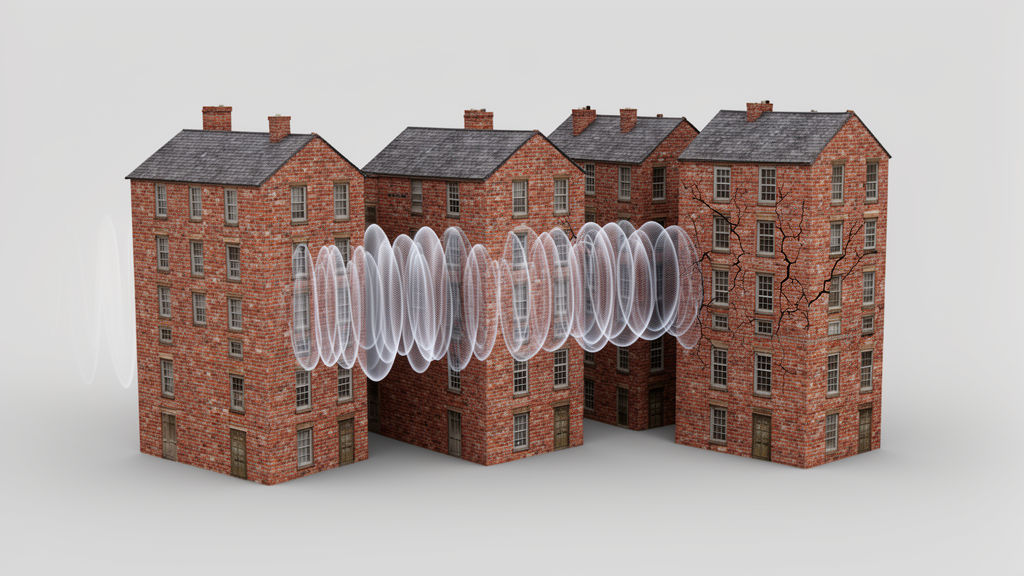
A computational study of low-rise unreinforced masonry buildings found that seismic interaction among adjacent units can protect a weaker building while making a stronger neighbor more fragile. The model also showed that failure could begin in the most vulnerable unit and develop into progressive collapse affecting adjacent structures that had remained stable. These results indicate that estimating the seismic fragility of such buildings as isolated structures can produce unrealistic demands and fragility estimates, particularly when neighboring units differ in strength and stiffness.

Unreinforced masonry buildings are prevalent in historic urban centers and often form clusters of independent structural units built directly next to one another. Conventional seismic performance assessments commonly analyze each building as though it were isolated, overlooking the interaction that can occur between neighboring structures. The research examined this coupling by modeling three distinct unreinforced masonry archetypes and arranging them into seven clusters composed of either two or three units. The configurations made it possible to evaluate the influence of each building’s position and the differences in strength and stiffness between adjacent structures.

To represent the masonry structures, the researchers used a three-dimensional equivalent-frame approach capable of capturing both in-plane and out-of-plane wall behavior. They first developed fragility curves for each archetype when treated as an isolated structural unit. Those curves were derived from nonlinear response-history analyses using a suite of actual ground motions and the multiple stripe analysis methodology. The researchers then constructed fragility curves for buildings located within the two- and three-unit clusters and compared them with the corresponding isolated estimates. This comparison quantified how the modeled seismic interaction changed the estimated likelihood of different damage states across the range of ground-motion inputs represented in the analyses.

The effects depended on the configuration rather than following a single uniform pattern. Units with lower in-plane stiffness and lower strength capacity could benefit from the support of stronger neighbors. That same interaction increased the fragility of the stronger buildings, and the increase became more pronounced as the stiffness disparity between neighboring units grew. Position also influenced the response of individual buildings, but the modeled collapse sequence consistently began with the most vulnerable unit, regardless of whether it occupied an end or interior position. Failure of that unit could trigger progressive collapse that compromised adjacent, otherwise stable structures, showing that a building’s properties and position alone did not determine its behavior during shaking.

The findings are numerical estimates for the selected low-rise masonry archetypes and cluster arrangements, not direct observations of damage following an earthquake. Within the scope of the models, however, the results provide quantitative evidence that assessing adjacent unreinforced masonry buildings in isolation is unconservative. The authors conclude that their seismic fragility cannot be adequately quantified in isolation and that realistic performance assessments for historic urban centers require cluster-level models that explicitly represent configuration, differences in structural properties and mutual interaction. The study thus shifts the assessment from a set of unrelated individual buildings to a system in which the seismic response and possible collapse sequence of one unit can affect its neighbors.

Subject of Research: Modeled seismic fragility of interacting low-rise unreinforced masonry building clusters

Article Title: Impact of pounding interaction on the seismic fragility of low-rise adjacent unreinforced masonry buildings

Article References: Gallardo, J. A., Tomić, I., Palazzi, N. C., de la Llera, J. C., & Beyer, K. (2026). Impact of pounding interaction on the seismic fragility of low-rise adjacent unreinforced masonry buildings. Bulletin of Earthquake Engineering. https://doi.org/10.1007/s10518-026-02722-3

Image Credits: AI Generated

DOI: 10.1007/s10518-026-02722-3

Keywords: unreinforced masonry, seismic fragility, building clusters, pounding interaction, progressive collapse, earthquake engineering, structural dynamics, nonlinear analysis, masonry walls, ground motions, Impact, pounding

Cite Scienmag News

Violet Maxwell. (October 22, 2026). Modeled Seismic Interaction Alters Fragility of Adjacent Masonry Building Clusters. Scienmag. https://scienmag.com/modeled-seismic-interaction-alters-fragility-of-adjacent-masonry-building-clusters/


Violet Maxwell. "Modeled Seismic Interaction Alters Fragility of Adjacent Masonry Building Clusters." Scienmag, 22 October 2026, https://scienmag.com/modeled-seismic-interaction-alters-fragility-of-adjacent-masonry-building-clusters/. Accessed 22 October 2026.

Violet Maxwell. "Modeled Seismic Interaction Alters Fragility of Adjacent Masonry Building Clusters." Scienmag. October 22, 2026. https://scienmag.com/modeled-seismic-interaction-alters-fragility-of-adjacent-masonry-building-clusters/

Tags: building clusterscomputational modeling of adjacent masonry unitsEarthquake engineeringeffects of structural coupling on seismic demand estimatesfragility curve development for masonry archetypesground motionsimpactimpact ofinfluence of building position and stiffness differences on seismic responsemasonry wallsmodeling of in-plane and out-of-plane wall behavior in seismic analysisnonlinear analysispoundingpounding interactionprogressive collapseprogressive collapse in masonry structuresseismic fragilityseismic interaction in masonry building clustersseismic protection and vulnerability of neighboring buildingsStructural dynamicsstructural fragility of historic urban masonry buildingsthree-dimensional equivalent-frame modeling for masonry wallsunreinforced masonryunreinforced masonry seismic performance assessment
Share26Tweet16
Previous Post

Cell study links resveratrol glucoside to mitochondrial and chromatin changes in senescence

Next Post

Gudan Wan reduced liver injury in mouse model of MASH

Related Posts

Review maps context-specific acoustic design for Nigerian public buildings
Earth Science

Review maps context-specific acoustic design for Nigerian public buildings

October 22, 2026
Arctic Fjord Sediments Yield Putative Mercury-Resistance DNA
Earth Science

Arctic Fjord Sediments Yield Putative Mercury-Resistance DNA

October 22, 2026
Breast milk testing finds BPA substitutes nearly as frequent as BPA
Earth Science

Breast milk testing finds BPA substitutes nearly as frequent as BPA

October 22, 2026
Multiple physical constraints improve groundwater contaminant model predictions
Earth Science

Multiple physical constraints improve groundwater contaminant model predictions

October 22, 2026
India’s Growth and Inflation Linked to Higher Long-Run CO₂ Emissions
Earth Science

India’s Growth and Inflation Linked to Higher Long-Run CO₂ Emissions

October 22, 2026
Professional perspectives identify sensory priorities for neuro-inclusive Nigerian secondary schools
Earth Science

Professional perspectives identify sensory priorities for neuro-inclusive Nigerian secondary schools

October 22, 2026
Next Post
Gudan Wan reduced liver injury in mouse model of MASH

Gudan Wan reduced liver injury in mouse model of MASH

  • Mothers who receive childcare support from maternal grandparents show more optimized

    Mothers who receive childcare support from maternal grandparents show more parental warmth, finds NTU Singapore study

    27656 shares
    Share 11059 Tweet 6912
  • University of Seville Breaks 120-Year-Old Mystery, Revises a Key Einstein Concept

    1061 shares
    Share 424 Tweet 265
  • Bee body mass, pathogens and local climate influence heat tolerance

    682 shares
    Share 273 Tweet 171
  • Researchers record first-ever images and data of a shark experiencing a boat strike

    546 shares
    Share 218 Tweet 137
  • Groundbreaking Clinical Trial Reveals Lubiprostone Enhances Kidney Function

    531 shares
    Share 212 Tweet 133
Science

Embark on a thrilling journey of discovery with Scienmag.com—your ultimate source for cutting-edge breakthroughs. Immerse yourself in a world where curiosity knows no limits and tomorrow’s possibilities become today’s reality!

RECENT NEWS

  • scDIG software study enables interactive single-cell population gating
  • Gudan Wan reduced liver injury in mouse model of MASH
  • Modeled Seismic Interaction Alters Fragility of Adjacent Masonry Building Clusters
  • Cell study links resveratrol glucoside to mitochondrial and chromatin changes in senescence

Categories

  • Agriculture
  • Anthropology
  • Archaeology
  • Athmospheric
  • Biology
  • Biotechnology
  • Blog
  • Bussines
  • Cancer
  • Chemistry
  • Climate
  • Earth Science
  • Editorial Policy
  • Marine
  • Mathematics
  • Medicine
  • Pediatry
  • Policy
  • Psychology & Psychiatry
  • Science Education
  • Science News
  • Social Science
  • Space
  • Technology and Engineering

Subscribe to Blog via Email

Enter your email address to subscribe to this blog and receive notifications of new posts by email.

Join 5,151 other subscribers

© 2025 Scienmag - Science Magazine

Welcome Back!

Login to your account below

Forgotten Password?

Retrieve your password

Please enter your username or email address to reset your password.

Log In
No Result
View All Result
  • HOME
  • SCIENCE NEWS
  • CONTACT US

© 2025 Scienmag - Science Magazine

Discover more from Science

Subscribe now to keep reading and get access to the full archive.

Continue reading