


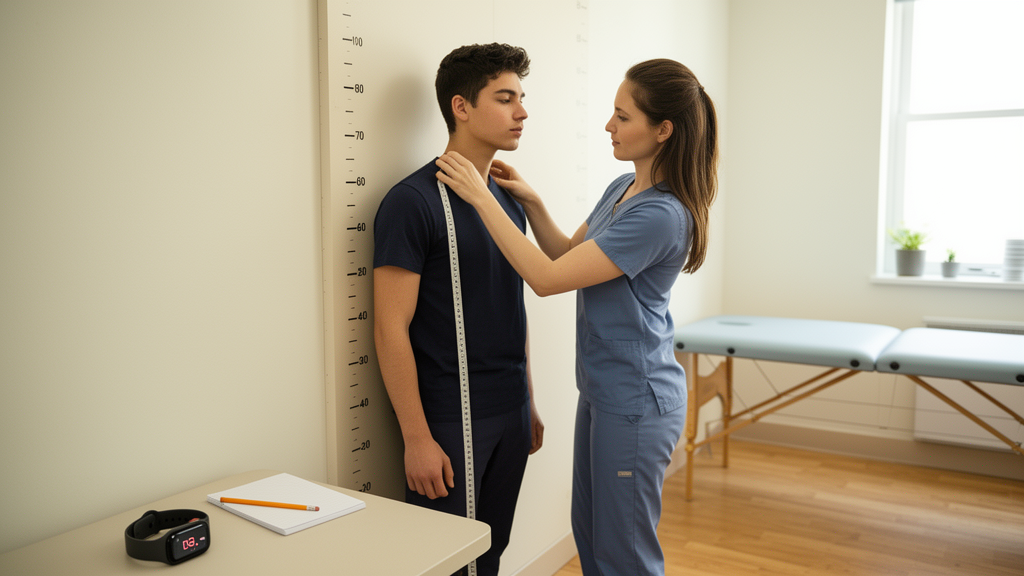
A cross-sectional study of 132 healthy physiotherapy students found no statistically significant differences in objectively measured trunk length, thoracic kyphosis or lumbar lordosis between third- and fourth-year cohorts, despite marked differences in their school-based standing and sitting patterns. Instead, trait anxiety and poorer sleep quality were independently associated with shorter trunk length after adjustment for anthropometric characteristics, academic year, school-based exposure, sleep quality and physical activity. An exploratory analysis also detected an indirect statistical association between emotional exhaustion and trunk length through sleep quality, but the design cannot establish causation or temporal order.
The researchers assessed students face to face between January 2024 and January 2026 at the Faculty of Physical Therapy and Rehabilitation in Ankara. Of 136 volunteers who provided written informed consent, 132 met the eligibility criteria: 70 were third-year students and 62 were fourth-year students. Volunteers also had to report no pain at the time of assessment under the Extended Nordic Musculoskeletal Questionnaire. Exclusion criteria included spinal or extremity pain during the preceding three months, physician-diagnosed scoliosis, limb-length discrepancy, congenital or severe deformities, previous spinal surgery, inflammatory, infectious or neoplastic conditions, neurological or cognitive disorders, cardiorespiratory disease, current use of antidepressant or attention-enhancing medication, and menstrual irregularities. The investigators followed the STROBE reporting checklist, and the protocol was prospectively registered on ClinicalTrials.gov.
Spinal surface geometry was measured non-invasively with the DIERS Formetric 4D rasterstereography system. Participants removed upper-body clothing and jewelry, stood on a predefined line two metres from the device, faced away from the examiner and assumed their usual relaxed standing posture before remaining motionless. The equipment captured the surface topography of the back and reconstructed a three-dimensional model of the trunk, with software automatically identifying anatomical landmarks. Investigators derived three outcomes: trunk length between the vertebral prominens and the centre point between the sacral dimples, the maximum kyphotic angle between the cervicothoracic and thoracolumbar transition points, and the maximum lordotic angle between the thoracolumbar and lumbosacral transition points. All assessments occurred in the morning and used the same device and standardized procedure, although the exact assessment time, hydration status and recent physical loading were not standardized or controlled.
Third- and fourth-year students differed clearly in several non-spinal characteristics. Fourth-year students reported longer school-based standing and shorter school-based sitting durations, with both differences reported at p < 0.001. They also recorded lower trait-anxiety and burnout scores and more walking activity. By contrast, the three objective spinal measurements did not differ significantly between the cohorts. The kyphotic angle was numerically lower among fourth-year students but narrowly missed the threshold for statistical significance at p = 0.051. Thus, the clearest difference in the students’ learning environment—greater exposure to clinical training rather than predominantly classroom-based study—did not translate into a demonstrable between-year difference in the measured spinal parameters.
Trunk length nevertheless showed several adjusted statistical associations. In the first hierarchical regression model, height had a particularly strong positive association with trunk length, while body weight had a negative association. Academic year and time spent standing and sitting at school were not independently associated with trunk length after those initial adjustments. Adding psychological variables improved the model’s explanatory power, and higher trait-anxiety scores were associated with shorter trunk length. Adding sleep quality improved the model again: because higher Pittsburgh Sleep Quality Index scores represent poorer sleep, the result indicated that poorer sleep quality was associated with shorter trunk length. In the fully adjusted model, trait anxiety had a standardized coefficient of −0.148 and sleep quality a coefficient of −0.139. Together with the anthropometric, academic-year, school-exposure and physical-activity variables, the model explained 68.4% of trunk-length variance.
Physical activity did not add a statistically significant amount of explanatory power once the other factors were included. A similar pattern appeared for the spinal angles. The initial model explained 14.4% of kyphotic-angle variance, with academic year and body weight contributing to that model, but anxiety, burnout, sleep and physical activity did not substantially improve prediction. For lordotic angle, the initial model explained 28.1% of the variance, with age, weight and height contributing, while the later additions of psychophysiological measures, sleep and activity also failed to produce a significant improvement. The clearest adjusted relationships with trunk length therefore concerned trait anxiety and sleep, whereas the two angle measures were more closely associated with anthropometric and basic workload-related variables.
The exploratory mediation analysis produced a more limited result concerning emotional exhaustion. Using sleep quality as the proposed mediator, the researchers estimated an indirect association with trunk length of B = −0.300, with a bias-corrected 95% bootstrap confidence interval from −0.686 to −0.062 and p = 0.048. No significant direct or total association between emotional exhaustion and trunk length was detected, and no significant indirect effects appeared for state anxiety, trait anxiety, depersonalization or personal accomplishment. The analysis used 5,000 bootstrap resamples and 123 complete cases, with adjustment for class group, age, weight, height, total physical activity and standing and sitting durations. Because all variables were assessed cross-sectionally, the result cannot show that emotional exhaustion impaired sleep and that impaired sleep shortened the trunk, or that trunk length influenced either of the other measures. It is an adjusted statistical pathway that requires longitudinal testing.
The sleep result is compatible with evidence cited in the study that spinal dimensions and intervertebral-disc characteristics vary across daily loading and recovery cycles. Intervertebral discs undergo changes in height and volume as axial compression accumulates and is subsequently relieved, while sleep is a restorative process during which disc rehydration and partial restoration of spinal height can occur. Psychosocial strain has also been linked to impaired sleep continuity and depth, and trait anxiety represents a generally persistent psychological characteristic rather than a temporary state. These observations offer possible mechanisms, but the present study did not measure disc hydration, within-day spinal-height changes or the sequence of events, so it did not directly test any proposed biological pathway.
The use of three-dimensional objective assessment was one of the study’s methodological strengths. Earlier research in healthcare students has often relied on symptoms, observational posture tools such as the Rapid Entire Body Assessment and Rapid Upper Limb Assessment, or clinical scales such as the New York Posture Scale. Rasterstereography provided a radiation-free, non-invasive measure of trunk surface geometry and allowed investigators to examine subtle spinal characteristics alongside psychological burden, sleep, physical activity and educational exposure. The results suggest a reason to consider student spinal health through more than ergonomics alone: objective posture measures did not separate the academic years, while psychological and recovery-related variables were associated with one measured spinal parameter. The authors propose that educational strategies may benefit from considering biomechanics, psychological well-being and sleep recovery as interacting dimensions, but the study neither tested an educational intervention nor demonstrated improved student health outcomes.
Several limitations constrain how far the findings can be generalized. The cross-sectional design prevents causal and temporal conclusions; self-reported anxiety, burnout, sleep, physical activity and school-based exposure may contain reporting bias; and physical exposures outside the educational setting were not comprehensively measured. The study involved one institution, and the academic-year groups differed in sex distribution. Although the regressions accounted for major anthropometric and educational variables, other potentially relevant factors were not fully controlled. Complete-case regression analyses used 123 participants because a small amount of data were missing, and no prior sample-size calculation was performed. A sensitivity analysis based on the final model estimated a minimum detectable effect size of approximately f² = 0.16. Variations in exact assessment time, hydration, recent loading and menstrual-cycle phase may also have influenced the spinal measurements. Larger longitudinal studies and educational-intervention trials would be needed to determine whether the observed associations persist over time, change during training or respond to changes in student well-being practices.
Subject of Research: Associations of sleep, anxiety and burnout with objective spinal parameters in physiotherapy students
Article Title: Academic-year differences and psychophysiological associations with objective spinal parameters in physiotherapy students: a cross-sectional DIERS formetric 4D study
Article References: Numanoğlu, E. A., Arık, A., Pamukçu, E., Tanımlı, Y. G., & Ergit, B. (2026). Academic-year differences and psychophysiological associations with objective spinal parameters in physiotherapy students: a cross-sectional DIERS formetric 4D study. BMC Medical Education, 26(1), Article 1703. https://doi.org/10.1186/s12909-026-10505-2
Image Credits: AI Generated
DOI: 10.1186/s12909-026-10505-2
Keywords: physiotherapy students, trunk length, sleep quality, trait anxiety, emotional exhaustion, spinal posture, rasterstereography, academic training, cross-sectional study, Academic-year, differences, psychophysiological
Cite Scienmag News
Glenn Wilkins. (October 22, 2026). Sleep and anxiety linked to trunk length in physiotherapy students. Scienmag. https://scienmag.com/sleep-and-anxiety-linked-to-trunk-length-in-physiotherapy-students/
Glenn Wilkins. "Sleep and anxiety linked to trunk length in physiotherapy students." Scienmag, 22 October 2026, https://scienmag.com/sleep-and-anxiety-linked-to-trunk-length-in-physiotherapy-students/. Accessed 22 October 2026.
Glenn Wilkins. "Sleep and anxiety linked to trunk length in physiotherapy students." Scienmag. October 22, 2026. https://scienmag.com/sleep-and-anxiety-linked-to-trunk-length-in-physiotherapy-students/


