


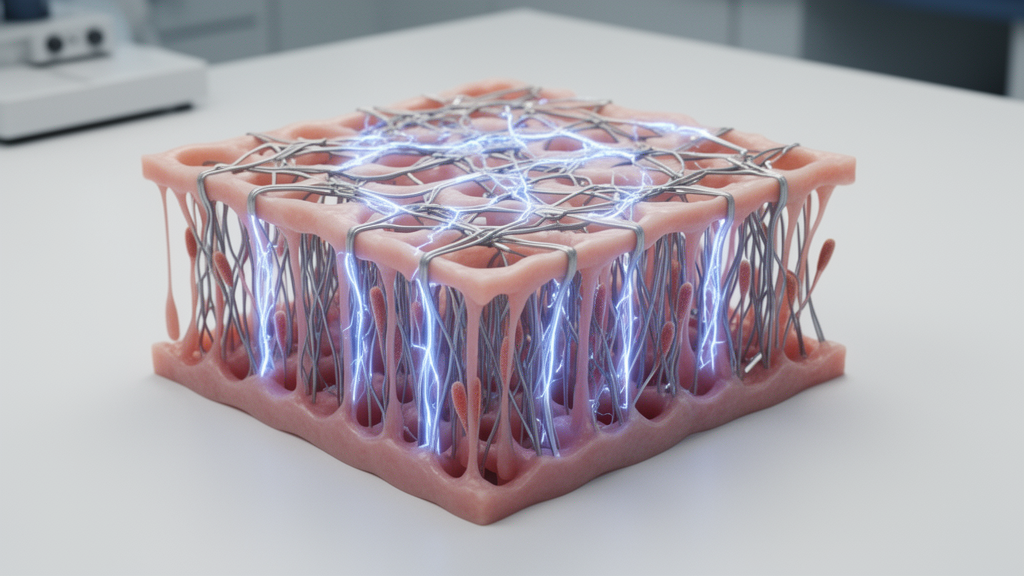
Electroactive biomaterial scaffolds could support tissue regeneration, but their biological performance depends on the combined effects of composition, architecture, interfacial chemistry, electrical behavior, mechanical compliance, biodegradation and stimulation rather than on conductivity alone. The finding comes from a review examining how these linked design features relate to cellular responses and to the practical conditions required for translating scaffold designs into regenerative applications.
The review organizes electroactive scaffolds within a structure–property–function framework. It considers conducting polymers, piezoelectric composites, iono-active hydrogels, carbon-based nanomaterials and hybrid systems in relation to charge transport, biocompatibility, biodegradability and electrochemical stability. Relevant biological outcomes include cell adhesion, proliferation, lineage differentiation, ion-channel activity, cytoskeletal organization and gene expression. The review also examines preclinical evidence and the status of clinical trials, while identifying manufacturing constraints, financial considerations and possible regulatory classifications as parts of the translation challenge.
Fabrication methods receive separate attention because the review assesses electrospinning, additive manufacturing, lithographic patterning and hydrogel hybridization according to replication, scalability and tissue-specific design requirements. The analysis does not establish that any one fabrication approach is superior across all tissues. Instead, it treats scaffold manufacture as a route for controlling material architecture and properties, and it connects those choices with the material’s electrochemical and mechanical behavior. It also evaluates how the mode of electrical stimulation can influence cell outcomes, including effects associated with ion-channel activity and gene expression.
The review presents electroactive scaffolds as promising but not yet ready for unrestricted clinical translation. It identifies a need for more rigorous quantitative reporting, standardized scaffold fabrication protocols and demonstrations of long-term safety. These requirements reflect the review’s broader conclusion: biological performance cannot be attributed simply to the presence of an electrically active component. Material composition, scaffold architecture, interfacial chemistry, conductivity, mechanical compliance, degradation behavior and stimulation must be considered together when assessing how a scaffold performs in a specific tissue context.
Subject of Research: How electroactive scaffold properties influence cellular responses in tissue regeneration
Article Title: Structure–property relationships and biological performance of electroactive biomaterial scaffolds for tissue regeneration
Article References: Haggam, R. A., Devarajan, Y., Jayabal, R., Kumar, M., Thimmappa, A. D., Nanda, S., Madhusudhan, M., Pradhan, P., & Perumal, A. (2026). Structure–property relationships and biological performance of electroactive biomaterial scaffolds for tissue regeneration. BioMedical Engineering OnLine. https://doi.org/10.1186/s12938-026-01625-3
Image Credits: AI Generated
DOI: 10.1186/s12938-026-01625-3
Keywords: electroactive biomaterials, tissue regeneration, scaffold design, conducting polymers, piezoelectric composites, ion-active hydrogels, carbon nanomaterials, electrospinning, additive manufacturing, clinical translation, Structure, property
Cite Scienmag News
Gregory Coleman. (October 22, 2026). Structure–property relationships and biological performance of electroactive biomaterial scaffolds for tissue regeneration. Scienmag. https://scienmag.com/structure-property-relationships-and-biological-performance-of-electroactive-biomaterial-scaffolds-for-tissue-regeneration/
Gregory Coleman. "Structure–property relationships and biological performance of electroactive biomaterial scaffolds for tissue regeneration." Scienmag, 22 October 2026, https://scienmag.com/structure-property-relationships-and-biological-performance-of-electroactive-biomaterial-scaffolds-for-tissue-regeneration/. Accessed 22 October 2026.
Gregory Coleman. "Structure–property relationships and biological performance of electroactive biomaterial scaffolds for tissue regeneration." Scienmag. October 22, 2026. https://scienmag.com/structure-property-relationships-and-biological-performance-of-electroactive-biomaterial-scaffolds-for-tissue-regeneration/


