

Thursday, October 22, 2026
Science
No Result
View All Result
  • Login
  • HOME
  • SCIENCE NEWS
  • CONTACT US
  • HOME
  • SCIENCE NEWS
  • CONTACT US
No Result
View All Result
Scienmag
No Result
View All Result
Home Science News Cancer

ANKRD11 restrains CD8+ T cells in hepatitis B and cancer models

October 22, 2026
in Cancer
Kristina Jarvis
By Kristina Jarvis Scienmag Editorial Profile - Infectious Disease Medicine
Reading Time: 2 mins read
0
ANKRD11 restrains CD8+ T cells in hepatitis B and cancer models

ANKRD11 restrains CD8+ T cells in hepatitis B and cancer models

65
SHARES
587
VIEWS
Share on FacebookShare on Twitter
ADVERTISEMENT

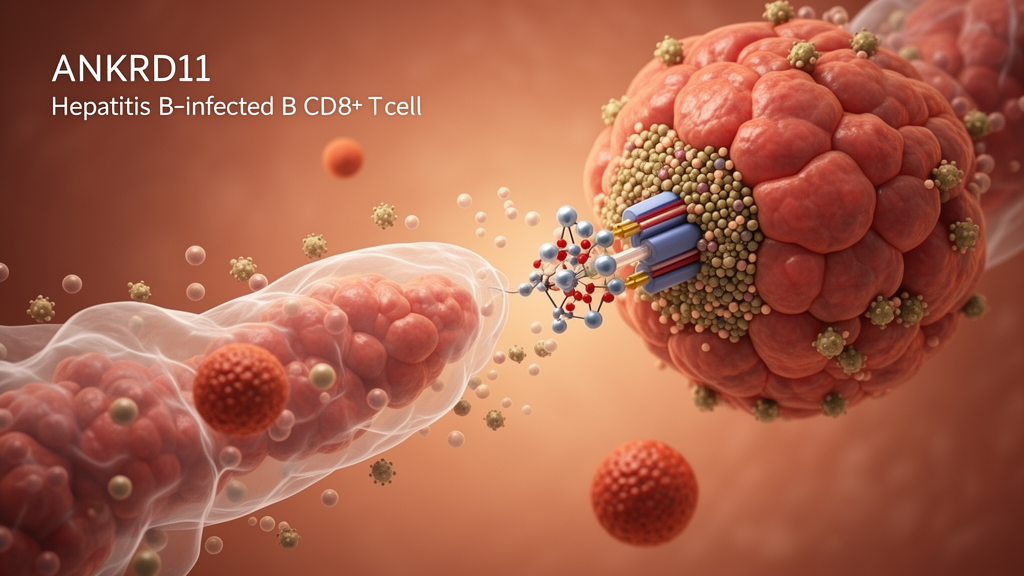
Researchers have identified ANKRD11 as a regulator that restrains CD8+ T-cell responses in experimental models of chronic hepatitis B virus infection and cancer. A team led by Zhou Xuyu of the Institute of Microbiology at the Chinese Academy of Sciences, with collaborators from Beijing Ditan Hospital and Capital Medical University, reported that the protein limits the activity of these infection-fighting immune cells by suppressing the AP-1 signaling pathway. The peer-reviewed study, published in Nature Immunology on September 11, found that removing ANKRD11 from T cells enhanced their capacity to respond to infected and cancerous cells in mice.

The work used a mouse model designed to reproduce key features of human immune responses to HBV. Chronic HBV infection affects an estimated 296 million people worldwide and can lead to serious liver disease, including cirrhosis and liver cancer. In the study’s model, CD8+ T cells normally weaken during persistent infection, multiply less effectively and become less able to attack virus-infected cells. The researchers combined whole-genome genetic screening with functional experiments to identify genes that could influence T-cell responses during chronic infection. Ankrd11 was selected for further study because it emerged as a strong candidate and had not previously been characterized as a regulator of this response.

Deleting Ankrd11 specifically in T cells did not measurably impair their development, but it substantially increased their antiviral and antitumor activity. The altered cells produced higher levels of key immune molecules and attacked infected and cancerous cells more effectively. Gene-expression analysis indicated that pathways associated with T-cell function were more readily activated when ANKRD11 was absent. The researchers also found that ANKRD11-deficient T cells were more resistant to signals that normally dampen immune responses. Together, these observations support the conclusion that ANKRD11 acts as a molecular brake on CD8+ T-cell activity, with AP-1 signaling among the pathways restrained by the protein.

In HBV-infected mice, selective removal of Ankrd11 from T cells resulted in more active immune cells within the liver, improved viral clearance and better disease outcomes. Separate experiments in another viral infection model and a cancer model showed that T cells lacking Ankrd11 could better control infection and shrink tumors, including in settings where other treatments had failed. Combining the approach with existing therapies produced a stronger effect in the researchers’ experiments. These findings provide preclinical evidence that targeting ANKRD11 may help restore immune activity in chronic infection and cancer, but the work was conducted in mouse models and does not establish safety or effectiveness in people. Any therapeutic use would require additional studies and clinical evaluation.

Subject of Research: Experimental evidence that ANKRD11 suppresses CD8+ T-cell responses in mouse models of chronic hepatitis B virus infection and cancer

Article Title: Researchers identify ANKRD11 as a brake on T-cell responses to chronic hepatitis B virus and cancer

Article References: Researchers identify ANKRD11 as a brake on T-cell responses to chronic hepatitis B virus and cancer. Original publication (Bibliographic details unavailable.)

Image Credits: AI Generated

DOI: Not provided

Keywords: ANKRD11, CD8+ T cells, hepatitis B virus, AP-1 signaling, antiviral immunity, cancer immunology, mouse models, immune evasion, Researchers, identify, brake, T-cell

Cite Scienmag News

Kristina Jarvis. (October 22, 2026). ANKRD11 restrains CD8+ T cells in hepatitis B and cancer models. Scienmag. https://scienmag.com/ankrd11-restrains-cd8-t-cells-in-hepatitis-b-and-cancer-models/

Kristina Jarvis. "ANKRD11 restrains CD8+ T cells in hepatitis B and cancer models." Scienmag, 22 October 2026, https://scienmag.com/ankrd11-restrains-cd8-t-cells-in-hepatitis-b-and-cancer-models/. Accessed 22 October 2026.

Kristina Jarvis. "ANKRD11 restrains CD8+ T cells in hepatitis B and cancer models." Scienmag. October 22, 2026. https://scienmag.com/ankrd11-restrains-cd8-t-cells-in-hepatitis-b-and-cancer-models/


Tags: ANKRD11ANKRD11 regulation of CD8+ T cell responses in hepatitis B and cancerantiviral immunityAP-1 signalingbrakeCancer immunologyCD8+ T cellsgenetic screening for T-cell response modulators in chronic viral infectionshepatitis B virusidentifyimmune evasionimpact of ANKRD11 deletion on T-cell efficacy against HBV and tumorsmechanisms of immune suppression in chronic hepatitis B and cancer modelsmouse modelsmouse models of human immune response to hepatitispotential therapeutic targeting of ANKRD11 to enhance antiviral and anticancer immunityResearchersrole of ANKRD11 in suppressing immune activity via AP-1 pathwayT-cell
Share26Tweet16
Previous Post

Multiomic map of methylation in Mycoplasma hyorhinis

Next Post

Flume study quantifies dam-break pressure on sloping wet beds

Related Posts

Study identifies correlates of cervical screening uptake in rural Uganda
Cancer

Study identifies correlates of cervical screening uptake in rural Uganda

October 22, 2026
Statins-bevacizumab colorectal cancer study retracted over figure concerns
Cancer

Statins-bevacizumab colorectal cancer study retracted over figure concerns

October 22, 2026
Bariatric Surgery Restores Metabolic and Immune Responses in Obesity
Cancer

Bariatric Surgery Restores Metabolic and Immune Responses in Obesity

October 22, 2026
PSMA-PRED protocol plans biomarker search for lutetium-PSMA treatment response
Cancer

PSMA-PRED protocol plans biomarker search for lutetium-PSMA treatment response

October 22, 2026
Early-onset colorectal cancer shows distinct immune-cell spatial patterns
Cancer

Early-onset colorectal cancer shows distinct immune-cell spatial patterns

October 22, 2026
Remote follow-up after breast biopsy reduces anxiety, not pain
Cancer

Remote follow-up after breast biopsy reduces anxiety, not pain

October 22, 2026
Next Post
Flume study quantifies dam-break pressure on sloping wet beds

Flume study quantifies dam-break pressure on sloping wet beds

  • Mothers who receive childcare support from maternal grandparents show more optimized

    Mothers who receive childcare support from maternal grandparents show more parental warmth, finds NTU Singapore study

    27656 shares
    Share 11059 Tweet 6912
  • University of Seville Breaks 120-Year-Old Mystery, Revises a Key Einstein Concept

    1061 shares
    Share 424 Tweet 265
  • Bee body mass, pathogens and local climate influence heat tolerance

    682 shares
    Share 273 Tweet 171
  • Researchers record first-ever images and data of a shark experiencing a boat strike

    546 shares
    Share 218 Tweet 137
  • Groundbreaking Clinical Trial Reveals Lubiprostone Enhances Kidney Function

    531 shares
    Share 212 Tweet 133
Science

Embark on a thrilling journey of discovery with Scienmag.com—your ultimate source for cutting-edge breakthroughs. Immerse yourself in a world where curiosity knows no limits and tomorrow’s possibilities become today’s reality!

RECENT NEWS

  • Psychotic symptoms and uric acid linked to suicidal ideation in schizophrenia
  • Flume study quantifies dam-break pressure on sloping wet beds
  • ANKRD11 restrains CD8+ T cells in hepatitis B and cancer models
  • Multiomic map of methylation in Mycoplasma hyorhinis

Categories

  • Agriculture
  • Anthropology
  • Archaeology
  • Athmospheric
  • Biology
  • Biotechnology
  • Blog
  • Bussines
  • Cancer
  • Chemistry
  • Climate
  • Earth Science
  • Editorial Policy
  • Marine
  • Mathematics
  • Medicine
  • Pediatry
  • Policy
  • Psychology & Psychiatry
  • Science Education
  • Science News
  • Social Science
  • Space
  • Technology and Engineering

Subscribe to Blog via Email

Enter your email address to subscribe to this blog and receive notifications of new posts by email.

Join 5,151 other subscribers

© 2025 Scienmag - Science Magazine

Welcome Back!

Login to your account below

Forgotten Password?

Retrieve your password

Please enter your username or email address to reset your password.

Log In
No Result
View All Result
  • HOME
  • SCIENCE NEWS
  • CONTACT US

© 2025 Scienmag - Science Magazine

Discover more from Science

Subscribe now to keep reading and get access to the full archive.

Continue reading