


A four-phase residual-modeling study found that artificial neural networks and regression models reproduced interannual variability in all-India rainfall with correlations of about 0.7 at a three-month lead, but did not reliably reconstruct the rainfall mean, climatological peaks or long-term trend unless those components were supplied separately. The study used Indian Ocean Dipole sea-surface temperatures as predictors and was designed to distinguish the part of the rainfall signal that models could predict from components that remained poorly constrained.
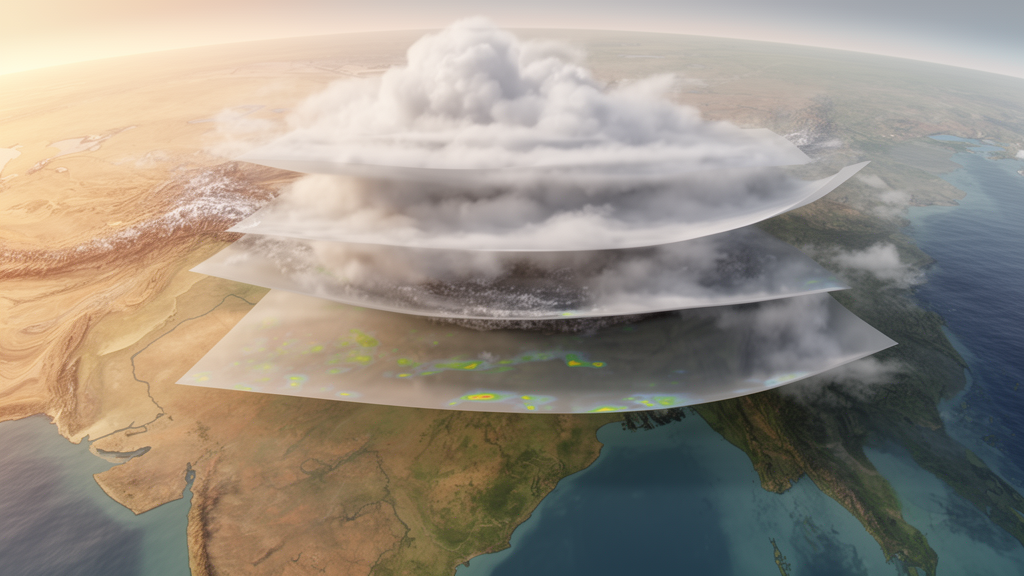
The researchers decomposed the all-India rainfall signal into mean, climatological, trend and residual components. Under the phased approach, the mean, climatology and trend were explicitly extracted before the residual rainfall component was predicted with the sea-surface-temperature inputs, after which the extracted components were reinserted. This structure, inspired by diagnostics used in dynamical models, makes the temporal origin of forecast performance more visible than a conventional assessment based only on rainfall-anomaly accuracy.
Both artificial neural networks and regression models performed reasonably well when their task was restricted to interannual variability. Their correlations near 0.7 indicate that the models captured a substantial share of year-to-year fluctuations in the residual rainfall component at the three-month horizon. The result does not mean that the models reconstructed the full all-India rainfall signal, however. Without explicit treatment of the long-term components, climatological peaks and trends were not consistently reproduced, showing why strong predictive performance for one temporal component cannot automatically be interpreted as skill across the entire rainfall record.
Detrending produced more stable predictions by eliminating spurious low-frequency drift, but it did not increase interannual predictability. The authors interpret this outcome as evidence that the sea-surface-temperature predictors used in the study exert limited control over the low-frequency component of all-India rainfall. The distinction matters for evaluating seasonal prediction models: stabilizing a forecast is not equivalent to improving its ability to anticipate the underlying interannual fluctuations.
The work is a statistical modeling study, not a demonstrated operational forecasting system, and the available research summary does not specify cross-validation procedures, regional results or independent operational tests. Within that scope, the phased residual framework offers a systematic diagnostic for separating predictable variability from baseline structure. Its central result is that three-month prediction models can capture interannual all-India rainfall behavior while still lacking reliable information about climatological peaks and long-term trends, a limitation that explicit component reconstruction exposes rather than removes.
Subject of Research: Statistical prediction of all-India monsoon rainfall from Indian Ocean Dipole sea-surface temperatures
Article Title: A phased residual framework for ANN prediction of Indian monsoon rainfall: bridging statistical and dynamical approaches
Article References: Aggarwal, R., Tripathi, K. C., & Kaur, M. (2026). A phased residual framework for ANN prediction of Indian monsoon rainfall: bridging statistical and dynamical approaches. Theoretical and Applied Climatology, 157(11), 741. https://doi.org/10.1007/s00704-026-06627-8
Image Credits: AI Generated
DOI: 10.1007/s00704-026-06627-8
Keywords: all-India rainfall, monsoon prediction, residual modeling, artificial neural networks, Indian Ocean Dipole, sea-surface temperatures, interannual variability, seasonal forecasting, phased, residual, framework, prediction
Cite Scienmag News
Violet Maxwell. (October 22, 2026). Phased residual framework reveals limits of three-month monsoon rainfall prediction. Scienmag. https://scienmag.com/phased-residual-framework-reveals-limits-of-three-month-monsoon-rainfall-prediction/
Violet Maxwell. "Phased residual framework reveals limits of three-month monsoon rainfall prediction." Scienmag, 22 October 2026, https://scienmag.com/phased-residual-framework-reveals-limits-of-three-month-monsoon-rainfall-prediction/. Accessed 22 October 2026.
Violet Maxwell. "Phased residual framework reveals limits of three-month monsoon rainfall prediction." Scienmag. October 22, 2026. https://scienmag.com/phased-residual-framework-reveals-limits-of-three-month-monsoon-rainfall-prediction/


