


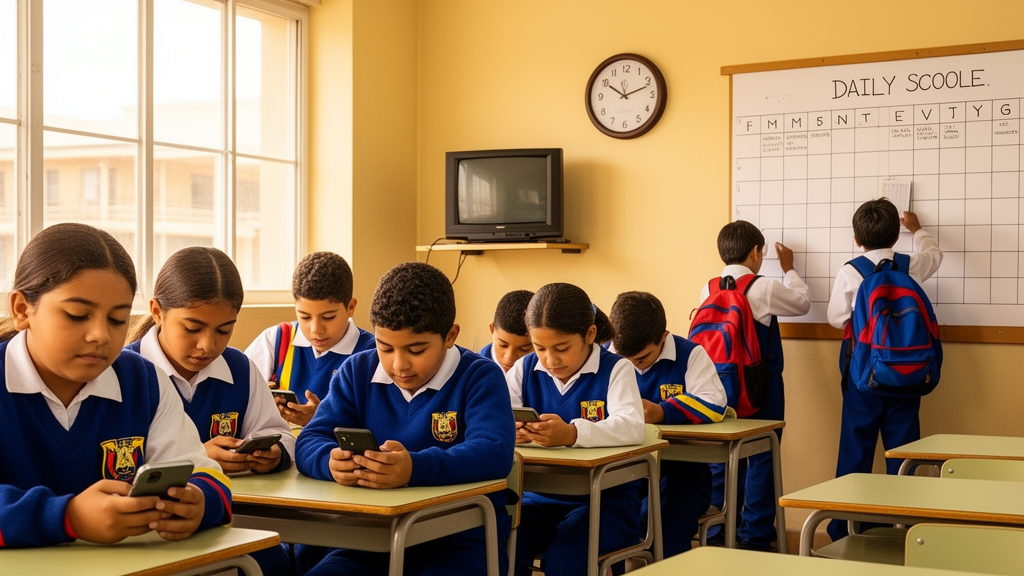
A study of 954 Ecuadorian schoolchildren aged 10 to 13 found that nomophobia—the fear or anxiety triggered by being unable to use a mobile phone—was assessed across psychological, social and biological dimensions, with the highest mean scores on the psychological measure. The research was conducted in Educational Zone 6 and used a validated 32-item scale to characterize mobile-phone anxiety among pupils in 23 schools. The investigators described associations with students’ activities, schedules and sociodemographic characteristics as small and exploratory, rather than evidence that those factors caused the measured responses.
The sample’s psychological dimension produced the highest mean scores, followed by the social and biological dimensions. In unadjusted comparisons, television viewing and attendance in the afternoon shift were associated with higher overall scores. Older pupils had higher social and biological scores, but age and school grade overlapped in the sample, so the researchers did not attribute an independent effect to either variable.
Students who practiced sports had lower biological-dimension scores. These were reported associations between measured variables; they do not show that television viewing, class schedules or sports participation changed the children’s nomophobia scores. The results became more limited after accounting for the number of statistical comparisons.
Following false-discovery-rate correction, television viewing remained associated with higher scores in the general comparison, while the afternoon shift retained a significant association in the biological dimension. Multilevel models accounted for students being clustered within 23 educational establishments and found that television viewing remained associated with higher nomophobia scores. That model association was not significant after correction across the model coefficients.
Effective sample sizes for some comparisons were about 136 to 310 students rather than the full sample of 954, an important limitation when interpreting the school-level structure and the smaller analysis-specific samples. The authors placed the findings in the context of education policy and digital citizenship, treating school mobile-phone use as a governance issue rather than testing the effects of a particular regulatory approach. Their contextual comparison examined Ecuador’s regulatory approach alongside those of four Latin American countries with national laws governing mobile phones in schools.
That comparison provides a legal and policy frame for the analysis, but it does not measure governance outcomes or establish whether any of the regulatory approaches is more effective. The research data were collected before Ecuador’s April 2025 ministerial agreement on mobile phones in schools, meaning the study is not an evaluation of that agreement or its implementation. Overall, the research presents nomophobia scores as a multidimensional pattern among the participating pupils and identifies television viewing as the most persistent association in the reported analyses.
Its principal contribution is descriptive: the study shows how responses on psychological, social and biological components differed across a school-age sample while demonstrating how multiple testing and clustering across schools constrained the interpretation of small associations. Nor does it show that school regulation, television viewing, schedules or extracurricular activities can prevent nomophobia. The supported conclusion is narrower: in this group of 954 pupils, psychological scores were highest, several sociodemographic and activity-related differences appeared in unadjusted analyses, and television viewing remained associated with higher scores under the study’s adjusted statistical procedures.
Subject of Research: Patterns of nomophobia scores and associated sociodemographic factors among 954 Ecuadorian schoolchildren aged 10 to 13
Article Title: Nomophobia among Ecuadorian schoolchildren: sociodemographic patterns and implications for digital citizenship and educational governance
Article References: Clavijo-Castillo, R., Reyes-Guaranda, M., & Cabrera-Ortiz, F. (2026). Nomophobia among Ecuadorian schoolchildren: sociodemographic patterns and implications for digital citizenship and educational governance. Frontiers in Political Science, 8, Article 1965153. https://doi.org/10.3389/fpos.2026.1965153
Image Credits: AI Generated
DOI: 10.3389/fpos.2026.1965153
Keywords: nomophobia, schoolchildren, Ecuador, mobile-phone anxiety, television viewing, school schedules, extracurricular sports, digital citizenship, educational governance, multilevel modeling, Ecuadorian, sociodemographic
Cite Scienmag News
Glenn Wilkins. (October 22, 2026). Nomophobia Patterns in Ecuadorian Schoolchildren Reveal Small Television and Schedule Links. Scienmag. https://scienmag.com/nomophobia-patterns-in-ecuadorian-schoolchildren-reveal-small-television-and-schedule-links/
Glenn Wilkins. "Nomophobia Patterns in Ecuadorian Schoolchildren Reveal Small Television and Schedule Links." Scienmag, 22 October 2026, https://scienmag.com/nomophobia-patterns-in-ecuadorian-schoolchildren-reveal-small-television-and-schedule-links/. Accessed 22 October 2026.
Glenn Wilkins. "Nomophobia Patterns in Ecuadorian Schoolchildren Reveal Small Television and Schedule Links." Scienmag. October 22, 2026. https://scienmag.com/nomophobia-patterns-in-ecuadorian-schoolchildren-reveal-small-television-and-schedule-links/


