


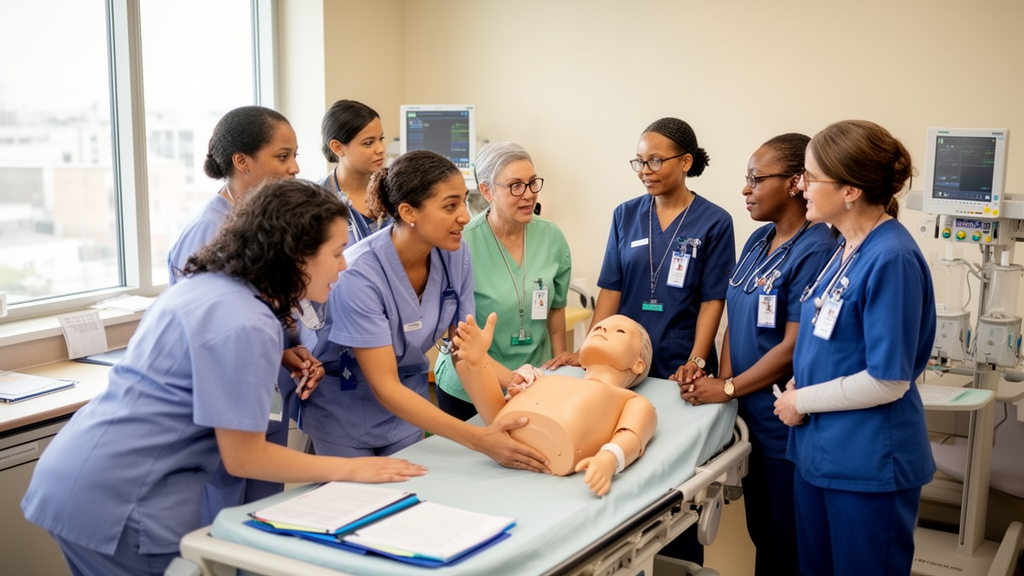
Nurse educators in a South African public nursing institution described professionalism not simply as compliant behavior or individual competence, but as a relational ethical process shaped by personal formation, teaching relationships, assessment practices and institutional conditions. The finding emerged from a qualitative study of 44 nurse educators who participated in five semi-structured focus group interviews. Rather than treating professional identity as something acquired through rules and training alone, the participants portrayed it as something enacted through relationships and shared responsibility.
The study used an exploratory, descriptive and contextual qualitative design at a single public, multi-campus nursing education institution in South Africa. Its interviews were originally conducted as part of a broader, multi-phased research project on Ubuntu-informed health sciences education; professionalism was not the focus of the original interview guide. Nevertheless, comments concerning professional conduct, ethical responsibility, role modelling, educator–student relationships and assessment appeared across all five focus groups, providing a coherent body of material for a focused analysis. This embedded design offers important context: the reported results concern a specific analytical strand within a wider project rather than an independently designed trial of an educational intervention.
Researchers analyzed the interview material using reflexive thematic analysis, combining primarily data-led coding with theoretically informed development of themes. Ubuntu provided the main relational lens for interpretation, while decoloniality served as a critical orientation. The analysis produced one overarching theme—relational professionalism as ethical formation and collective responsibility—and four interconnected subthemes: relational ethical formation, relational accountability, embodied pedagogical praxis, and communal responsibility shaped by institutional, curricular and structural conditions. Together, these themes suggest that professionalism involves both how educators understand their obligations and the practical and organizational conditions that enable or constrain those obligations.
Relational ethical formation, as described in the study, places relationships and ethical development at the center of professional identity. Relational accountability extends this idea by presenting responsibility as something established through interaction rather than detached from people and circumstances. Embodied pedagogical praxis indicates that professionalism is also performed in everyday educational practice, while communal responsibility highlights how institutional, curricular and structural conditions influence whether professional norms can be enacted. The participants’ accounts therefore challenge an exclusively compliance-oriented account centered on behavioral competencies, ethical conduct and regulatory accountability. That model may illuminate what educators do, but the study indicates that it can understate the interpersonal and contextual processes through which professional identity becomes possible.
The findings are best understood as contextually grounded accounts from one institutional setting, not as a universal measurement of nursing professionalism or proof that a particular teaching model causes better ethical outcomes. The sample was limited to 44 nurse educators within one South African public nursing education institution, and the themes were developed from material gathered for a broader project. Although the data were collected across five focus groups and the researchers used both inductive coding and an explicit interpretive framework, the study did not test changes in student behavior, clinical competence or professional compliance. It was also not a clinical trial, and no clinical outcomes were evaluated.
Even with those boundaries, the research shifts attention toward a practical question that compliance frameworks alone may not answer: how does a professional identity form, and who or what shares responsibility for sustaining it? For nursing educators, the answer emerging from the interviews depends on relationships, pedagogical practice and the environments in which teaching and assessment occur. The study consequently frames ethical formation as a collective endeavor embedded in institutions and curricula, while also documenting the limits of treating professionalism solely as a personal attribute. Its contribution is an Ubuntu-informed interpretation from a particular public education setting that may inform further research on how nursing programs balance regulatory accountability with relational and culturally responsive professional formation.
Subject of Research: How South African nurse educators describe relational professionalism, ethical formation and collective responsibility in nursing education
Article Title: Relational professionalism in nursing education: a qualitative study of nurse educators’ narratives of ethical formation and collective responsibility
Article References: Matahela, V. E., & van Rensburg, G. H. (2026). Relational professionalism in nursing education: a qualitative study of nurse educators’ narratives of ethical formation and collective responsibility. BMC Nursing. https://doi.org/10.1186/s12912-026-05543-6
Image Credits: AI Generated
DOI: 10.1186/s12912-026-05543-6
Keywords: nursing education, professional identity, ethical formation, collective responsibility, nurse educators, Ubuntu, focus groups, qualitative research, South Africa, decolonial pedagogy, Relational, professionalism
Cite Scienmag News
Ophelia Keating. (October 22, 2026). Nurse Educators Frame Professionalism as Collective, Relational Responsibility. Scienmag. https://scienmag.com/nurse-educators-frame-professionalism-as-collective-relational-responsibility/
Ophelia Keating. "Nurse Educators Frame Professionalism as Collective, Relational Responsibility." Scienmag, 22 October 2026, https://scienmag.com/nurse-educators-frame-professionalism-as-collective-relational-responsibility/. Accessed 22 October 2026.
Ophelia Keating. "Nurse Educators Frame Professionalism as Collective, Relational Responsibility." Scienmag. October 22, 2026. https://scienmag.com/nurse-educators-frame-professionalism-as-collective-relational-responsibility/


