


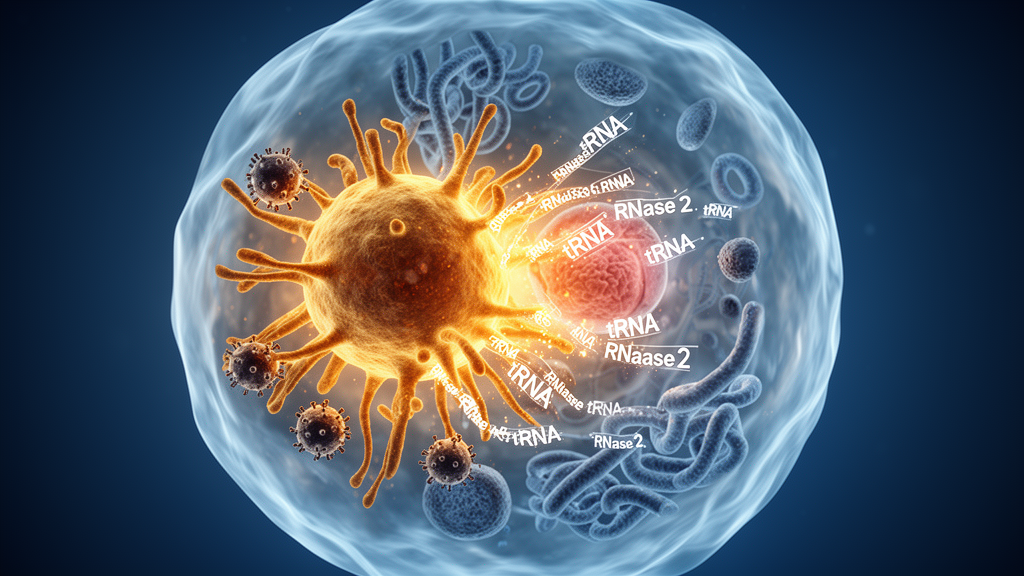
Human RNase 2 is required for macrophages to mount an effective response to viral single-stranded RNA, according to research published in Cellular and Molecular Life Sciences. Scientists compared wild-type macrophages with cells in which RNase 2 had been knocked out, then exposed each group to a virus-derived RNA called ssRNA40. The deletion disturbed cellular homeostasis, activated stress-response markers and abolished much of the antiviral gene response observed in wild-type cells. In wild-type macrophages, the RNA response included genes associated with inflammation and antiviral immunity, with evidence of activation in TLR8-dependent, mitogen-activated protein kinase and JAK–STAT pathways.
RNase 2 is described as the most abundant member of the human RNase A family in macrophages, and its expression is activated when the cells encounter virus. The study used co-transcriptomics to examine the effects of its deletion at the level of gene expression. The investigators identified five prominent transfer-RNA-derived small RNAs, or tDRs, produced during the ssRNA40 response when RNase 2 was present. These fragments did not arise uniformly across transfer RNAs: RNase 2 showed a preference for cleavage within anticodon loops containing CA- or uridine-rich sequences. A second conserved feature was the CCA end of 3′ tDRs, from which truncated 3′-CC fragments were released.
Among the fragments detected specifically in wild-type macrophages exposed to ssRNA40, the 3′ half of tRNA-LysTTT showed the largest significant difference in sequence coverage. The results link RNase 2 activity to two related processes: the control of macrophage gene expression during exposure to viral RNA and the selective production of small RNA fragments from transfer RNAs. Because the work compared wild-type and knockout macrophages under laboratory conditions, it supports a mechanistic role for RNase 2 in the measured antiviral response but does not establish how the enzyme contributes to outcomes in people or other animals.
The researchers also tested whether the transfer-RNA digestion products could account for the altered immune profile. They generated products from tRNA-LysTTT in vitro using recombinant RNase 2 and added them to RNase 2-knockout macrophages. The immune response profile of the knockout cells was mostly recovered, suggesting that tDRs mediate at least part of the effect attributed to RNase 2. This intervention connected the biochemical cleavage pattern with the transcriptomic phenotype, although the abstract does not specify whether the rescue involved every affected pathway or whether the added products entered the cells directly.
Overall, the findings portray RNase 2 as a selective RNA-processing enzyme with a central role in the macrophage response to viral RNA. Its absence was associated not simply with loss of antiviral gene activity but with cellular stress and disruption of a homeostatic state. The study further suggests that targeted cleavage of transfer RNAs at anticodon loops and CCA ends generates small RNAs that help activate the immune profile. The reported evidence comes from transcriptomic comparisons, biochemical fragment analysis and an in vitro rescue experiment; it does not yet establish clinical effects, therapeutic value or the full range of viral RNAs and macrophage states affected by RNase 2.
Subject of Research: RNase 2-mediated transfer RNA cleavage and antiviral responses in human macrophages
Article Title: Human RNase 2 is essential for macrophage response to viral RNA and enerates tRNA-derived small RNAs by selective cleavage at tRNA anticodon loops and CCA ends
Article References: Li, J., Lu, L., Diaz-Satizabal, L., Anguita, R., Moret-Gómez, I., Julián, E., & Boix, E. (2026). Human RNase 2 is essential for macrophage response to viral RNA and enerates tRNA-derived small RNAs by selective cleavage at tRNA anticodon loops and CCA ends. Cellular and Molecular Life Sciences. https://doi.org/10.1007/s00018-026-06500-x
Image Credits: AI Generated
DOI: 10.1007/s00018-026-06500-x
Keywords: RNase 2, macrophages, viral RNA, antiviral immunity, transfer RNA fragments, tRNA cleavage, inflammation, TLR8, ssRNA40, transcriptomics, Human, RNase
Cite Scienmag News
Kristina Jarvis. (October 22, 2026). RNase 2 shapes macrophage antiviral responses through targeted tRNA cleavage. Scienmag. https://scienmag.com/rnase-2-shapes-macrophage-antiviral-responses-through-targeted-trna-cleavage/
Kristina Jarvis. "RNase 2 shapes macrophage antiviral responses through targeted tRNA cleavage." Scienmag, 22 October 2026, https://scienmag.com/rnase-2-shapes-macrophage-antiviral-responses-through-targeted-trna-cleavage/. Accessed 22 October 2026.
Kristina Jarvis. "RNase 2 shapes macrophage antiviral responses through targeted tRNA cleavage." Scienmag. October 22, 2026. https://scienmag.com/rnase-2-shapes-macrophage-antiviral-responses-through-targeted-trna-cleavage/


