


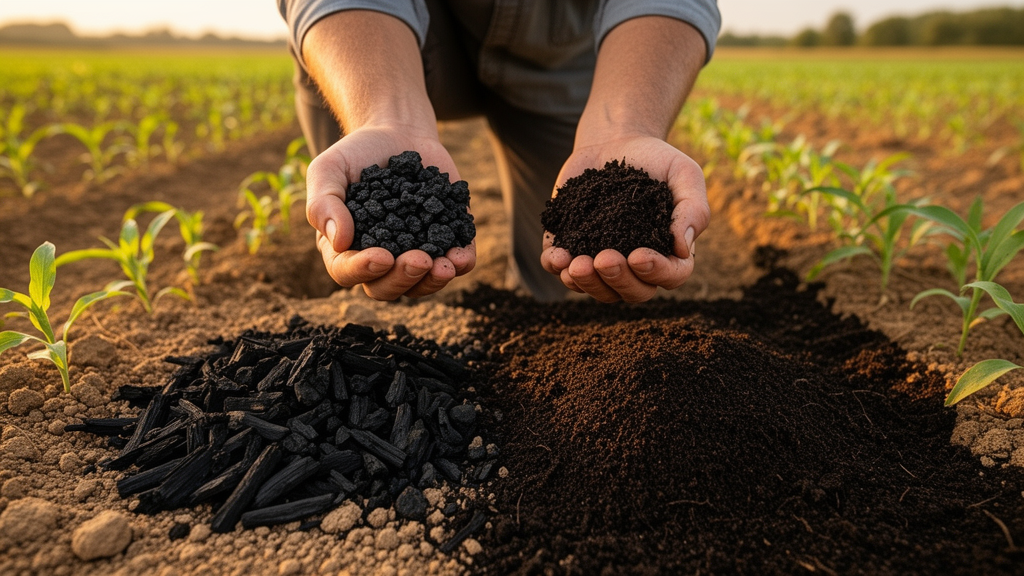
A systematic review of 156 studies finds that biochar can improve degraded soils, immobilize contaminants and reduce some greenhouse-gas emissions, but it is not a universally beneficial amendment. The strongest results emerged when biochar was matched to both the feedstock and the soil: mineral-rich manure or sludge char performed best for heavy-metal immobilization and pH correction, stable woody char was most effective against organic pollutants, and nutrient-bearing crop-residue char most consistently improved fertility and reduced nitrous oxide or methane under wet, acidic conditions. These same properties also generated trade-offs, including increased nitrous oxide emissions, suppressed enzymes, transient nitrogen immobilization and contaminant remobilization in some settings.
The review, which followed Preferred Reporting Items for Systematic Reviews and Meta-Analyses 2020 guidelines, searched Web of Science, Scopus, PubMed, ScienceDirect and Google Scholar for peer-reviewed English-language work published from 2009 to 2026. Investigators screened 1,854 records and retained 156 studies with quantitative outcomes, untreated controls and biochar-specific treatments. The evidence encompassed laboratory, greenhouse and field experiments worldwide, with pyrolysis temperatures from 200 to 1,200 °C and application rates from 1 to 730 tonnes per hectare. Two reviewers screened records independently, while a 15-point quality system rated 85 studies as high quality and 71 as moderate quality. Inter-rater agreement was strong for a 30-study subset, with a weighted kappa of 0.88.
Biochar is the carbon-rich solid produced by pyrolysing biomass under oxygen-limited conditions. Its behavior depends on a visible chain of production choices. Woody feedstocks generally produce high-carbon, stable structures, manure retains nutrients and ash, and crop residues supply more labile carbon. Temperatures below 400 °C generally preserve more functional groups and volatile matter; temperatures above 600 °C produce denser aromatic carbon with greater persistence and often stronger sorption of hydrophobic organic compounds. Ash can add calcium, magnesium, potassium and alkalinity, while carboxylic, hydroxyl and carbonyl groups provide reactive sites. Porosity can improve aeration, water retention and microbial habitat, but the review found that the same properties could favor methanogens in flooded soils or adsorb enzymes needed for nutrient cycling.
Physical responses were most convincing in fine-textured, degraded or acidic soils. Across the included experiments, biochar reduced bulk density by 0.03 to 0.36 grams per cubic centimetre, increased porosity by 2 to 50%, improved aggregate stability by 7 to 17% and raised water-holding capacity by 9 to 130%. A corn char made at 350 °C produced the largest reported bulk-density reduction, whereas a green-cutting char applied to sandy soil had no effect. Aggregate stability did not improve when herbaceous char was added to sandy soils, where too little clay exists to form stable particle bindings. Water-holding gains were especially large in coarse soils amended with organic-rich spent-coffee-waste char at high rates, but were absent in some sandy soils. The pattern matters because biochar’s pore sizes may complement compacted clay-rich soils more effectively than soils already dominated by large interparticle spaces.
Chemical and biological changes were similarly conditional. Soil pH shifted from 0.3 units lower to 1.6 units higher, with manure-derived char producing the largest increase in acidic sandy soil; high-silica rice-husk char instead lowered pH and cation-exchange capacity in a low-buffering soil. Reported soil-organic-matter increases ranged from 0.35 to 3.11 percentage points, while total soil-organic-carbon increases reached 30.5 grams per kilogram. Those carbon totals are not proof that native organic carbon became more stable because the added biochar itself contributes carbon by mass balance, and most studies did not use isotopic tracing to separate the sources. Biologically, about 58% of the assessed responses were positive, 24% negative and 18% neutral. Moderate-temperature crop-residue char stimulated Lactobacillales, Bacteroidales, Bacillus and Pseudomonas and sometimes suppressed Fusarium, whereas high-temperature woody char sometimes reduced microbial biomass and enzyme activity.
For contaminated soil, the review reported reductions in bioavailable or extractable contaminant fractions rather than the disappearance of total metals. Lead removal ranged from 50 to 100%, cadmium from 2 to 99.9%, copper from 28 to 99.9% and zinc from 48 to 99.9%. At initial metal concentrations below 100 milligrams per kilogram, manure- and sludge-derived chars commonly exceeded 93% immobilization, partly through surface complexation, cation exchange, electrostatic attraction and mineral precipitation. Efficiency generally declined as contaminant loads rose because sorption and reaction sites became limiting. Pesticides showed reported removal of 34 to 100%, polycyclic aromatic hydrocarbons 29.3 to 100% and total petroleum hydrocarbons 60 to 84.8%. High-temperature woody char was the most consistent sorbent for hydrophobic organic pollutants, while nutrient-rich crop-residue char performed well on petroleum hydrocarbons through coupled sorption and biodegradation.
Greenhouse-gas results produced the clearest warning against treating biochar as a universal climate tool. Roughly 64% of the summarized nitrous-oxide studies reported reductions, 27% increases and 9% no significant change; for methane, the corresponding shares were 58%, 25% and 17%, and for carbon dioxide 50%, 30% and 20%. Nitrous oxide fell sharply in acidic, poorly aerated or waterlogged soils treated with crop-residue or sewage-sludge char, with individual reductions reaching 98.4%. It increased by as much as 191% in a forest-soil treatment, and other increases occurred in well-aerated, neutral soils at high rates. Methane declined by as much as 92.6% in some waterlogged paddy soils but rose where labile carbon supported methanogenesis. Carbon dioxide sometimes fell in acidic, degraded soils, increased through positive priming of native soil carbon in other systems and remained unchanged in alkaline soils.
These outcomes reveal three practical archetypes. Moderate-temperature manure or sludge char, generally produced at 400–600 °C, is a powerful liming and metal-immobilization material but carries the greatest risk of stimulating nitrous oxide above roughly 40 tonnes per hectare in neutral, aerated soil. Woody char produced above 600 °C offers persistent carbon and strong organic-pollutant sorption, yet supplies few nutrients and may suppress microbial biomass and enzymes. Crop-residue char made at 300–550 °C provides the strongest biological and fertility stimulation and the strongest methane and nitrous-oxide reductions in wet acidic soils, but its lower mineral content limits metal immobilization. The synthesis suggests a potential synergy for moderate rates of 10–30 tonnes per hectare, although the review noted that direct experimental validation of simultaneous fertility, remediation and emissions benefits remains limited.
Long-term evidence is the review’s largest unresolved weakness. Most included experiments lasted days to one year, even though biochar itself can persist for centuries or millennia. Nutrient pulses may be quickly taken up or lost, sorption sites can saturate as contaminants, dissolved organic matter and minerals accumulate, and early priming responses may fade as labile carbon is consumed. Adverse effects can also emerge when volatile compounds or contaminants remain in poorly processed char, when low-temperature material temporarily immobilizes nitrogen, or when high-silica material acidifies weakly buffered soil. The review also excluded non-English publications, used a quality tool that had not been independently validated for biochar research, and could not fully stratify outcomes by laboratory, greenhouse and field settings. It did not systematically assess economics or life-cycle impacts, and it examined little evidence for microplastics, antibiotics or per- and polyfluoroalkyl substances. The evidence therefore supports a highly conditional tool: matching the char’s chemistry and production temperature to the intended soil function, then testing the outcome over years rather than assuming that a short-term improvement will persist.
Subject of Research: Systematic review of biochar effects on soil fertility, contaminant remediation and greenhouse-gas emissions
Article Title: Role of biochar in soil fertility improvement, soil remediation and greenhouse gas emissions reduction: A systematic review
Article References: Gashu, G., Otinga, A. N., Njoroge, R., Magiroi, K. N., Melese, A. M., & Kambale, M. (2026). Role of biochar in soil fertility improvement, soil remediation and greenhouse gas emissions reduction: A systematic review. Environmental Challenges, 25, Article 101685. https://doi.org/10.1016/j.envc.2026.101685
Image Credits: AI Generated
DOI: 10.1016/j.envc.2026.101685
Keywords: biochar, soil fertility, soil remediation, greenhouse gases, carbon sequestration, nitrous oxide, methane, heavy metals, pyrolysis, systematic review, Role, soil
Cite Scienmag News
Sloane Callahan. (October 22, 2026). Biochar’s Soil Benefits Depend Sharply on Material and Setting. Scienmag. https://scienmag.com/biochars-soil-benefits-depend-sharply-on-material-and-setting/
Sloane Callahan. "Biochar’s Soil Benefits Depend Sharply on Material and Setting." Scienmag, 22 October 2026, https://scienmag.com/biochars-soil-benefits-depend-sharply-on-material-and-setting/. Accessed 22 October 2026.
Sloane Callahan. "Biochar’s Soil Benefits Depend Sharply on Material and Setting." Scienmag. October 22, 2026. https://scienmag.com/biochars-soil-benefits-depend-sharply-on-material-and-setting/


