


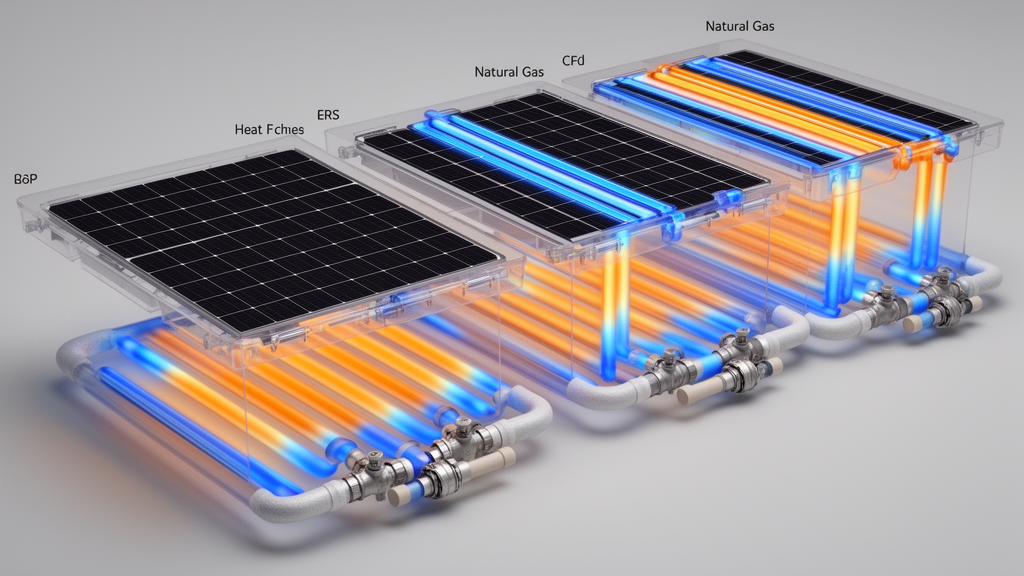
A validated computational fluid dynamics study of a flat-plate solar collector found that water flow rate, absorber material, plate thickness and tube arrangement have a stronger influence on modeled thermal efficiency than solar irradiance alone. Across the investigated parameter ranges, water mass flow accounted for 35% of modeled output variance, absorber thermal conductivity for 22%, plate thickness for 15%, tube geometry for 11%, absorber positioning for 9%, and optical properties for 4–7%. These are numerical estimates for a 2-square-meter collector using water, not measured performance gains at an operating natural gas station, but they provide a ranked guide for designing solar thermal equipment intended to support low-temperature gas preheating.
The research targets a specific energy-system problem. At city gate stations, high-pressure natural gas is expanded before entering lower-pressure distribution networks, and the associated temperature reduction can encourage hydrate formation and the freezing of suspended water droplets. Conventional indirect gas heaters burn additional natural gas to preheat the incoming stream, typically to 55–85 °C. Because flat-plate collectors can provide low-temperature heat, the researchers modeled a collector comprising a glass cover, air gap, absorber plate, nine parallel copper riser tubes and insulated boundaries. Water, rather than natural gas, served as the working fluid, entering at 31 °C at flow rates from 0.02 to 0.05 kg/s under solar irradiance ranging from 200 to 1,200 W/m².
The three-dimensional conjugate heat-transfer model was implemented in ANSYS Fluent 17.0 with the finite-volume method. Continuity, momentum and energy equations were solved using Reynolds-averaged Navier–Stokes calculations and the standard k-epsilon turbulence closure, while the Boussinesq approximation represented buoyancy in the air gap. The simulations assumed steady operation, uniform flow through all nine tubes, fully developed flow inside the tubes, negligible solar-radiation loss from collector boundaries and temperature-dependent properties for water and air. Symmetry conditions allowed one tube and its adjoining collector section to be represented rather than the complete assembly. Solar input was estimated with an isotropic diffuse-radiation model, and collector efficiency was defined as the water’s useful enthalpy gain divided by incident solar energy on the aperture.
Numerical accuracy was assessed through mesh refinement, turbulence-model comparison, experimental measurements and an established analytical collector model. Three grids containing 1.2 million, 2.4 million and 4.8 million cells were tested. The apparent order of convergence was 2.12, and the Grid Convergence Index for thermal efficiency was 0.82%, below the researchers’ 2% acceptance threshold, so the 2.4-million-cell mesh was used for the parametric runs. Predicted tube temperatures agreed with measurements from a collector operated at 928 W/m², a 310 K inlet-water temperature, a 303 K ambient temperature and a 36-degree tilt; the average deviation was about 3.2%, with a maximum near the outlet of 4.8%. At baseline, CFD predicted 23.1% efficiency, compared with 22.8% from the analytical model and 22.4% experimentally.
Mass flow produced the clearest operational response. Increasing the water flow from 0.02 to 0.05 kg/s raised thermal efficiency from 21.6% to 24.6%, a relative improvement of about 14%. The modeled mechanism was stronger convective heat transfer at the tube walls: higher flow reduced boundary-layer resistance, lowered the average absorber temperature and consequently reduced radiative and convective losses from the collector’s upper surface. Useful heat gain rose from 401 to 457 W, while outlet-water temperature declined from 35.8 to 32.4 °C as the same heat was distributed over a larger flow. In the proposed application, heated water could be stored for later use rather than consumed immediately, allowing an array to favor heat collection through higher circulation rates.
Absorber construction was the second major lever. At the stated baseline, copper produced 24.6% efficiency, aluminum 22.8% and steel 18.2%, making copper 35% more efficient than steel. The absorber also acts as a fin, transferring heat laterally from the plate between tubes to the bonded contact points. Copper’s high thermal conductivity maintained a more uniform plate temperature and moved more absorbed solar energy into the water, whereas steel created larger temperature gradients and greater fin resistance. Increasing plate thickness from 0.1 to 0.6 mm raised efficiency from 19.8% to 22.8%, a 15.2% improvement associated with lower through-thickness resistance. Aluminum nevertheless delivered about 92.7% of copper’s performance in the model, although the study did not establish its economic advantage experimentally.
Geometry produced additional differences that would be concealed by treating the collector as a uniform system. At an equivalent 25 mm hydraulic diameter, circular tubes delivered 22.6% efficiency, compared with 21.2% for hexagonal, 19.8% for square and 18.4% for triangular tubes. The sharp corners of polygonal sections promoted flow separation and recirculation regions with weaker local heat transfer. Absorber placement proved similarly consequential: configurations with the plate below the tubes reached 24.2% and 24.0% efficiency, a mid-height arrangement produced 21.6%, and above-tube configurations yielded 19.2% and 18.8%. The estimated constriction resistance at the plate–tube interface fell from roughly 0.25 K/W for narrow line contact to about 0.04 K/W when broader area contact reduced the thermal bottleneck.
Optical properties had smaller but still measurable effects. Raising absorber absorptivity from 0.80 to 0.98 increased efficiency from 22.4% to 23.8%, a 6.3% relative gain. Increasing glass-cover transmissivity from 0.82 to 0.96 raised efficiency from 20.1% to 23.8%, or 18.4%. Irradiance behaved differently. Efficiency climbed from 18.2% at 200 W/m² to 23.1% at 928 W/m², but approached an asymptote of approximately 23.3% above 800 W/m². At high input levels, the hotter absorber increased radiative losses along with useful heat collection, leaving the efficiency ratio nearly unchanged. The authors interpret this saturation as a reason to size collectors and thermal storage around the full daily radiation profile rather than peak sunlight alone.
Two complementary sensitivity methods established the hierarchy behind these modeled trends. Morris screening used 50 trajectories with eight levels per parameter, while Sobol variance decomposition used 10,000 quasi-Monte Carlo model evaluations. For mass flow, the Sobol first-order index was 0.35 and the total-order index 0.41, indicating dominant influence with some interaction effects. Absorber conductivity followed at 0.22 and 0.29, while plate thickness produced 0.15 and 0.20. Tube geometry had a larger gap between its first-order and total-order indices, 0.11 and 0.16, indicating that its best choice depends partly on other settings. A quadratic response-surface model fitted to 50 central-composite design points had an R² above 0.95 and an adjusted R² above 0.92, providing the statistical basis for identifying parameter combinations within the modeled range.
The study converts the component results into a cautious system-level illustration rather than a demonstration at a gas station. For a representative station processing 100,000 standard cubic meters of natural gas per day and requiring a 45 K temperature rise, the authors estimated a continuous heating duty of 82.5 kW. Under their assumed irradiance and sunshine conditions, a 100 m² collector array operating at baseline efficiency was estimated to provide 13.1 GJ of heat annually, equivalent to about 0.5% of that duty and associated with 735 kg less carbon dioxide emissions. A larger array using the modeled high-performing settings was estimated to collect 73 GJ, or 2.8% of annual demand, and avoid about 4.1 tonnes of carbon dioxide. These projections depend on representative assumptions; the research did not perform a full techno-economic or life-cycle assessment.
Several limitations constrain direct transfer of the results to field installations. The steady-state model does not reproduce diurnal, seasonal or rapid cloud-driven changes, and its uniform-flow assumption may overstate real efficiency by an estimated 5–10% when headers distribute water unevenly. Headers, supports and fittings were omitted, water was the only working fluid, and wind speed and ambient temperature were fixed. Spectral optical effects were also neglected, although the authors estimate that they would generally alter performance by 1–2%. Most importantly, the optimized combination—higher flow, copper absorber, thicker plate, circular tubes and a below-tube absorber configuration—was not tested experimentally. The defensible conclusion is therefore that the validated numerical model identifies promising design priorities for solar-assisted natural gas preheating, while site-specific testing, transient modeling, flow-distribution analysis and full system optimization remain necessary before field benefits can be claimed.
Subject of Research: Computational optimization of flat-plate solar collectors for natural gas preheating applications
Article Title: CFD-based parametric analysis and design optimization of flat-plate collector geometry for low-carbon natural gas preheating in pressure regulating stations
Article References: Moondanizadeh, M., & Kianoush, P. (2026). CFD-based parametric analysis and design optimization of flat-plate collector geometry for low-carbon natural gas preheating in pressure regulating stations. Results in Engineering, 32, Article 113507. https://doi.org/10.1016/j.rineng.2026.113507
Image Credits: AI Generated
DOI: 10.1016/j.rineng.2026.113507
Keywords: flat-plate solar collectors, natural gas preheating, computational fluid dynamics, thermal efficiency, sensitivity analysis, absorber plate, tube geometry, thermal storage, city gate stations, solar thermal energy, CFD-based, parametric
Cite Scienmag News
Audrey Campbell. (October 22, 2026). CFD study ranks water-heated collector factors for natural gas preheating. Scienmag. https://scienmag.com/cfd-study-ranks-water-heated-collector-factors-for-natural-gas-preheating/
Audrey Campbell. "CFD study ranks water-heated collector factors for natural gas preheating." Scienmag, 22 October 2026, https://scienmag.com/cfd-study-ranks-water-heated-collector-factors-for-natural-gas-preheating/. Accessed 22 October 2026.
Audrey Campbell. "CFD study ranks water-heated collector factors for natural gas preheating." Scienmag. October 22, 2026. https://scienmag.com/cfd-study-ranks-water-heated-collector-factors-for-natural-gas-preheating/


