


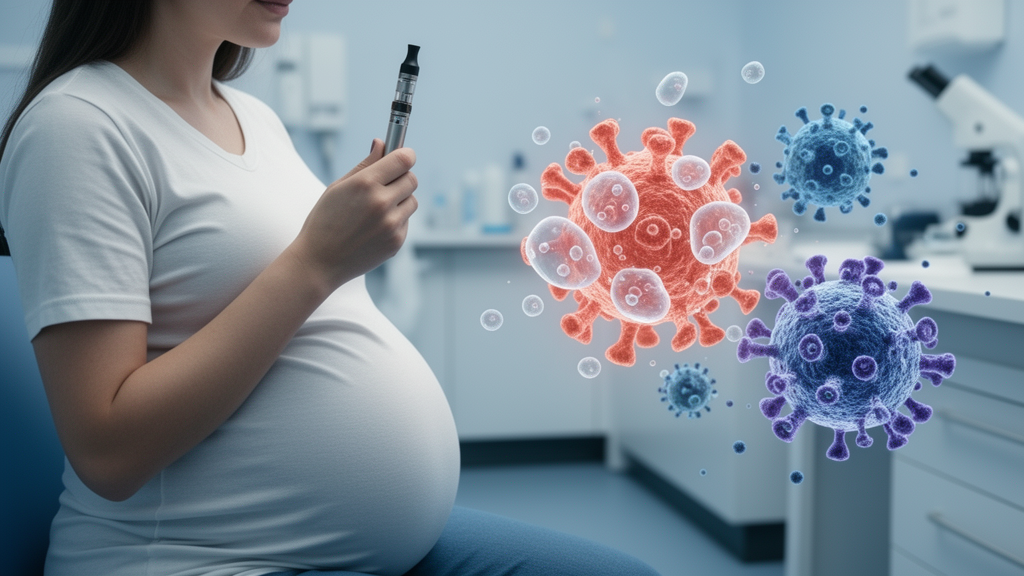
Researchers at Wayne State University School of Medicine have received a five-year, $2.4 million grant from the National Institute of Environmental Health Sciences to investigate how exposure to e-cigarette components during pregnancy may alter fetal lung immune development and the newborn response to respiratory viral infections. The project, led by Jayanth Ramadoss and Marta Rodriguez-Garcia, will combine preclinical pregnancy models, controlled vaping exposure systems, cellular and molecular analyses and neonatal viral infection models. Its central objectives are to determine how selected components of newer-generation e-cigarette aerosols affect immune pathways in the developing lung, whether those effects differ between male and female offspring and whether a postnatal treatment can improve antiviral responses in exposed newborns.
The award supports a mechanistic research project rather than a clinical trial or an evaluation of an intervention for pregnant people. Investigators will focus on acid, base and salt components used in newer-generation e-cigarette products. Gestational exposure will be delivered through advanced vaping exposure systems designed to mimic patterns of human use. The study will examine how these compounds affect pulmonary immune development, including neutrophils, macrophages, natural killer cells and alveolar epithelial cells. Researchers will also use neonatal viral infection models to evaluate whether changes in fetal immune development are associated with greater susceptibility to respiratory viral infection after birth.
Preliminary findings cited by the research team indicate that prenatal exposure to the selected e-cigarette compounds can disrupt innate immune pathways in the fetal lung. The affected pathways include viral sensing, type I interferon signaling and neutrophil-related immune responses. In the laboratory models examined in those preliminary studies, the changes differed between male and female offspring and were associated with increased susceptibility to neonatal viral infection. These observations provide the scientific basis for the grant-supported investigation. The announcement does not establish how extensively the same effects occur in human pregnancy, the magnitude of any effects in people or whether a particular commercial e-cigarette product has been shown to cause the outcomes observed in the models.
The five-year project is organized around three aims. First, researchers will define how gestational exposure to e-cigarette components affects fetal lung immune cells, including their development and characteristics. Second, the team will use single-cell RNA sequencing, advanced computational modeling and machine- and deep-learning approaches to identify gene networks and signaling pathways disrupted by exposure. Third, researchers will test whether postnatal treatment with interferon beta can improve antiviral responses and disrupted gene networks in newborns exposed to e-cigarette components during pregnancy. The final aim is explicitly experimental: the announcement describes a test to be conducted in the project’s models and does not report that a treatment has already proved effective.
Several complementary techniques will be used to examine the exposed fetal lungs and neonatal immune responses. Spectral flow cytometry, confocal imaging and single-cell RNA sequencing are among the methods named in the project description, alongside computational modeling and machine- and deep-learning approaches. These techniques will support the investigation of immune-cell populations, gene networks and signaling pathways affected by the selected aerosol components. Neonatal viral infection models will provide the setting for testing functional antiviral responses and evaluating the postnatal interferon-beta experiment. The grant announcement does not provide results from these methods because the five-year program is newly funded.
A major feature of the investigation is its focus on biological sex as a determinant of fetal immune programming. Early data from the Ramadoss laboratory indicate that male and female fetal organs can respond differently to gestational e-cigarette exposure, suggesting that the consequences of prenatal vaping may not be uniform across offspring. The researchers plan to assess whether changes in pulmonary immune cells, affected signaling pathways and vulnerability to neonatal viral infection vary according to sex. By examining these differences, the project seeks to identify sex-specific mechanisms of immune disruption rather than assume that the same developmental processes are affected equally in all offspring.
The planned postnatal interferon-beta experiment is intended to test whether some functional consequences of prenatal exposure can be modified after birth. Researchers will determine whether administering interferon beta to newborns in the experimental models can improve their antiviral responses and address disrupted gene networks. A favorable result would indicate that at least part of the altered immune response could be modified in that experimental setting. It would not establish that interferon beta is effective or safe for human newborns, nor would it demonstrate that the approach prevents respiratory viral infection in people. The study’s broader purpose is to investigate biological mechanisms and identify possibilities for subsequent work.
The project brings together reproductive biology, pregnancy research, environmental health, fetal development, immunology, virology and computational analysis. Its scope is preclinical: it uses pregnancy models, controlled aerosol-delivery systems, laboratory immune analyses and neonatal infection models to examine how prenatal exposures may shape later immune function. Translation to human health would require additional evidence, including whether the relevant exposures and biological pathways are comparable in human pregnancy and whether findings from the models apply to infants. The announcement presents the work as potentially relevant to future counseling, prevention strategies and interventions, but it does not report clinical findings or establish a specific clinical recommendation.
Ramadoss, a professor of obstetrics and gynecology and director of the C.S. Mott Center for Human Growth and Development’s Pregnancy and Environment Division, will serve as lead principal investigator. Rodriguez-Garcia, an associate professor of biochemistry, microbiology and immunology, will serve as a multiple principal investigator. The Mott Center, where the researchers are based, conducts multidisciplinary work in reproductive biology, pregnancy, fetal development, cancer, environmental health and the developmental origins of disease. The award also reflects broader institutional interest in how environmental conditions during pregnancy can influence child health and development.
Ultimately, the study aims to clarify how prenatal exposure to e-cigarette aerosols changes the fetal lung immune environment and whether those changes help explain later susceptibility to respiratory viral infection. Its combination of controlled exposure models, cellular and transcriptomic analysis, computational approaches, sex-specific comparisons and a postnatal immune-treatment test is intended to identify mechanisms that could later inform more targeted approaches to protecting infants. For now, the available evidence consists of a grant announcement and preliminary laboratory observations cited by the investigators. The funded work has not yet established the scale, mechanism or human relevance of any effect, and the interferon-beta question remains a planned experiment rather than a demonstrated clinical result.
Subject of Research: Prenatal e-cigarette exposure, fetal lung immune development and neonatal respiratory viral susceptibility
Article Title: New $2.4 million NIH study will explore exposures of e-cigarettes before birth and future health implications
Article References: New $2.4 million NIH study will explore exposures of e-cigarettes before birth and future health implications. Original publication (Bibliographic details unavailable.)
Image Credits: AI Generated
DOI: Not provided
Keywords: prenatal vaping, e-cigarette aerosols, fetal lung immunity, neonatal infection, antiviral response, type I interferon, single-cell RNA sequencing, sex-specific biology, preclinical models, NIH grant, million, will
Cite Scienmag News
Kristina Jarvis. (October 22, 2026). NIH-funded study probes prenatal vaping and offspring antiviral immunity. Scienmag. https://scienmag.com/nih-funded-study-probes-prenatal-vaping-and-offspring-antiviral-immunity/
Kristina Jarvis. "NIH-funded study probes prenatal vaping and offspring antiviral immunity." Scienmag, 22 October 2026, https://scienmag.com/nih-funded-study-probes-prenatal-vaping-and-offspring-antiviral-immunity/. Accessed 22 October 2026.
Kristina Jarvis. "NIH-funded study probes prenatal vaping and offspring antiviral immunity." Scienmag. October 22, 2026. https://scienmag.com/nih-funded-study-probes-prenatal-vaping-and-offspring-antiviral-immunity/


