


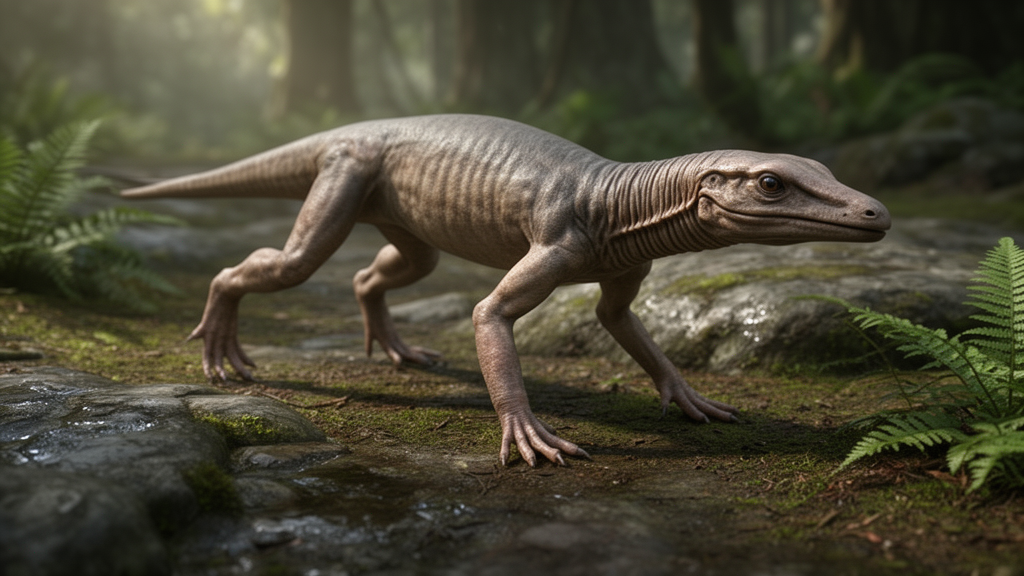
The first vertebrates to move onto land may have possessed necks that were too stiff to turn their heads much, according to a peer-reviewed biomechanical study that combined fossil anatomy with experiments on living sturgeon. Rather than emerging so early vertebrates could scan their surroundings, the distinct separation of the head from the shoulders was probably tied to changes in the body and front limbs associated with locomotion. The findings challenge a long-standing hypothesis that greater neck mobility was the principal evolutionary driver behind the separation of the head and shoulder region in the ancestors of four-limbed animals, or tetrapods.
The study, published in Nature on October 14, 2026, focused on transitional fishes from the Devonian Period, roughly 420 to 360 million years ago. These animals combined aquatic features with traits associated with life in shallow water or on land, including more robust fins that may have supported their weight or propelled them along the substrate. They also possessed the first distinct neck regions found in this evolutionary sequence. Among the most informative fossils was Tiktaalik roseae, a 375-million-year-old fish discovered on Ellesmere Island in Nunavut, Canada, and first described in 2006. Because Tiktaalik is a close relative of limbed vertebrates, its anatomy can illuminate intermediate stages in the transition from swimming to weight-bearing movement and from water to land.
For decades, researchers have commonly interpreted the appearance of a neck as an adaptation that gave early tetrapods more freedom to look down, look from side to side, find food and avoid predators. That proposal became particularly compelling when fossils such as Tiktaalik revealed that the shoulder girdle was no longer rigidly attached to the skull. Under this interpretation, separating the head from the shoulders would have allowed the head to move independently and would therefore have been advantageous as vertebrates entered shallow water and terrestrial environments. Reconstructing the function of the region remains difficult, however, because much of the vertebral column of these ancient animals consisted of soft tissue that is rarely preserved as fossils.
The new research addressed that evidential problem by modeling the mechanical behavior of the unusually constructed backs of early tetrapods. Unlike the bodies of most living vertebrates, these animals had small vertebrae arranged around a long, continuous rod of tissue called the notochord. Because the notochord behaves differently from the joints between modern vertebral bones, standard models of neck movement could not reliably represent the early tetrapod body plan. The researchers therefore tested the material properties of the notochord in modern sturgeon, a living fish with a broadly comparable vertebral structure, and transferred those measured properties into models of fossil animals including Tiktaalik.
Sturgeon provided a useful mechanical analogue because their vertebral columns are built in a broadly similar way to those of early tetrapods, even though the modern fish do not possess a neck in the same sense. In sturgeon and other typical fishes, the shoulder girdle attaches directly to the skull, so turning to one side requires rotating much or all of the body. The new simulations used experimentally established notochord stiffness to estimate what the head and neck of the fossil vertebrates could do when their head-to-shoulder separation was represented in the models. The results showed that the modeled necks were unexpectedly stiff. Even where the head and shoulders were clearly separated, the early tetrapods would have had little ability to rotate the head independently.
“We know that tetrapods did eventually gain higher neck mobility,” said Dana Korneisel, a postdoctoral researcher at Uppsala University in Sweden and the study’s first author. “Clearly it was advantageous eventually, but it was not an advantage available to these early tetrapods yet because of the limitations of their anatomy.” Head elevation in the modeled animals was no greater than might be expected in fish and in some cases was lower. The researchers also found that the twisting motion associated with shaking one’s head was not feasible for these animals. These results are model-based estimates of the movement permitted by the backbone, rather than direct observations of fossil behavior.
The team emphasized that its calculations considered only the notochordal vertebral column. Muscles, skin and, in some of the animals, bones embedded within the skin also surrounded the backbone and could have restricted movement further. On that basis, actual mobility may have been less than the simulations suggest, although the authors stressed that the model estimates serve as a mechanical reconstruction rather than a complete account of the living animals. The approach combines information preserved in fossils with physical measurements from an extant species to infer how anatomical changes affected function during the transition to life on land.
Tom Stewart, an assistant professor of biology at Penn State and a coauthor of the study, said the broader anatomical changes at the time were radical. “This is a really interesting time in Earth’s history where some of the first forests are forming, and there’s a really radical reorganization of the Earth,” he said. Understanding when the lineage moved from water to land, how the transition occurred and which anatomical systems changed is central to reconstructing that history. Many skeletal changes seen around 380 million years ago remain evident in the bodies of living animals, including tetrapods such as humans.
Stewart also cautioned that reconstructing where early tetrapods lived, how they moved and what behaviors they exhibited is difficult from the fossil record. The study’s mechanical perspective offers a way to interpret anatomical structures in functional terms: the distinct neck may reflect the reorganization of the body and forelimbs during locomotion, even if it did not initially provide a substantial increase in head mobility. The international research team included scientists from Penn State, Uppsala University, the University of Washington, the University of Ottawa and Carleton University. The results do not indicate that neck mobility was unimportant to tetrapod evolution; rather, they suggest that substantial mobility was not yet available to the earliest animals in this transitional sequence, and that the initial separation of the head and shoulders is better explained by other anatomical changes than by the need to look around more freely.
Subject of Research: Biomechanical modeling of neck mobility in early tetrapods using fossil anatomy and a modern sturgeon analogue.
Article Title: Why did animals evolve necks? Study reveals it wasn’t for turning their heads
Article References: Why did animals evolve necks? Study reveals it wasn’t for turning their heads. Original publication (Bibliographic details unavailable.)
Image Credits: AI Generated
DOI: Not provided
Keywords: early tetrapods, neck evolution, Tiktaalik, biomechanics, notochord, sturgeon, fossil anatomy, locomotion, tetrapod evolution, animals, evolve, necks
Cite Scienmag News
Gavin Prescott. (October 22, 2026). Early land animals evolved stiff necks for locomotion, not head movement. Scienmag. https://scienmag.com/early-land-animals-evolved-stiff-necks-for-locomotion-not-head-movement/
Gavin Prescott. "Early land animals evolved stiff necks for locomotion, not head movement." Scienmag, 22 October 2026, https://scienmag.com/early-land-animals-evolved-stiff-necks-for-locomotion-not-head-movement/. Accessed 22 October 2026.
Gavin Prescott. "Early land animals evolved stiff necks for locomotion, not head movement." Scienmag. October 22, 2026. https://scienmag.com/early-land-animals-evolved-stiff-necks-for-locomotion-not-head-movement/


