


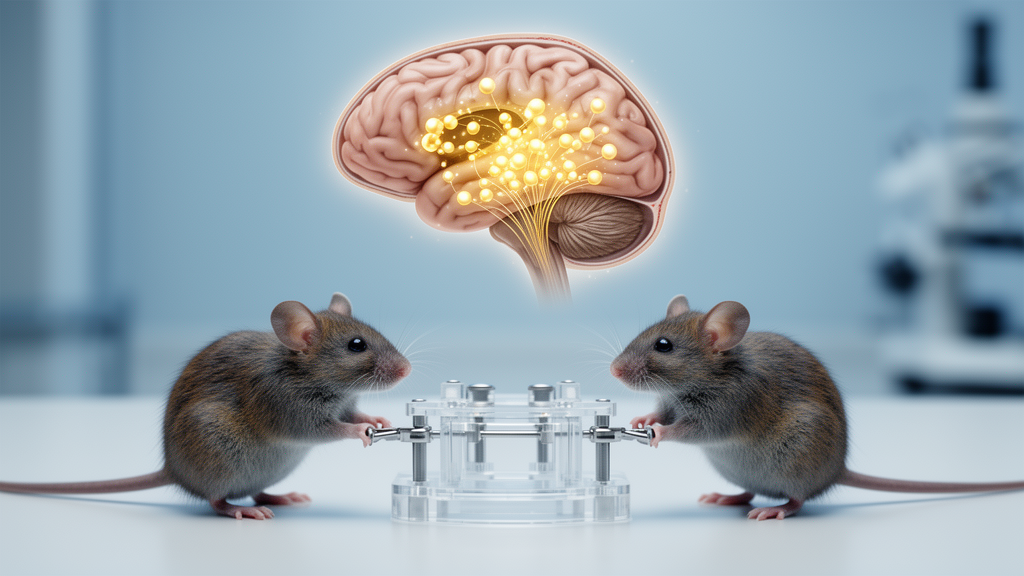
Two male C57BL/6J mice learning to coordinate nose pokes developed stronger and more synchronized dopamine signals in the nucleus accumbens as their cooperation improved, according to a study of learned social behavior. The action-linked signal was present when successful coordination occurred independently of immediate water delivery, while blocking dopamine D1 receptors selectively impaired cooperative performance at a dose that did not significantly reduce locomotion or independent nose-poke behavior. The results link accumbal dopamine signaling to the maintenance of cooperation, but they do not establish that dopamine assigns a subjective reward value to cooperative actions or that the same mechanism applies across species and social settings.
The researchers combined a mouse nose-poke task with fiber photometry, which used an optical fiber to measure fluorescence from the genetically encoded dopamine sensor GRABDA3m. After individual training in which nose pokes were associated with water, trained animals were paired in adjacent compartments separated by an opaque perforated divider that permitted social communication. A cooperative trial succeeded only when both mice completed sequential nose pokes within a one-second cooperation window. If the interval between their pokes exceeded that window, the trial was counted as a failure and neither mouse received water.
Over seven days of cooperative testing, the mice showed a progressive learning curve. The success rate rose from an extremely low initial level to approximately 15% by the end of training, while the number of successful trials increased to an average of about 23 per day. Latency to the first successful cooperation shortened and stabilized at around 50 seconds. The interval between the two animals’ pokes also became more concentrated within a shorter period, indicating that the improvement was not simply an increase in individual action frequency. The animals learned to arrange their actions into a precise temporal sequence.
Dopamine dynamics in the nucleus accumbens tracked that learning process. On the first day of cooperative training, dopamine transients did not differ significantly between successful and failed trigger actions. As proficiency increased, successful cooperative pokes evoked robust dopamine transients, whereas failed pokes did not produce a significant response. The area under the curve associated with successful pokes increased with training and was positively related to the cooperation success rate, with the reported linear regression accounting for 48.01% of the variation in that measure. Dopamine signals recorded from the two mice also became more synchronized, and this inter-brain correlation was positively associated with behavioral success. Signals associated with reward acquisition changed less over the same period.
Control experiments tested whether the response could instead be explained by the physical nose poke, motor vigor, partner presence or generalized social arousal. In a non-cooperative condition, pairs of mice received water independently for their own pokes while retaining the same broad social exposure to the apparatus and partition. In an independent-action condition, one mouse performed the task while the adjacent compartment remained empty. The non-cooperative and independent groups produced similar numbers of nose pokes. Cooperating mice, by contrast, had longer response latencies because they had to wait for alignment with a partner rather than simply acting as fast as possible. Despite comparable poke behavior and overall locomotor activity, only the cooperative group developed strong poke-locked dopamine transients late in training. In both control groups, little or no enhancement of the poke-stage signal was detected, while dopamine activity was concentrated around reward delivery.
Additional manipulations separated cooperative action from sensory cues and primary reward. During water-reward extinction, successful coordination continued to trigger the success tone, but no water was delivered. Dopamine activity associated with licking declined across the extinction trials, consistent with weakening of the reward response, whereas the dopamine transient following the cooperative poke remained unchanged. In a separate cue-extinction test, the success tone was removed while water reward was retained; both the poke-related and reward-related dopamine signals remained stable. The authors did not retrain the animals between these conditions because restoring the cue-reward association would have weakened the extinction test.
The researchers also introduced a two-second delay between successful coordinated pokes and reward delivery. Cooperating mice showed dopamine peaks both at the coordinated poke and at the later reward, whereas independently acting mice showed a response confined to reward delivery, with little or no significant poke-stage release. At the two-second delay, the poke-stage dopamine area was significantly greater in the cooperative group than in the independent group, while the groups did not differ significantly at the reward stage. Together, the extinction and delay experiments associate the action-linked signal with successful coordination rather than with reward delivery, a success tone or a simple expectation of the upcoming outcome.
These recordings and interventions focused on the medial shell of the nucleus accumbens, a subregion that the study connects with context-dependent motivational processing. The source also notes that this territory receives input from ventral tegmental area dopamine neurons whose response properties are not fully captured by classical reward-prediction-error models. However, the experiments did not directly identify the dopamine neurons or upstream inputs that generated the measured population signal. Fiber photometry cannot resolve individual neurons, projection-defined cell populations or the separate contributions of arousal, attention and other motivational states. The findings therefore support an association between medial-shell dopamine dynamics and successful coordination rather than a complete circuit-level explanation.
Task reversal showed that the learned dopamine pattern could persist after the behavior that first induced it changed. Mice trained to cooperate switched to the independent task and immediately adopted faster, simpler performance, yet their poke-evoked dopamine response remained robust and did not decay to the lower level characteristic of mice trained only to act independently. In the opposite direction, mice moved from independent action to cooperation developed successful-poke dopamine transients progressively as their cooperation success improved. This asymmetry suggested a form of behavioral inertia in the neural representation. The persistence of the signal after reversal may reflect experience-dependent plasticity, but the experiment did not directly distinguish intrinsic-value coding from habit-like stabilization or consolidation.
To test causality, the researchers locally infused the D1-receptor antagonist SCH-23390 into the nucleus accumbens after the animals had mastered their tasks. A low dose of 0.05 micrograms per side caused a sharp, reversible reduction in cooperative success rate and number of successful trials. Total distance traveled did not differ significantly from the saline condition, arguing against general motor impairment as the explanation. At the same dose, independently acting mice retained their nose-poke performance and movement, while a high dose of 0.5 micrograms per side produced broader behavioral inhibition in both groups. The selective effect of the lower dose provides causal evidence that D1-receptor signaling contributes to maintaining cooperative behavior more strongly than to simple individual reward seeking. It does not reveal whether that contribution operates through motivational value, execution gain, intrinsic-value coding or another process required for coordination.
Several limitations define the study’s scope. It included only two-month-old male mice, so the findings’ generality across sexes is unknown. Cooperation was operationalized as narrowly timed nose pokes in a controlled apparatus, and the findings may not extend to more flexible or ecologically natural social behavior. The investigators did not compare the nucleus accumbens core or lateral shell, so the response may be specific to the medial shell or shared across subregions. The population-level optical measurement also cannot identify the relevant dopamine cell types or inputs. In addition, the resistance of the signal to reward omission could reflect goal-directed valuation, experience-dependent stabilization or habit-like mechanisms, which require dedicated social outcome-devaluation tests to distinguish. The evidence supports the conclusion that accumbal dopamine dynamics track successful coordination and that D1-receptor signaling helps sustain cooperation in this mouse task, while leaving broader interpretations and applications to future research.
Subject of Research: Nucleus accumbens dopamine dynamics during learned cooperation in male mice
Article Title: Dopamine dynamics promote cooperative behavior not just the rewards accompanying cooperation
Article References: Chai, K., Cai, J., Zhuo, Y., Da, N., Wang, W., Liu, H., Yao, D., Xia, Y., Chen, K., & Li, L. (2026). Dopamine dynamics promote cooperative behavior not just the rewards accompanying cooperation. iScience, 29(11), Article 117787. https://doi.org/10.1016/j.isci.2026.117787
Image Credits: AI Generated
DOI: 10.1016/j.isci.2026.117787
Keywords: cooperation, dopamine, nucleus accumbens, D1 receptors, mouse behavior, fiber photometry, social neuroscience, reward processing, motivational signaling, behavioral learning, dynamics, promote
Cite Scienmag News
Cassandra Pierce. (October 22, 2026). Accumbal dopamine tracks successful coordination and supports cooperation in male mice. Scienmag. https://scienmag.com/accumbal-dopamine-tracks-successful-coordination-and-supports-cooperation-in-male-mice/
Cassandra Pierce. "Accumbal dopamine tracks successful coordination and supports cooperation in male mice." Scienmag, 22 October 2026, https://scienmag.com/accumbal-dopamine-tracks-successful-coordination-and-supports-cooperation-in-male-mice/. Accessed 22 October 2026.
Cassandra Pierce. "Accumbal dopamine tracks successful coordination and supports cooperation in male mice." Scienmag. October 22, 2026. https://scienmag.com/accumbal-dopamine-tracks-successful-coordination-and-supports-cooperation-in-male-mice/


