

Wednesday, October 21, 2026
Science
No Result
View All Result
  • Login
  • HOME
  • SCIENCE NEWS
  • CONTACT US
  • HOME
  • SCIENCE NEWS
  • CONTACT US
No Result
View All Result
Scienmag
No Result
View All Result
Home Science News Cancer

ACSS2 inhibition boosts cabozantinib activity in liver cancer models

October 21, 2026
in Cancer
Nathaniel Bowman
By Nathaniel Bowman Scienmag Editorial Profile - Precision Oncology
Reading Time: 2 mins read
0
ACSS2 inhibition boosts cabozantinib activity in liver cancer models

ACSS2 inhibition boosts cabozantinib activity in liver cancer models

65
SHARES
587
VIEWS
Share on FacebookShare on Twitter
ADVERTISEMENT

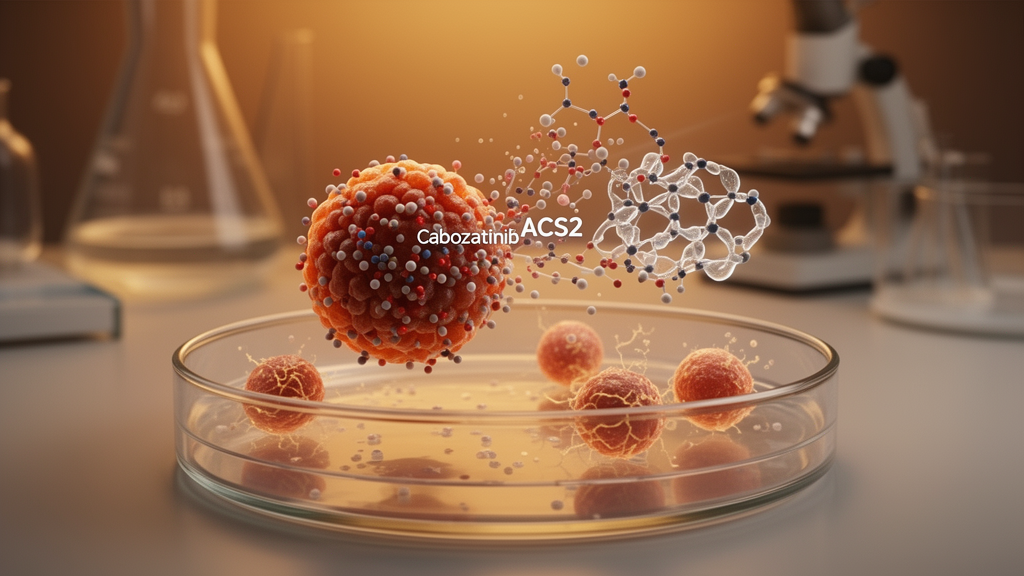
Cabozantinib increased autophagic flux in hepatocellular carcinoma cells, helping protect the cancer cells from the drug’s growth-inhibitory and pro-apoptotic effects, according to a laboratory study. Combining cabozantinib with either an inhibitor of ACSS2 or the autophagy inhibitor chloroquine enhanced antitumor activity in cell cultures and animal models. The findings identify a potential resistance mechanism and a candidate combination strategy, but they do not establish clinical benefit in people with hepatocellular carcinoma.

Researchers used RNA sequencing to analyze changes in gene expression after cabozantinib treatment in hepatocellular carcinoma cells. They also used a luciferase reporter assay to measure the transcriptional activity of transcription factor EB, or TFEB. Additional experiments examined the effects of cabozantinib alone or in combination with autophagy inhibitors, with findings assessed in vitro and in vivo. The study’s mechanistic and therapeutic experiments were conducted in preclinical models rather than in patients.

The mechanistic results indicated that cabozantinib increased the expression of acetyl-CoA synthetase 2, or ACSS2, and promoted its nuclear translocation. Nuclear ACSS2 was linked to activation of TFEB. TFEB then bound to promoter regions of lysosomal and autophagy-related genes, promoting lysosomal biogenesis and inducing autophagic flux. Thus, the experiments placed ACSS2 upstream of TFEB-dependent autophagy in the response of hepatocellular carcinoma cells to cabozantinib. The authors described this process as a protective response that counteracted the drug-induced inhibition of cell growth and apoptosis.

Impairing autophagy increased the cancer-cell killing associated with cabozantinib. Downregulating ACSS2 promoted cabozantinib-induced apoptosis, while treatment with an ACSS2 inhibitor enhanced the antitumor efficacy of cabozantinib in vitro and in vivo. Chloroquine produced a similar enhancement when used in combination with cabozantinib, supporting the conclusion that blocking autophagic flux can increase sensitivity to the treatment. These results were reported across both cell-based and animal experiments, although the supplied study abstract does not provide numerical response measures, statistical results, model details or other effect-size estimates.

The study proposes that cabozantinib can induce an ACSS2-TFEB-autophagy pathway that allows hepatocellular carcinoma cells to resist treatment, and that inhibiting ACSS2 or autophagy may counteract that response. The work offers a mechanistic basis for examining cabozantinib-based combinations in hepatocellular carcinoma. Its scope is preclinical: the reported evidence comes from cancer cells and animal models, not a clinical trial. Accordingly, the results show enhanced antitumor activity in experimental models and do not yet demonstrate that the combinations improve outcomes for patients with liver cancer.

Subject of Research: Preclinical enhancement of cabozantinib activity in hepatocellular carcinoma through ACSS2 and autophagy inhibition

Article Title: Inhibition of ACSS2 enhances cabozantinib sensitivity by blocking TFEB-induced autophagic flux in hepatocellular carcinoma

Article References: Feng, X., Lan, J., Du, J., Jiang, C., Qiu, G., Song, Y., Zhou, X., Zhang, Z., Xu, L., Hu, D., Liang, Y., Huang, J., Zeng, Y., & Yuan, K. (2026). Inhibition of ACSS2 enhances cabozantinib sensitivity by blocking TFEB-induced autophagic flux in hepatocellular carcinoma. British Journal of Cancer. https://doi.org/10.1038/s41416-026-03538-3

Image Credits: AI Generated

DOI: 10.1038/s41416-026-03538-3

Keywords: hepatocellular carcinoma, cabozantinib, ACSS2, TFEB, autophagic flux, drug resistance, chloroquine, lysosomal biogenesis, cancer cells, animal models, Inhibition, enhances

Cite Scienmag News

Nathaniel Bowman. (October 21, 2026). ACSS2 inhibition boosts cabozantinib activity in liver cancer models. Scienmag. https://scienmag.com/acss2-inhibition-boosts-cabozantinib-activity-in-liver-cancer-models/

Nathaniel Bowman. "ACSS2 inhibition boosts cabozantinib activity in liver cancer models." Scienmag, 21 October 2026, https://scienmag.com/acss2-inhibition-boosts-cabozantinib-activity-in-liver-cancer-models/. Accessed 21 October 2026.

Nathaniel Bowman. "ACSS2 inhibition boosts cabozantinib activity in liver cancer models." Scienmag. October 21, 2026. https://scienmag.com/acss2-inhibition-boosts-cabozantinib-activity-in-liver-cancer-models/


Tags: ACSS2ACSS2 inhibition in liver canceranimal modelsautophagic fluxautophagic flux in cancer cell survivalautophagy inhibitors in hepatocellular carcinomacabozantinibcabozantinib resistance mechanisms in hepatocellular carcinomacancer cellschloroquinecombination therapy with autophagy inhibitors in liver cancerdrug resistanceenhancesgene expression analysis in cancer drug responsehepatocellular carcinomainhibitionlysosomal biogenesislysosomal biogenesis in hepatocellular carcinomapreclinical models of liver cancer treatmentrole of autophagy in cancer therapytargeting ACSS2 to enhance cancer therapyTFEBTFEB activation in cancer cells
Share26Tweet16
Previous Post

Review maps microbial and nano strategies against agricultural soil contaminants

Next Post

Review of 180 studies examines climate links to Candida auris threats

Related Posts

Moderate exercise protects against osteoarthritis in mice through gut microbes
Cancer

Moderate exercise protects against osteoarthritis in mice through gut microbes

October 21, 2026
Research report: Targeting the gut-liver axis: New review explores microbial modulation to enhance immunotherapy in hepatocellular carcinoma
Cancer

Research report: Targeting the gut-liver axis: New review explores microbial modulation to enhance immunotherapy in hepatocellular carcinoma

October 21, 2026
Small spatial-transcriptomics study links metabolism to T-cell exclusion in esophageal adenocarcinoma
Cancer

Small spatial-transcriptomics study links metabolism to T-cell exclusion in esophageal adenocarcinoma

October 21, 2026
Research report: Subnational inequalities and socioeconomic gradients in prostate cancer burden across Mexico, 2000–2023
Cancer

Research report: Subnational inequalities and socioeconomic gradients in prostate cancer burden across Mexico, 2000–2023

October 21, 2026
Single-arm trial finds preliminary hetrombopag activity in gynecologic cancer
Cancer

Single-arm trial finds preliminary hetrombopag activity in gynecologic cancer

October 21, 2026
Meta-analysis finds improved heart function with CRT after cancer treatment
Cancer

Meta-analysis finds improved heart function with CRT after cancer treatment

October 21, 2026
Next Post
Review of 180 studies examines climate links to Candida auris threats

Review of 180 studies examines climate links to Candida auris threats

  • Mothers who receive childcare support from maternal grandparents show more optimized

    Mothers who receive childcare support from maternal grandparents show more parental warmth, finds NTU Singapore study

    27656 shares
    Share 11059 Tweet 6912
  • University of Seville Breaks 120-Year-Old Mystery, Revises a Key Einstein Concept

    1061 shares
    Share 424 Tweet 265
  • Bee body mass, pathogens and local climate influence heat tolerance

    682 shares
    Share 273 Tweet 171
  • Researchers record first-ever images and data of a shark experiencing a boat strike

    546 shares
    Share 218 Tweet 137
  • Groundbreaking Clinical Trial Reveals Lubiprostone Enhances Kidney Function

    531 shares
    Share 212 Tweet 133
Science

Embark on a thrilling journey of discovery with Scienmag.com—your ultimate source for cutting-edge breakthroughs. Immerse yourself in a world where curiosity knows no limits and tomorrow’s possibilities become today’s reality!

RECENT NEWS

  • Review of 180 studies examines climate links to Candida auris threats
  • ACSS2 inhibition boosts cabozantinib activity in liver cancer models
  • Review maps microbial and nano strategies against agricultural soil contaminants
  • Moderate exercise protects against osteoarthritis in mice through gut microbes

Categories

  • Agriculture
  • Anthropology
  • Archaeology
  • Athmospheric
  • Biology
  • Biotechnology
  • Blog
  • Bussines
  • Cancer
  • Chemistry
  • Climate
  • Earth Science
  • Editorial Policy
  • Marine
  • Mathematics
  • Medicine
  • Pediatry
  • Policy
  • Psychology & Psychiatry
  • Science Education
  • Science News
  • Social Science
  • Space
  • Technology and Engineering

Subscribe to Blog via Email

Enter your email address to subscribe to this blog and receive notifications of new posts by email.

Join 5,150 other subscribers

© 2025 Scienmag - Science Magazine

Welcome Back!

Login to your account below

Forgotten Password?

Retrieve your password

Please enter your username or email address to reset your password.

Log In
No Result
View All Result
  • HOME
  • SCIENCE NEWS
  • CONTACT US

© 2025 Scienmag - Science Magazine

Discover more from Science

Subscribe now to keep reading and get access to the full archive.

Continue reading