


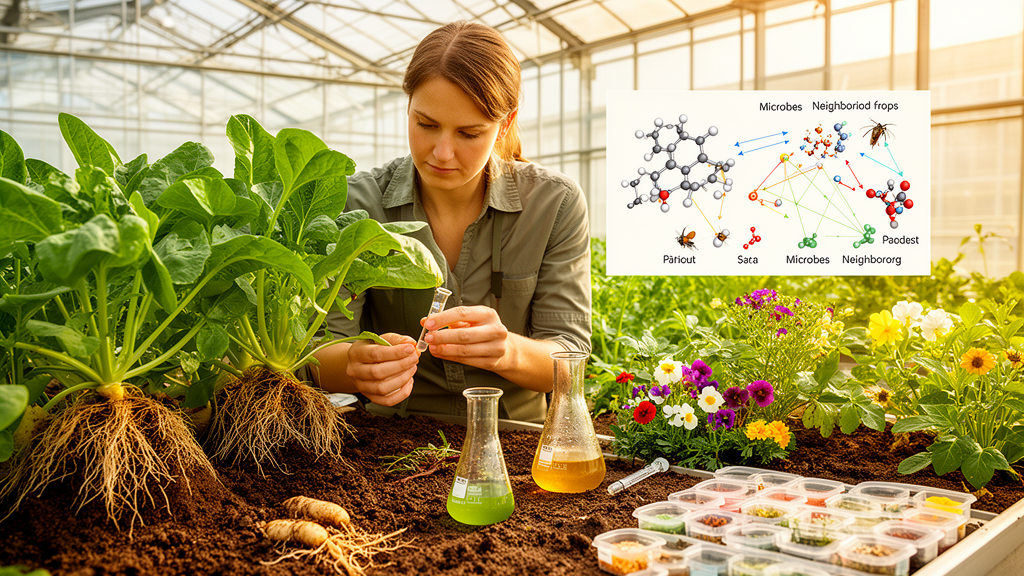
Plant-derived compounds can alter the performance of neighboring plants and influence crop–weed dynamics, community assembly and environmental filtering, according to a review in Plant Biosystems. The review frames allelopathy as a set of chemically mediated interactions whose effects depend strongly on donor–receiver identity, evolutionary history, dose, exposure duration and environmental context. It also cautions that inhibitory effects must be distinguished from chemical perception, while field-scale agricultural applications remain constrained by uncertainty about realistic exposure and bioavailable concentrations.
The review identifies four principal routes through which plants release compounds. These include root exudation, volatilization, foliar leaching and the decomposition of residues. After release, the chemicals encounter soil processes that can determine whether they persist, move or change form. Soil sorption can reduce a compound’s availability, while abiotic transformation and microbial biotransformation can alter it. The review therefore treats the amount detected in soil as different from the concentration that is actually bioavailable to a plant, an important distinction for interpreting agricultural experiments.
Allelopathy is not equivalent to phytotoxicity alone. The review emphasizes that direct inhibition is only one possible outcome of chemical interaction. At low or sublethal concentrations, compounds may instead function as informational cues that plants perceive and recognize. Such chemical perception is part of the broader interaction framework, but the abstract does not specify particular plant responses to individual cues. This distinction is necessary because a chemical effect that appears inhibitory at one concentration or exposure duration cannot automatically be interpreted as the same kind of effect under every condition.
The magnitude of an allelopathic effect is also shaped by the identity of the donor plant and the receiver plant. Evolutionary history is included among the factors that can modify outcomes, indicating that the same chemical interaction may not produce the same result across species or ecological contexts. The review also highlights the possibility that natural effects reflect additive or synergistic activity among multiple metabolites rather than the action of one compound. As a result, conclusions based on a single chemical, donor or experimental setting may have limited reach in living plant communities.
These mechanisms connect allelopathy to broader ecological processes. The review places chemical mediation alongside community assembly and environmental filtering, showing how plant chemistry can contribute to the structure of plant assemblages. Evidence from invasion ecology is described as consistent with the Novel Weapons Hypothesis in some systems, but the authors warn against treating that pattern as a universal explanation. The relevant evidence is qualified by system-specific variation and by the multiple factors that determine whether a chemical interaction produces a measurable ecological effect.
In agriculture, the review identifies several possible applications for allelopathy. These include weed-suppressive crops, crop residues, cover crops and the discovery of bioherbicides. The proposal is not that these applications are already established as reliable field solutions. Instead, the review highlights their potential and identifies a central barrier: controlled observations may not represent the concentrations and mixtures encountered in an agricultural field. Bioavailable allelochemicals must be quantified under realistic conditions before an observed laboratory or plot-level effect can support dependable management use.
Future progress, the authors argue, depends on experiments that separate chemical interference from resource competition and the physical effects of residues. This separation is essential because plants can affect one another through several routes at once, and a plant’s response cannot automatically be assigned to chemistry alone. The review also calls for measurements of bioavailable allelochemicals in situ, rather than relying solely on concentrations detected in soil or controlled assays. Incorporating microbial activity and spatial and temporal variation would further reflect the processes that shape chemical exposure in field environments.
Overall, the review presents allelopathy as a promising but conditional component of sustainable weed management and resilient agroecosystem design. Its central conclusion is not that plant chemistry guarantees a weed-control benefit, but that agricultural applications depend on accurately identifying the compounds, pathways, exposures and ecological conditions involved. The authors’ proposed research agenda—distinguishing chemical effects from other interactions, measuring available compounds in place, and accounting for microbial and spatiotemporal dynamics—offers a framework for testing whether allelopathic potential can become a reliable practical tool.
Subject of Research: Mechanisms and ecological roles of plant allelopathy in agriculture
Article Title: Plant–plant chemical interactions in agriculture: mechanisms and ecological roles of allelopathy
Article References: Nguyen, G. H., Phan, N. N. M., & Ho, L. T. (2026). Plant–plant chemical interactions in agriculture: mechanisms and ecological roles of allelopathy. Plant Biosystems, 160(6), Article 296. https://doi.org/10.1007/s44473-026-00332-0
Image Credits: AI Generated
DOI: 10.1007/s44473-026-00332-0
Keywords: allelopathy, plant chemistry, crop–weed interactions, weed management, root exudates, soil microbes, bioherbicides, agroecosystems, community assembly, plant invasion, Plant, chemical
Cite Scienmag News
Alan Morgan. (October 21, 2026). Review maps how plant chemistry shapes interactions in agriculture. Scienmag. https://scienmag.com/review-maps-how-plant-chemistry-shapes-interactions-in-agriculture/
Alan Morgan. "Review maps how plant chemistry shapes interactions in agriculture." Scienmag, 21 October 2026, https://scienmag.com/review-maps-how-plant-chemistry-shapes-interactions-in-agriculture/. Accessed 21 October 2026.
Alan Morgan. "Review maps how plant chemistry shapes interactions in agriculture." Scienmag. October 21, 2026. https://scienmag.com/review-maps-how-plant-chemistry-shapes-interactions-in-agriculture/


