


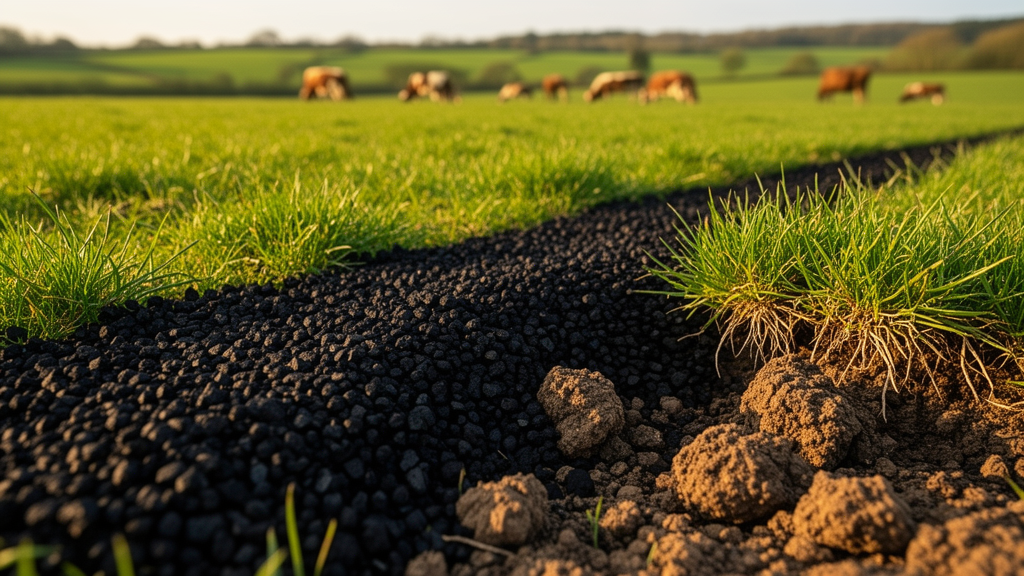
Adding woody biochar to acidic, coarse-textured soil improved aboveground productivity in a field experiment in northern Portugal, according to a study in Plant and Soil. Plots treated with biochar produced 9 tonnes per hectare, compared with 6 tonnes per hectare in untreated plots. The treatment also increased protein yield by 52%, reduced soil hardness in deeper layers and improved several aspects of the soil’s nutrient and moisture conditions.
The researchers used a randomized block field experiment with 10 replicate plots, each measuring 3 by 3 metres. Woody biochar was incorporated homogeneously into the topsoil at 4% by weight in a sown biodiverse pasture. The study addressed conditions associated with the acidic granitic soils found across northern and central Portugal, where nutrient limitations, aluminum and manganese toxicity, low water retention and hard-setting layers can restrict plant growth. The experiment therefore examined a combined set of chemical, physical and water-related constraints rather than a single measure of pasture performance.
Biochar’s improvement in soil nutrient status did not mainly come from raising the availability of all nutrients. The exception was potassium, whose availability increased, while total nitrogen and organic matter also rose in the soil. The treatment reduced the concentrations of some antagonistic soil metals, including aluminum, manganese and iron, although the authors noted that the decreases in manganese and iron were not fully clear. It also reduced the antagonism exerted by aluminum and manganese on calcium and magnesium uptake and lowered the ratios of those metals relative to available phosphorus. In plant tissue, grasses had increased potassium and decreased manganese, forbs had increased nitrogen and sulfur, and legumes had reduced magnesium and zinc concentrations.
Moisture responses depended on depth. Biochar increased topsoil moisture content by 31%, but subsoil moisture content decreased. Despite that contrast, extreme drought stress was eliminated during the critical flowering period in this experiment. The result shows how an amendment can produce different effects in different parts of the soil profile while addressing a major stress period for the pasture. The study’s plot-based design and specific treatment rate describe the response under the tested conditions; the findings do not by themselves establish how the same application would perform in every pasture, soil or management setting.
Biochar also reduced measured soil hardness by 29% to 68% in deeper layers, but it did not reduce hardness in the topsoil. The deeper response was not described as more pronounced than the topsoil result, and the physical effect therefore differed with depth. Plant gains were concentrated in grasses and legumes, while forb biomass did not increase. Across the pasture, productivity rose from 6 to 9 tonnes per hectare, accompanied by the 52% increase in protein yield. The authors present biochar as a potentially multifunctional option for acidic, coarse, drought-affected granitic soils, with possible relevance to reducing the need for separate measures such as dolomitic liming, mechanical treatment or irrigation. Those are potential implications of the results, not direct demonstrations that biochar replaces those practices.
Subject of Research: Effects of woody biochar on productivity, soil nutrients, moisture and hardness in a Mediterranean sown pasture
Article Title: Biochar application to soil alleviates nutrient limitation, drought stress, and soil hardness, while improving aboveground productivity in a Mediterranean sown pasture
Article References: Jelinčić, A., Verheijen, F. G. A., Simões, L. B., Jongen, M., Gonzalez-Pelayo, O., Santos, V., Jeffery, S., Domingos, T., & Bastos, A. C. (2026). Biochar application to soil alleviates nutrient limitation, drought stress, and soil hardness, while improving aboveground productivity in a Mediterranean sown pasture. Plant and Soil. https://doi.org/10.1007/s11104-026-09157-4
Image Credits: AI Generated
DOI: 10.1007/s11104-026-09157-4
Keywords: biochar, Mediterranean pasture, soil nutrients, drought stress, soil hardness, pasture productivity, protein yield, granitic soils, soil amendment, field experiment, application, soil
Cite Scienmag News
Alan Morgan. (October 21, 2026). Biochar boosts pasture productivity while easing soil constraints. Scienmag. https://scienmag.com/biochar-boosts-pasture-productivity-while-easing-soil-constraints/
Alan Morgan. "Biochar boosts pasture productivity while easing soil constraints." Scienmag, 21 October 2026, https://scienmag.com/biochar-boosts-pasture-productivity-while-easing-soil-constraints/. Accessed 21 October 2026.
Alan Morgan. "Biochar boosts pasture productivity while easing soil constraints." Scienmag. October 21, 2026. https://scienmag.com/biochar-boosts-pasture-productivity-while-easing-soil-constraints/


