


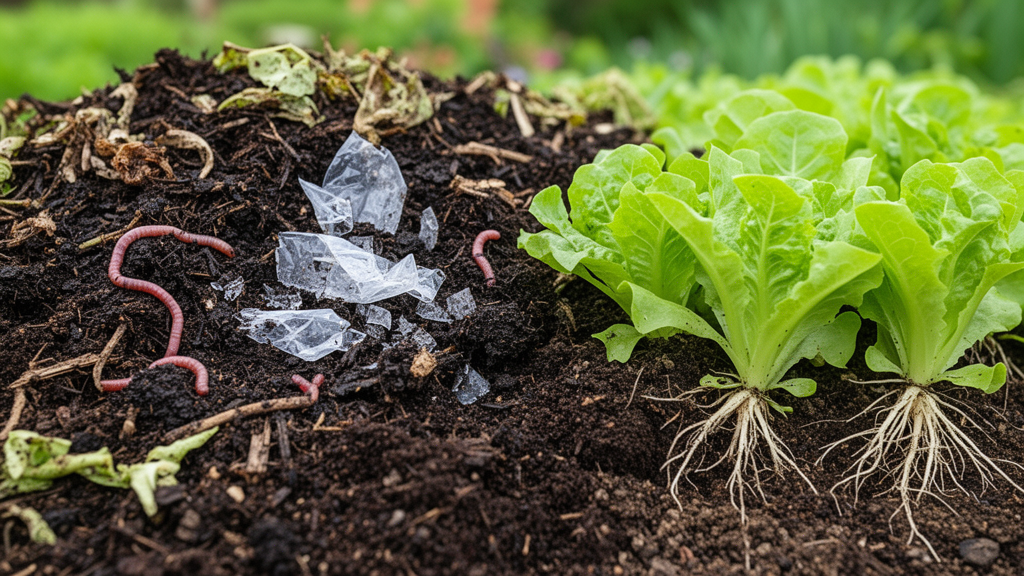
Certified biodegradable and compostable plastics left municipal organic waste compost mature, stable and within regulatory limits, while compost made with the highest plastic content stimulated the strongest soil microbial responses in a controlled lettuce study. Researchers in Italy prepared three composts under industrial conditions: one without compostable plastic, one containing 1.43% plastic in the incoming municipal organic waste, and one containing 2.86%. The two plastic levels represented the national average and twice that average. After screening and characterization, the composts were applied to silty agricultural soil from Piedmont in a six-week incubation and a separate four-week pot experiment with lettuce. The results indicate that properly composted certified materials remained compatible with compost production and soil use over the study period, although the experiment does not establish the effects of repeated field applications or long-term residue accumulation.
The three compost matrices had broadly similar chemical properties. On a dry-weight basis, total organic carbon ranged from 26.88% to 28.88%, total nitrogen from 2.62% to 2.89%, and their carbon-to-nitrogen ratios from 9.66 to 10.66. All met the organic-carbon and nitrogen thresholds specified in EU Regulation 2019/1009. Their pH values were alkaline, ranging from 8.02 to 8.13, while electrical conductivity ranged from 4.05 to 4.72 decisiemens per meter. Thermogravimetric analysis also indicated mature, stable material. The ratio between the second and first exothermic events rose from 0.90 in the plastic-free compost to 0.99 in the compost with twice the average plastic content, suggesting a somewhat greater share of thermally stable organic compounds, but not a deterioration in compost quality. Regulated trace elements in all three composts remained below the regulatory limits, and increasing plastic content did not produce a consistent enrichment of potentially toxic elements.
For the soil incubation, each treatment was replicated three times in containers holding the equivalent of 500 grams of dry soil. An unamended control was compared with soils receiving the three composts at a nitrogen-equivalent rate of 100 kilograms per hectare. The soil was held at 23 degrees Celsius and 60% of its water-holding capacity for six weeks. Bulk carbon and nitrogen measures changed only slightly, with no significant treatment differences in total organic carbon or total nitrogen. Compost-amended soils had total organic carbon values about 2% to 5% above the control, while dissolved organic carbon tended to increase, reaching 24% above the control in the treatment containing the average plastic level. These small and partly nonsignificant changes contrasted with clearer responses in soil biological indicators, consistent with the short duration and moderate compost application rate.
Cumulative soil respiration was markedly higher in amended soils. By the end of the 42-day respiration measurement, the soil receiving the highest-plastic compost produced 81% more carbon dioxide than soil amended with plastic-free compost and 63% more than soil amended with compost at the national-average plastic content. The share of added carbon that was respired rose from 12% in the plastic-free treatment to 14% at the average plastic level and 22% at the highest level. The metabolic quotient, which expresses carbon dioxide production relative to microbial biomass carbon, was 97% higher in the highest-plastic treatment than in the unamended control. Because the composts were applied at the same nitrogen-based rate and contained comparable total carbon, the stronger response was associated with differences in compost characteristics rather than simply a larger carbon input. The elevated quotient indicates more respiration per unit of microbial biomass carbon and therefore lower apparent microbial metabolic efficiency, although the experiment cannot identify the precise mechanism responsible.
Microbial nitrogen and several enzyme activities also responded significantly to treatment. Microbial biomass nitrogen was 21% higher than in the unamended control after application of the highest-plastic compost and more than fivefold higher than in soil amended with plastic-free compost. By contrast, plastic-free compost produced the lowest microbial biomass nitrogen value, 74% below the control. Dehydrogenase activity increased by 86%, 92% and 109% over the control in the plastic-free, average-plastic and highest-plastic treatments, respectively. Laccase and tyrosinase activities, which participate in oxidative processes involving complex organic substrates, also responded. Laccase activity was about 7% to 8% above the control in the two plastic-containing treatments. Tyrosinase activity rose by approximately 212% at the average plastic level and 104% at the highest level, meaning the response was not proportional to plastic concentration. N-acetyl-beta-glucosaminidase activity, associated with the breakdown of chitin-derived and other amino-sugar compounds, increased by about 75% and 52% in the two plastic-containing treatments. Beta-glucosidase and phosphomonoesterase activities did not differ significantly.
The pot experiment used the same four treatments with four replicates each, placing three lettuce seedlings, Lactuca sativa cultivar Masaida, in each pot containing the equivalent of one kilogram of dry soil. Plants were maintained at 25 degrees Celsius for four weeks. After the crop was harvested, the amended soils contained 16% to 20% more total organic carbon, 26% to 31% more total nitrogen, 45% to 72% more dissolved organic carbon and 48% to 83% more total dissolved nitrogen than the control. Olsen phosphorus increased by 18% to 22% following lettuce growth, reversing the nonsignificant downward trend observed during the earlier incubation. The fact that phosphorus availability differed after cultivation but did not differ significantly among the three composts suggests that plant-soil processes were more important to this outcome than plastic concentration. Microbial biomass carbon and nitrogen did not differ significantly after lettuce growth, although the highest-plastic treatment had the highest mean values for both.
Lettuce shoot dry biomass increased in every amended treatment, with the greatest rise—26% above the unamended control—recorded in soil receiving the highest-plastic compost. Root biomass and the root-to-shoot ratio were not significantly affected, indicating that compost primarily increased aboveground production rather than changing the allocation of biomass between roots and shoots. Shoot nitrogen and phosphorus uptake did not differ significantly among treatments. Leaf potassium was notably higher in amended plants, increasing by 28% to 44% compared with the control. Leaf iron was lower by 41% to 57%, a pattern that could be associated with changes in soil iron availability, dilution by greater shoot biomass or altered rhizosphere interactions, but the study did not distinguish among these explanations. These findings show that the fertilizing effect of compost persisted despite the presence of certified plastic residues.
Element transfer to the crop did not show evidence of harmful accumulation. Although some DTPA-extractable metals differed after lettuce growth, the pattern was not consistently related to increasing plastic concentration. Chromium was highest in soil receiving the average-plastic compost, while copper fell in that treatment. Extractable iron decreased in the plastic-free and average-plastic treatments, and zinc increased in the plastic-free and highest-plastic treatments, with no single response tracking plastic dose. In lettuce leaves, lead was 26% to 32% lower in amended plants than in controls, zinc remained comparatively stable, and none of the other analyzed elements showed a significant treatment effect. The researchers therefore observed no accumulation of potentially toxic elements in lettuce leaves, even at twice the national-average plastic content. The finding applies to this compost, soil, crop and short experimental duration; it does not establish that repeated applications or exposure under other field conditions would produce the same outcome.
Overall, the study supports a distinction between certified compostable materials that have undergone industrial composting and persistent conventional plastics. At the tested concentrations, the residues did not compromise compost maturity, stability, nutrient quality or regulatory compliance. The composts continued to improve soil carbon, nutrient availability and lettuce shoot growth after application, and the realistic average plastic level generally produced soil responses comparable to plastic-free compost. The strongest signal was not reduced crop performance or toxic-element transfer but a change in microbial functioning, especially greater respiration and a higher metabolic quotient in soil amended with the highest-plastic compost. Because several enzyme responses peaked at the intermediate plastic level and the experiment used one soil, one crop and short controlled periods, the authors call for longer-term field research on repeated compost applications, cumulative exposure and the persistence or transformation of plastic-derived residues in agricultural soil.
Subject of Research: Effects of certified compostable plastic residues in municipal organic waste compost on soil biology, nutrient dynamics and lettuce growth
Article Title: Effects of compostable plastic residues in municipal organic waste compost on soil quality and lettuce growth
Article References: Paesano, A., Cupi, J., Cioffi, N., Gioacchini, P., Ciurli, A., Malena, P., Mazzon, M., & Marzadori, C. (2026). Effects of compostable plastic residues in municipal organic waste compost on soil quality and lettuce growth. Frontiers in Soil Science, 6, Article 1952297. https://doi.org/10.3389/fsoil.2026.1952297
Image Credits: AI Generated
DOI: 10.3389/fsoil.2026.1952297
Keywords: compostable plastics, municipal organic waste, compost quality, soil microbial activity, soil respiration, soil enzymes, nutrient availability, lettuce growth, plant-soil interactions, Effects, compostable, plastic
Cite Scienmag News
Alan Morgan. (October 21, 2026). Compostable plastic residues preserve compost quality and support lettuce growth. Scienmag. https://scienmag.com/compostable-plastic-residues-preserve-compost-quality-and-support-lettuce-growth/
Alan Morgan. "Compostable plastic residues preserve compost quality and support lettuce growth." Scienmag, 21 October 2026, https://scienmag.com/compostable-plastic-residues-preserve-compost-quality-and-support-lettuce-growth/. Accessed 21 October 2026.
Alan Morgan. "Compostable plastic residues preserve compost quality and support lettuce growth." Scienmag. October 21, 2026. https://scienmag.com/compostable-plastic-residues-preserve-compost-quality-and-support-lettuce-growth/


