


A 21-year comparison of three ways of tracking soil organic carbon at a Belgian cropland produced sharply different answers. Direct soil inventories found no significant change in carbon stocks, while the RothC process model estimated a small gain and eddy-covariance measurements implied sustained carbon loss. Across five crop rotations at the Lonzée field site in Wallonia, the flux-derived budget indicated an average loss of 69.8 ± 19.2 grams of carbon per square metre per year, whereas the model projected a gain of 20.4 ± 34.7 grams. The divergence shows that measuring whether cropland is storing or releasing carbon remains methodologically difficult, even when long records, repeated soil sampling and detailed uncertainty calculations are combined.
The study examined a temperate oceanic site that had been cultivated for more than 80 years and included sugar beet, winter wheat and seed potato in a typical four-year rotation, with silage maize and other crops appearing in later years. The analysis covered April 2004 through December 2024, encompassing five rotations and 252 months of flux observations. Most winter wheat periods were followed by mustard cover crops, although other combinations included oats, faba beans, spinach, phacelia and clover. The researchers used sowing-to-sowing intervals so that post-harvest residue decomposition could be assigned as closely as possible to the crop that produced the residues. This also allowed direct comparison with a model that represents soil carbon but not living vegetation.
At the core of the comparison was an eddy-covariance tower measuring exchanges of carbon dioxide, heat and water between the field and atmosphere. The researchers corrected the high-frequency attenuation of carbon-dioxide fluxes, filtered measurements collected under weak turbulence, and filled missing data using the Marginal Distribution Sampling method. Crop-specific seasons replaced conventional three-month periods so that thresholds and gap-filling reflected changing surface conditions through each rotation. Of 363,841 retained half-hourly time steps, 67.0% were direct measurements, 29.4% were gap-filled under constrained meteorological conditions, and 3.52% required a fallback method for scarce observations near crop transitions.
The resulting carbon budget combined net ecosystem exchange with lateral carbon movements. Carbon exported in harvested grain, tubers, straw and other products was subtracted, while carbon imported through farmyard manure, lime-derived inputs, seeds and seed potatoes was added. The investigators propagated uncertainties from measurement error, spectral correction, friction-velocity filtering and the estimates of imported and exported carbon. Systematic errors were accumulated linearly, random errors in quadrature, and covariance among uncertainty sources was assumed to be negligible. The resulting uncertainty was therefore treated as a higher bound. Over the full period, uncertainty was distributed among the major budget components rather than arising overwhelmingly from one processing step.
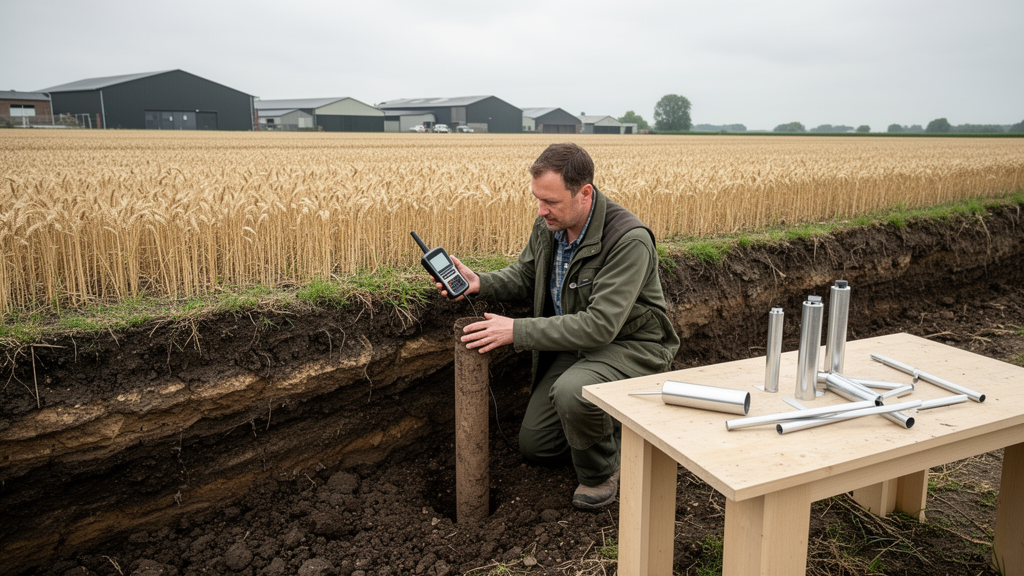
Soil inventories supplied a separate physical check. The 2007 campaign used 61 cores around the tower, whereas the 2017 campaign used 100 samples distributed across the 14-hectare field and deeper soil layers. Stocks were calculated on an equivalent-soil-mass basis and compared with spatially co-located samples. Carbon in the upper 30 centimetres was 3.81 ± 0.38 kilograms per square metre in 2007 and 3.79 ± 0.21 kilograms in 2017; values in the 30-to-60-centimetre layer were also effectively unchanged. Effect-size confidence intervals included zero for both layers, providing no statistical evidence of a stock change from 2007 to 2017. The inventory result was broadly consistent with the RothC simulation for 2017, which estimated a change of −0.28 ± 0.48 kilograms per square metre under the study’s sign convention.
By contrast, the cumulative eddy-covariance budget pointed in the opposite direction. Over five rotations, vegetation took up an estimated 7.72 ± 0.22 kilograms of carbon per square metre, harvest removed 11.5 ± 0.25 kilograms and imported materials added 2.28 ± 0.21 kilograms, producing a net biome productivity of 1.45 ± 0.40 kilograms per square metre. Because positive values denote carbon release, this represented a long-term source trend. The flux signal was much larger than its uncertainty: the cumulative standard deviation of net ecosystem exchange was only about 3% of the measured uptake. Random measurement uncertainty averaged 0.98 grams per square metre per year, while filtering and spectral corrections contributed 8.09 and 6.29 grams, respectively.
The mismatch may reflect incomplete capture of turbulent carbon dioxide exchange by the tower. The site’s energy balance closed by 60.8% over the five rotations, and the study’s carbon balance ratio was approximately 82.5%, consistent with possible underestimation of the absolute carbon flux. A sensitivity test found that assigning 52% of the energy-balance non-closure to carbon dioxide would increase net ecosystem exchange enough to reconcile the flux budget with cumulative net biome productivity. This is a diagnostic relationship, not a validated correction, because the connection between missing energy and carbon fluxes remains uncertain. Other contributors include the omission of dissolved organic and inorganic carbon losses, uncertainty over carbon allocation to the subsoil and differences between what a flux tower and a soil model represent.
Despite their disagreement about the overall balance, the flux and modelling approaches agreed on the importance of management. Both identified winter wheat followed by a cover crop as a moderate net carbon source when no organic amendment was applied. Cover-crop residues and wheat straw were insufficient to offset carbon released through soil respiration. Farmyard manure was the principal external carbon input and emerged as the main driver of accumulation. When manure was added to a winter wheat–cover crop sequence, both methods showed increased soil carbon, although some manure-supported periods had uncertainties too large for a definitive sink classification. The evidence therefore indicates that changing crop sequence alone was not enough at this site; external organic input played the more decisive role.
These findings carry several limits. RothC represented carbon dynamics only in the upper 23 centimetres, although the tower sampled CO₂ exchange from the broader soil profile, and field measurements showed that 16.5 ± 4.2% of winter-wheat root biomass occurred between 30 and 100 centimetres. The model’s final stock change, −0.43 ± 0.73 kilograms per square metre, was smaller than its own uncertainty, and the Monte Carlo analysis sampled uncertain drivers and parameters independently rather than preserving their correlations. The last three months of bare soil after the final cover crop was crushed were omitted, and the study did not quantify nitrous oxide emissions associated with manure. Consequently, the comparison establishes that the methods disagree and identifies robust management patterns, but it does not show that cropland was definitively losing soil carbon or that manure applications necessarily provided a net greenhouse-gas benefit.
The combined result points to a broader lesson for carbon monitoring: no single instrument can supply an unquestioned account of long-term soil carbon change. Flux towers provide continuous information about ecosystem exchange but depend on assumptions and corrections; inventories directly sample stored carbon but cover only two dates; and process models can connect management to carbon pools while remaining sensitive to structure, initial conditions and parameterization. At Lonzée, their disagreement exposes a limitation in translating absolute CO₂ fluxes into soil sequestration. Their agreement on manure and on the weak performance of unamended cover-crop sequences nevertheless provides a stronger basis for interpreting management effects than any one approach alone.
Subject of Research: Comparison of soil organic carbon stock-change estimates in Belgian cropland using inventories, RothC modelling and eddy covariance
Article Title: Eddy covariance diverges from inventory and model-based estimates of soil organic carbon stock change across five crop rotations in Belgian cropland
Article References: Beauclaire, Q., Longdoz, B., Delhez, L., Winck, B., Loubet, B., Zhou, Y., Sabetizade, M., Arquin, N., Saby, N., & Heinesch, B. (2026). Eddy covariance diverges from inventory and model-based estimates of soil organic carbon stock change across five crop rotations in Belgian cropland. Biogeosciences, 23(20), 7345-7374. https://doi.org/10.5194/bg-23-7345-2026
Image Credits: AI Generated
Keywords: soil organic carbon, eddy covariance, RothC model, cropland, carbon budgets, farmyard manure, cover crops, Belgium, carbon sequestration, Eddy, covariance, diverges
Cite Scienmag News
Drew Townsend. (October 21, 2026). Belgian cropland study finds divergent soil carbon estimates. Scienmag. https://scienmag.com/belgian-cropland-study-finds-divergent-soil-carbon-estimates/
Drew Townsend. "Belgian cropland study finds divergent soil carbon estimates." Scienmag, 21 October 2026, https://scienmag.com/belgian-cropland-study-finds-divergent-soil-carbon-estimates/. Accessed 21 October 2026.
Drew Townsend. "Belgian cropland study finds divergent soil carbon estimates." Scienmag. October 21, 2026. https://scienmag.com/belgian-cropland-study-finds-divergent-soil-carbon-estimates/


