


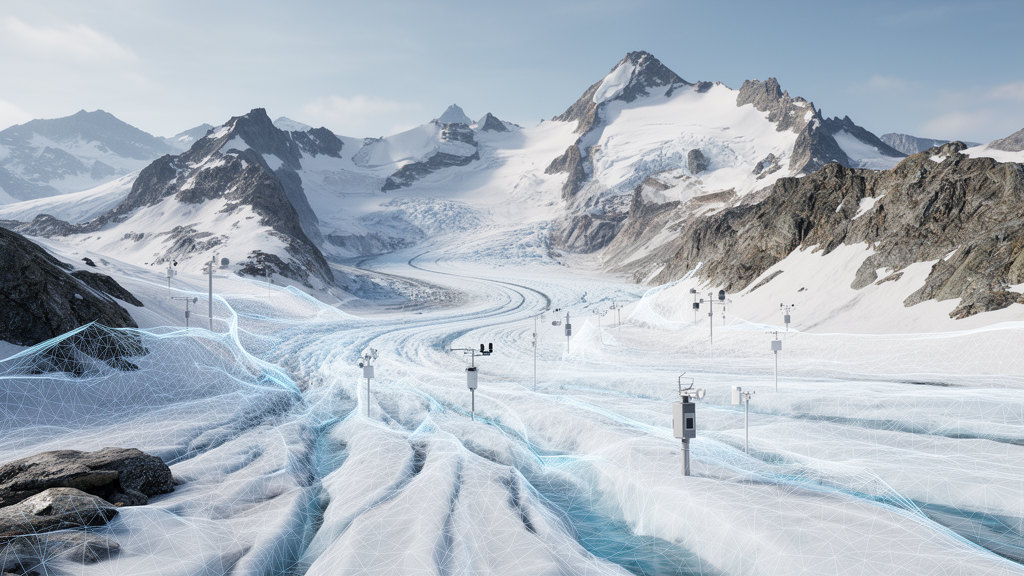
A hybrid physics–machine learning model called GlaUnTI improved estimates of glacier surface mass balance on 13 European glaciers that were geographically excluded from model training, according to a study of 78 glaciers across the Alps, Scandinavia, Iceland, Svalbard and the Pyrenees. The research covered 1995–2024 and compared the hybrid model with a conventional temperature-index model and a purely data-driven recurrent neural network. On the independent test glaciers, GlaUnTI reduced annual point-level root mean square error by 37.4% relative to the temperature-index baseline and annual glacier-wide error by 22.1%, while maintaining mean biases close to zero. The results show that a physically interpretable mass-balance model can be combined with learned corrections to improve transferability to unmonitored glaciers without abandoning the underlying glacier physics.
Surface mass balance is the net result of accumulation and ablation at a glacier’s surface. Direct observations remain sparse and unevenly distributed, making it difficult to apply one calibrated model across large numbers of glaciers. Temperature-index models are widely used because they estimate accumulation from precipitation and melt from near-surface air temperature, often with separate degree-day factors for snow and ice. Their small parameter sets are interpretable and practical, but their accuracy can depend strongly on glacier-specific calibration. That dependence limits transfer to glaciers with different geometries and climate regimes, particularly because global geodetic mass-change products can be noisy at the scale of an individual glacier and do not represent exactly the same quantity as surface mass balance.
GlaUnTI retains the temperature-index structure but adds a shallow convolutional neural corrector. The underlying model represents solid precipitation, snow accumulation, fractional snow cover and temperature-driven melt using smooth functions that support automatic differentiation. The corrector learns spatial and temporal adjustments to five key quantities: precipitation sensitivity, the snow degree-day factor, the relative ice degree-day factor, the centre of the rain-to-snow transition and a temperature offset. Because these adjustments modify interpretable parameters rather than replacing the mass-balance equations, the model keeps a physical backbone while allowing data-driven compensation for systematic errors. In the comparison with the data-driven baseline, the temperature-index backbone used seven trainable parameters, whereas the gated recurrent unit had 961.
The neural component has separate spatial and temporal branches. The spatial branch uses an initial mass-balance estimate, sensitivities of that estimate to small temperature and precipitation perturbations, glacier outlines, surface elevation, elevation uncertainty and, in one variant, satellite-derived glacier facies. The temporal branch processes monthly temperature and precipitation totals. Their outputs are combined and resampled to generate glacier- and grid-cell-specific parameter corrections. The facies maps classify surface conditions such as ice, snow, debris, firn and refrozen-like material at the end of the ablation season when available; the study assembled 163 such maps for 68 glaciers. The two GlaUnTI variants used identical structural changes in this respect, with the facies-enabled version adding classified surfaces and classification confidence as predictors where the maps existed.
The study compiled 10,483 annual, 15,421 winter and 3,482 summer point mass-balance measurements, alongside 1,637 annual, 1,278 winter and 1,279 summer glacier-wide estimates. These records were combined with daily ERA5-Land temperature and precipitation, annual elevation estimates and time-varying glacier outlines. The data covered 78 glaciers, with 38 in the Alps, 21 in Scandinavia, nine in Svalbard, eight in Iceland and two in the Pyrenees. A glacier-level stratified split assigned 52 glaciers to training, 13 to validation and 13 to an entirely independent test set spanning contrasting climates and geometries. The test set contained 793 annual, 756 winter and 314 summer point measurements, together with 312 annual, 235 winter and 233 summer glacier-wide estimates. The authors used the glacier-wide estimates as weaker constraints than direct point observations because monitoring programmes derive them by extrapolating measurements across each glacier.
At point locations, the conventional temperature-index model produced an annual correlation of 0.854, a root mean square error of 1.707 metres water equivalent and a mean bias of +0.298 metres water equivalent. The purely data-driven gated recurrent unit performed worse, with a correlation of 0.798 and root mean square error of 2.066 metres. GlaUnTI without facies maps raised the correlation to 0.933 and reduced error to 1.095 metres, while the facies-enabled version achieved a correlation of 0.940, an error of 1.068 metres and a mean bias of just +0.009 metres. Seasonal results generally followed the same ranking, although the data-driven model retained the lowest winter bias. Per-glacier distributions showed generally lower errors and narrower spreads for the GlaUnTI models, indicating that the aggregate improvement was not confined to one glacier.
At the glacier-wide scale, the differences were also pronounced. The temperature-index baseline achieved an annual correlation of 0.606 and root mean square error of 0.805 metres water equivalent, while the data-driven recurrent network fell to a correlation of 0.331 and an error of 1.009 metres. The two GlaUnTI variants improved the correlation to 0.684 and 0.700 and reduced error to 0.651 and 0.627 metres, respectively. Including facies information produced moderate benefits for summer and annual glacier-wide estimates, although the evidence was limited: the facies-available evaluation contained 27 annual glacier-wide estimates and 32 annual point measurements. The researchers therefore treated the maps as useful auxiliary information rather than evidence of a large general gain. Their results are also consistent with the physical expectation that facies information can act as a proxy for processes such as surface-albedo contrasts, firn retention and debris cover, rather than serving as a causal driver of mass balance in its own right.
The hybrid model also approached the performance obtained when the conventional model was calibrated separately for each test glacier. In that deliberately favourable comparison, each temperature-index model used the target glacier’s observations from 1995–2012, was validated on 2013–2018 and was evaluated on 2019–2024. The locally calibrated model achieved an annual point-level correlation of 0.948, a mean bias of −0.308 metres water equivalent and a root mean square error of 0.905 metres. GlaUnTI, evaluated without glacier-specific fine-tuning, achieved a correlation of 0.944, a bias of +0.107 metres and an error of 0.883 metres. It also had lower absolute bias in winter and summer and comparable seasonal errors. The comparison shows that GlaUnTI approached local calibration in this test while its original spatial training used no observations from the target glaciers.
GlaUnTI nevertheless has important limitations. Its temperature-index backbone does not explicitly resolve radiation, debris effects, snow ageing, terrain shading or the transport of snow by ice flow, so some physical processes remain embedded in learned corrections rather than represented mechanistically. Point stakes may also fail to represent conditions across an entire 100-metre grid cell, particularly on glaciers with strong microclimate or topographic variation. Elevation observations contain gaps and uncertainty, and climate forcing has its own errors. The study’s sensitivity analysis addressed the choice of how elevations were extended outside the 2000–2019 observation window: replacing quadratic temporal extrapolation with backfilled values changed mass-balance estimates by less than ±2.5%, indicating that this extrapolation strategy was secondary to other error sources. The European scope and limited facies observations also mean that transfer beyond the sampled climates and glacier types remains to be tested.
Beyond prediction, the model’s differentiability enables analytical applications demonstrated in the study. It supports gradient-based calibration, input attribution, transfer learning, inverse optimisation and the propagation of climate-forcing uncertainty through long mass-balance trajectories. In one example on Grosser Aletsch in the Swiss Alps, the researchers optimized a temperature offset for 2015–2024 that made the model’s average annual glacier-wide surface mass balance for 2020–2024 equal zero. The resulting effective offset was −2.42°C. The authors emphasized that this was a reduced inverse experiment with fixed glacier geometry, not a complete climate-change scenario, and that the inferred offset could compensate for both forcing discrepancies and residual model biases. In another example, integrated gradients separated the temperature- and precipitation-associated contributions to annual anomalies for Schwarzberg. A separate uncertainty calculation propagated temporally correlated temperature and precipitation errors through cumulative mass-balance trajectories using first-order automatic differentiation.
The study’s broader implication is methodological rather than a claim that all local glacier processes have been resolved. The fully data-driven recurrent network had the weakest spatial transfer, while the physically structured temperature-index model generalized more reliably and benefited from a learned corrector that could adjust its key parameters. End-to-end differentiability also makes it possible to connect mass balance with differentiable ice-flow models, perform input attribution and ask what effective forcing perturbation would be needed to reach a specified balance target. The authors identify possible extensions involving albedo products, transient snowlines, satellite indicators of melt, more explicit energy-balance forcing and regional geodetic mass-change records. They caution that geodetic observations integrate processes beyond surface mass balance, including dynamic thinning, frontal ablation and basal melt, and that climate-forcing uncertainty should be represented explicitly rather than hidden within learned structural corrections.
Subject of Research: Transferable estimation of glacier surface mass balance using a hybrid physics–machine learning model
Article Title: GlaUnTI: a hybrid physics–machine learning model enables transferable glacier surface mass balance estimation
Article References: Maslov, K. A., Schellenberger, T., Persello, C., & Stein, A. (2026). GlaUnTI: a hybrid physics–machine learning model enables transferable glacier surface mass balance estimation. The Cryosphere, 20(10), 6045-6070. https://doi.org/10.5194/tc-20-6045-2026
Image Credits: AI Generated
Keywords: glacier surface mass balance, hybrid modelling, machine learning, temperature-index model, European glaciers, climate forcing, remote sensing, neural corrector, snow accumulation, glacier melt, GlaUnTI, hybrid
Cite Scienmag News
Sloane Callahan. (October 21, 2026). Hybrid model improves glacier mass-balance transfer across Europe. Scienmag. https://scienmag.com/hybrid-model-improves-glacier-mass-balance-transfer-across-europe/
Sloane Callahan. "Hybrid model improves glacier mass-balance transfer across Europe." Scienmag, 21 October 2026, https://scienmag.com/hybrid-model-improves-glacier-mass-balance-transfer-across-europe/. Accessed 21 October 2026.
Sloane Callahan. "Hybrid model improves glacier mass-balance transfer across Europe." Scienmag. October 21, 2026. https://scienmag.com/hybrid-model-improves-glacier-mass-balance-transfer-across-europe/


