

Wednesday, October 21, 2026
Science
No Result
View All Result
  • Login
  • HOME
  • SCIENCE NEWS
  • CONTACT US
  • HOME
  • SCIENCE NEWS
  • CONTACT US
No Result
View All Result
Scienmag
No Result
View All Result
Home Science News Archaeology

Ancient eland collagen found in 60,000-year-old South African ochre

October 21, 2026
in Archaeology
Courtney Benton
By Courtney Benton Scienmag Editorial Profile - Science and Technology Policy
Reading Time: 2 mins read
0
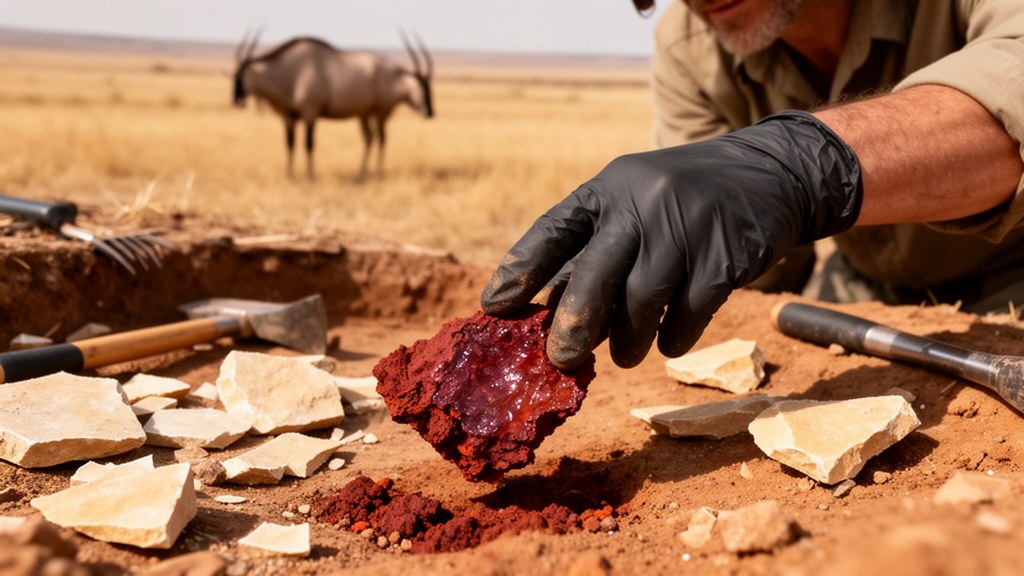
Ancient eland collagen found in 60,000-year-old South African ochre

Ancient eland collagen found in 60,000-year-old South African ochre

65
SHARES
587
VIEWS
Share on FacebookShare on Twitter
ADVERTISEMENT

Researchers have detected common eland collagen in an ochre-rich archaeological surface dating to about 60,000 years ago at the Kilpdrift Complex in South Africa. The team from Kyushu University, the University of Bergen and the University of Copenhagen reported the finding in Proceedings of the Royal Society B, describing it as biomolecular evidence that animal-derived material was associated with ochre use during the Middle Stone Age. The researchers proposed two possible explanations: animal-derived materials were deliberately mixed with the ochre, or ochre-treated eland hides were present at the site.

The Kilpdrift Complex lies within the coastal cliffs of the De Hoop Nature Reserve and is a Middle and Later Stone Age archaeological site. Investigators analysed archived sediment samples taken from the ochre-rich surface in an experimental palaeoproteomic study. Because the recovered proteins were not readily visible, the researchers used molecular analysis to identify their animal source. The analysis found type I collagen assigned to the common eland, Taurotragus oryx, providing evidence that eland material had been associated with the archaeological deposit.

Proteins were extracted from the sediment and separated and analysed using liquid chromatography-tandem mass spectrometry, commonly abbreviated LC-MS/MS. This method breaks extracted proteins into measurable peptide fragments. The resulting fragments were compared with large protein databases and a custom collagen reference database to determine the species of origin. The eland identification was based on this biomolecular comparison, allowing researchers to detect animal material that could not be characterized by visual examination of the sediment alone.

The successful recovery of identifiable collagen from archaeological sediment demonstrates a potential role for palaeoproteomics at sites where ancient DNA rarely survives. Ancient proteins can therefore supplement other forms of archaeological analysis by revealing biological traces associated with otherwise inconspicuous deposits. In this case, the method recovered eland collagen from a challenging African environment and documented an association between animal material and ochre use. The study does not establish the precise origin of the collagen, whether it was intentionally added to the ochre, or whether the deposit reflects a specific technical or symbolic activity.

Evidence of organic components mixed with ochre has been extremely rare in Africa, according to the research report, making the eland collagen an unusual addition to the record of Middle Stone Age behaviour. The authors interpret the association as evidence of the complex technical and possibly symbolic behaviours of early Homo sapiens, but they acknowledge that the protein evidence alone cannot distinguish between deliberate mixing and the presence of ochre-treated hides. Further archaeological context would be needed to determine the sequence of events that created the deposit and the function of the ochre and animal material. The principal demonstrated result is therefore the identification of common eland collagen in approximately 60,000-year-old ochre-rich sediment through palaeoproteomic analysis.

Subject of Research: Palaeoproteomic identification of eland collagen associated with Middle Stone Age ochre use in South Africa

Article Title: Invisible eland identified from 60,000-year-old ochre-rich sediment

Article References: Invisible eland identified from 60,000-year-old ochre-rich sediment. Original publication (Bibliographic details unavailable.)

Image Credits: AI Generated

DOI: Not provided

Keywords: palaeoproteomics, ancient collagen, common eland, ochre, Middle Stone Age, archaeology, mass spectrometry, South Africa, Kilpdrift Complex, Invisible, eland, identified

Cite Scienmag News

Courtney Benton. (October 21, 2026). Ancient eland collagen found in 60,000-year-old South African ochre. Scienmag. https://scienmag.com/ancient-eland-collagen-found-in-60000-year-old-south-african-ochre/

Courtney Benton. "Ancient eland collagen found in 60,000-year-old South African ochre." Scienmag, 21 October 2026, https://scienmag.com/ancient-eland-collagen-found-in-60000-year-old-south-african-ochre/. Accessed 21 October 2026.

Courtney Benton. "Ancient eland collagen found in 60,000-year-old South African ochre." Scienmag. October 21, 2026. https://scienmag.com/ancient-eland-collagen-found-in-60000-year-old-south-african-ochre/


Tags: 000-year-old Middle Stone Age biomolecular evidence60ancient collagenAncient eland collagen in South African archaeological ochreanimal-derived materials associated with ochre usearchaeologycommon elandelandevidence of animal hide processing in prehistoric South Africaidentification of Taurotragus oridentifiedinsights into Middle Stone Age subsistence and material useinvisibleKilpdrift ComplexLC-MS/MS protein identification in ancient samplesmass spectrometryMiddle Stone Ageochreochre and animal material mixing in early human sitespalaeoproteomic analysis of archaeological sedimentspalaeoproteomicssignificance of collagen in archaeological biomolecular studiesSouth Africa
Share26Tweet16
Previous Post

Angelman syndrome mice show disrupted Kv4.2 channel redistribution

Next Post

Review assesses network pharmacology for herbal medicines in rheumatoid arthritis

Related Posts

Medieval abbot may have occupied Westminster Abbey’s reused Roman sarcophagus
Archaeology

Medieval abbot may have occupied Westminster Abbey’s reused Roman sarcophagus

October 20, 2026
Research report: Chronology and Funerary Practices Associated with Antennae Tumuli in Western Sahara
Archaeology

Research report: Chronology and Funerary Practices Associated with Antennae Tumuli in Western Sahara

October 20, 2026
Drone LiDAR Finds Three Unregistered Aboriginal Rock Shelters
Archaeology

Drone LiDAR Finds Three Unregistered Aboriginal Rock Shelters

October 20, 2026
Meat, Marrow and Bone Tools: How Middle Pleistocene Hominins in China Exploited Animals
Archaeology

Meat, Marrow and Bone Tools: How Middle Pleistocene Hominins in China Exploited Animals

October 19, 2026
Neanderthal Glue Reimagined: Scientists Make Stone Age Adhesive from Birch Leaves
Archaeology

Neanderthal Glue Reimagined: Scientists Make Stone Age Adhesive from Birch Leaves

October 19, 2026
Roman builders tapped more volcanic ash than we thought, new study shows
Archaeology

Roman builders tapped more volcanic ash than we thought, new study shows

October 17, 2026
Next Post
Network Pharmacology Maps How Herbal Compounds Strike Rheumatoid Arthritis From Multiple Angles

Review assesses network pharmacology for herbal medicines in rheumatoid arthritis

  • Mothers who receive childcare support from maternal grandparents show more optimized

    Mothers who receive childcare support from maternal grandparents show more parental warmth, finds NTU Singapore study

    27656 shares
    Share 11059 Tweet 6912
  • University of Seville Breaks 120-Year-Old Mystery, Revises a Key Einstein Concept

    1061 shares
    Share 424 Tweet 265
  • Bee body mass, pathogens and local climate influence heat tolerance

    682 shares
    Share 273 Tweet 171
  • Researchers record first-ever images and data of a shark experiencing a boat strike

    546 shares
    Share 218 Tweet 137
  • Groundbreaking Clinical Trial Reveals Lubiprostone Enhances Kidney Function

    531 shares
    Share 212 Tweet 133
Science

Embark on a thrilling journey of discovery with Scienmag.com—your ultimate source for cutting-edge breakthroughs. Immerse yourself in a world where curiosity knows no limits and tomorrow’s possibilities become today’s reality!

RECENT NEWS

  • Review assesses network pharmacology for herbal medicines in rheumatoid arthritis
  • Ancient eland collagen found in 60,000-year-old South African ochre
  • Angelman syndrome mice show disrupted Kv4.2 channel redistribution
  • P2RX2 exon-2 indel disrupts splicing and reduces receptor output in one DFNA41 family

Categories

  • Agriculture
  • Anthropology
  • Archaeology
  • Athmospheric
  • Biology
  • Biotechnology
  • Blog
  • Bussines
  • Cancer
  • Chemistry
  • Climate
  • Earth Science
  • Editorial Policy
  • Marine
  • Mathematics
  • Medicine
  • Pediatry
  • Policy
  • Psychology & Psychiatry
  • Science Education
  • Science News
  • Social Science
  • Space
  • Technology and Engineering

Subscribe to Blog via Email

Enter your email address to subscribe to this blog and receive notifications of new posts by email.

Join 5,150 other subscribers

© 2025 Scienmag - Science Magazine

Welcome Back!

Login to your account below

Forgotten Password?

Retrieve your password

Please enter your username or email address to reset your password.

Log In
No Result
View All Result
  • HOME
  • SCIENCE NEWS
  • CONTACT US

© 2025 Scienmag - Science Magazine

Discover more from Science

Subscribe now to keep reading and get access to the full archive.

Continue reading