


A machine-learning system that analyzed molecular features in exhaled breath separated people with established gout from healthy controls with near-perfect accuracy in a preliminary single-center case-control study. Among 201 male participants, the best breath-based model achieved an area under the receiver-operating characteristic curve, or AUC, of 0.999 after five-fold stratified cross-validation. Its accuracy, sensitivity and specificity were each 0.990, while the 95% confidence interval for AUC was 0.997 to 1.000. The results suggest that a breath “metabolic fingerprint” may contain information closely associated with gout, but the investigators cautioned that the model has not been externally validated and requires testing in larger, prospective and more clinically diverse populations.
The study, reported in Frontiers in Molecular Biosciences, recruited consecutive eligible volunteers at the Affiliated Hospital of Jiangxi University of Chinese Medicine in Nanchang, China, from December 2025 through March 2026. The cohort included 99 men with established gout and 102 healthy controls. Gout was classified using the 2015 American College of Rheumatology and European Alliance of Associations for Rheumatology criteria; some participants had monosodium urate crystals identified by polarized-light microscopy in synovial fluid or a tophus, while others met the clinical, laboratory and imaging score threshold. Healthy controls were drawn from routine health examinations and had normal serum urate, normal joint function, and no history of chronic renal or metabolic disease. Because this was a nonrandomized case-control design comparing established disease with health, the study did not test early or presymptomatic gout.
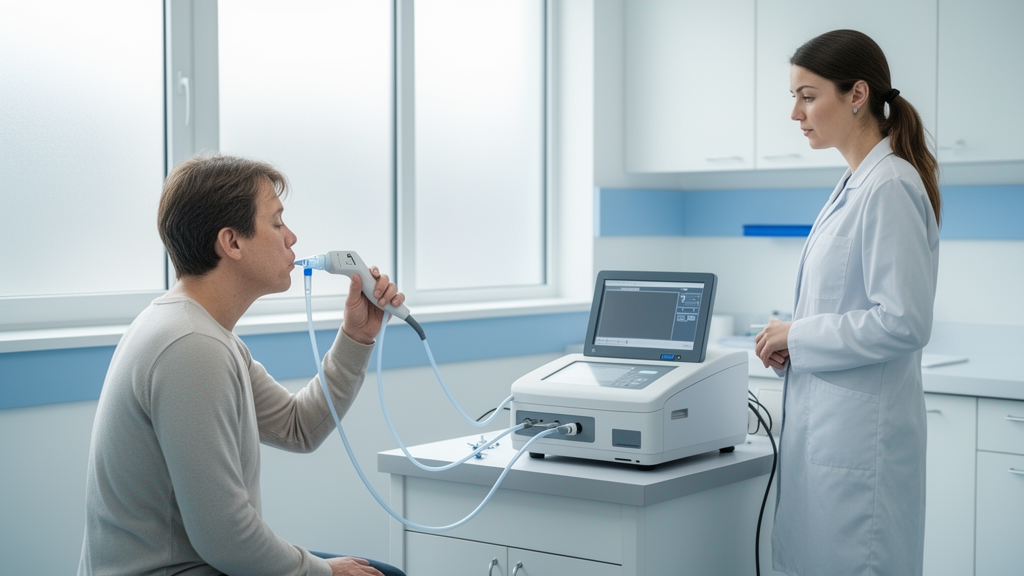
For the breath analysis, participants were asked to avoid smoking, alcohol and food for at least one hour, rinse their mouths with purified water, inhale deeply through the nose and exhale into an electrospray extraction ionization mass spectrometry system for 20 seconds. The EESI-MS instrument coupled to a linear ion-trap mass spectrometer could directly ionize material in the exhaled stream, including gas-phase molecules and aerosol- or droplet-bound constituents. The investigators therefore used the broad term “breath molecular features” for the detected mass-to-charge signals rather than treating every feature as a confirmed volatile organic compound. Raw spectra were background-subtracted, normalized by total ion current and log-transformed, producing 451 candidate features across the measured mass range.
The researchers also developed a clinical-risk model using age, body mass index, smoking history, drinking history and family history, as well as a separate model based on standardized tongue photographs. This multimodal design was intended to test whether breath information merely reproduced obvious differences between the groups. The two groups did differ in several characteristics: mean body mass index was 27.88 kg/m² in the gout group and 22.07 kg/m² in controls, mean serum urate was 514.81 and 353.57 μmol/L, respectively, and alcohol consumption was reported by 65.7% of patients and 32.4% of controls. The clinical model reached an AUC of 0.890, with sensitivity of 0.909 and specificity of 0.716, so it could not reproduce the breath model’s near-perfect separation. The tongue model performed much less well, reaching an AUC of 0.654.
Within each cross-validation training fold, the researchers ranked the breath features and retained the top 30 for modeling. They evaluated logistic regression, random forest and Extra Trees classifiers, then selected the best-performing Extra Trees configuration as “BreathGOUT.” The same general pipeline was used for models combining breath data with clinical variables and tongue-image measurements. Feature selection and preprocessing were confined to each training fold, while predictions from the five held-out folds were pooled to calculate final performance. The investigators also tested whether a global difference in breath-signal intensity was responsible for the result: total ion current was markedly lower in the gout group, but that measure alone produced AUCs of 0.984 to 0.988, and performance remained between 0.995 and 0.999 under several alternative normalization strategies, including no normalization.
Breath profiling nevertheless identified 12 molecular features that differed between groups after false-discovery-rate correction. Eleven signals were lower in the gout group, while the feature at mass-to-charge ratio 318.0 was higher and had an individual AUC of 0.987. Based on mass-to-charge matching and a human breath metabolomics database, the researchers tentatively associated that signal with a urate dimer, making it a biologically intriguing candidate. Other putative assignments included inosine at 145.0, hippuric acid at 177.0, cresol at 107.0, quercetin at 287.0, and several compounds or chemical classes at additional mass-to-charge ratios. Most individual candidate features had AUCs above 0.90. These labels remain provisional, however, because the ions were not confirmed with authentic standards or tandem mass-spectrometry fragmentation, and the proposed urate dimer should not yet be interpreted as a direct measure of crystal-formation risk.
The integrated “BreathGOUT-Plus” model combined the 451 breath features with five clinical variables and 28 tongue-image features. It also achieved an AUC of 0.999, with accuracy, sensitivity and specificity of 0.990, matching the breath-only model rather than improving upon it. The investigators interpret the result as evidence that the dominant discriminatory information in this cohort came from breath spectrometry, not that the additional modalities are clinically irrelevant. They note that breath signals may be affected by short-term factors such as recent high-purine intake, alcohol or urate-lowering medication, whereas BMI and family history are more stable. A combined system might therefore become more robust under conditions not represented in this dataset, but that hypothesis was not directly tested. Likewise, the tongue results were weak and no sublingual feature remained significant after multiple-testing correction.
Several limitations sharply constrain the findings. All participants were men recruited from one hospital, and all samples were analyzed in a single batch, so the performance may not transfer to women, people with asymptomatic hyperuricemia, patients experiencing a first gout attack, or people with other forms of arthritis. The researchers did not perform BMI-stratified or propensity-score-matched analyses, and they could not completely separate disease-related metabolic signals from factors such as body mass, smoking or alcohol use. Renal function was not systematically measured, technical replicates and pooled quality-control samples were not used, and no internal standards were included because the work was untargeted profiling rather than absolute quantification. The sharp difference in total signal intensity also remains unexplained, even though normalization experiments indicated that relative spectral patterns carried the classification signal. Tongue photographs had standardized lighting and camera settings, but camera distance and tongue-protrusion duration were not quantitatively recorded.
The study’s most defensible conclusion is therefore not that a breath test is ready to diagnose gout, but that molecular analysis of exhaled breath contains a strong, testable signal in this proof-of-concept cohort. The near-perfect cross-validated result is striking, yet it remains an internal estimate from a modest, selected, single-center sample without prospective or external validation. Before the approach could be considered for broader use, multicenter studies would need to establish reproducibility across instruments and centers, confirm the candidate ions with targeted analytical methods, account for diet and medication, measure renal function, and test patients with asymptomatic hyperuricemia, first-presentation arthritis and competing arthritides. If those studies reproduce the performance, breath metabolomics could become a complementary noninvasive tool for evaluating urate-related metabolic disturbance. Until then, the findings point to a promising biomarker platform rather than a validated diagnostic test.
Subject of Research: Machine-learning analysis of exhaled-breath molecular features for noninvasive discrimination of established gout in a single-center case-control cohort.
Article Title: Breath molecular feature profiling with machine learning for noninvasive diagnosis of gout: a single-center case-control study
Article References: Cai, Z., Huang, X., Luo, X., Chen, X., Sun, W., & Li, H.-N. (2026). Breath molecular feature profiling with machine learning for noninvasive diagnosis of gout: a single-center case-control study. Frontiers in Molecular Biosciences, 13, 1939939. https://doi.org/10.3389/fmolb.2026.1939939
Image Credits: AI Generated
DOI: 10.3389/fmolb.2026.1939939
Keywords: gout, breathomics, exhaled breath, mass spectrometry, machine learning, metabolomics, noninvasive diagnosis, urate dimer, clinical validation, Breath, molecular, feature
Cite Scienmag News
Ophelia Keating. (October 21, 2026). Breath Analysis Nearly Perfectly Separates Gout Patients in Proof-of-Concept Study. Scienmag. https://scienmag.com/breath-analysis-nearly-perfectly-separates-gout-patients-in-proof-of-concept-study/
Ophelia Keating. "Breath Analysis Nearly Perfectly Separates Gout Patients in Proof-of-Concept Study." Scienmag, 21 October 2026, https://scienmag.com/breath-analysis-nearly-perfectly-separates-gout-patients-in-proof-of-concept-study/. Accessed 21 October 2026.
Ophelia Keating. "Breath Analysis Nearly Perfectly Separates Gout Patients in Proof-of-Concept Study." Scienmag. October 21, 2026. https://scienmag.com/breath-analysis-nearly-perfectly-separates-gout-patients-in-proof-of-concept-study/


