


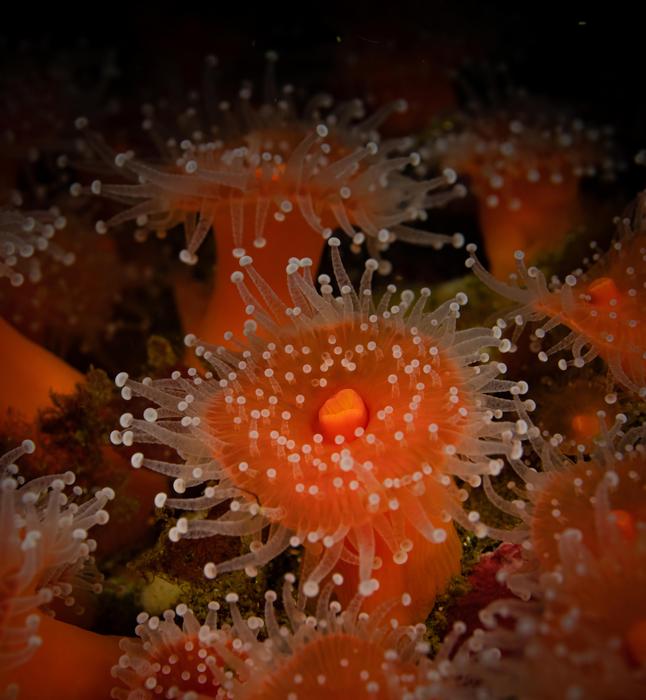
Parasites thought only to infect tropical coral reefs have been discovered in a large variety of creatures in cold marine ecosystems along the Northeast Pacific, according to new research from University of British Columbia botanists.

Credit: Patrick Keeling, University of British Columbia.
Parasites thought only to infect tropical coral reefs have been discovered in a large variety of creatures in cold marine ecosystems along the Northeast Pacific, according to new research from University of British Columbia botanists.
The finding, published today in Current Biology, greatly expands the range of corallicolids, suggesting the parasites infect a range of organisms related to coral, like sea anemones and other cold-water marine invertebrates, around the world.
“This highlights significant blind spots in our strategies designed to sample microbial biodiversity,” says University of British Columbia biodiversity researcher Dr. Patrick Keeling, senior author on the study. “It has implications for the way we sample, measure and interpret environmental diversity, because our current approaches are clearly missing an important and potentially massive fraction of that diversity.”
Corallicolids were thought to be only associated with coral reefs based on hundreds of millions of environmental sequences—samples from soil, seawater or air, rather than directly from animals that live in the same environments. But Dr. Keeling and his team had suspicions that the way microbial diversity is surveyed in environmental sequences might be biased against certain kinds of parasites.
Luck also had a bit to do with the discovery. After discovering corallicolids in tropical reefs in 2019, subsequent COVID travel restrictions essentially forced Dr. Keeling’s team to cast their parasite nets closer to home—initially at a dock on Galiano Island, one of the southern Gulf Islands off the coast of British Columbia.
They collected 325 samples from nine species of cold-water anthozoans from non-coral reef environments at five locations in coastal British Columbia, Canada. The sampling covered a diverse range of anthozoans from cold water in temperate marine environments. Samples were screened for corallicolid infection using polymerase chain reaction—a laboratory nucleic acid amplification technique—and sequencing of nuclear small subunit rRNA.
While the parasites are correlate with coral mortality during bleaching events, it’s unclear what exact impact corallicolids have on corals—or any of the other organisms—they infect.
“It’s possible that Corallicolids have different effects depending on who they’re infecting,” says UBC researcher Morelia Trznadel, the first author of the paper. “The parasite lineages we found in our study seem to ‘jump’ between hosts quite frequently, and while they’ve already been linked to poorer responses during coral bleaching, we don’t know if they’re equally harmful to all hosts.”
In the future the researchers want to expand sampling to include potential hosts further north along the Pacific coast—including newly discovered deep-water reefs.
This work was supported by the Gordon and Betty Moore Foundation and the Hakai Institute.
Journal
Current Biology
Method of Research
Observational study
Subject of Research
Animals
Article Title
Coral-infecting parasites in cold marine ecosystems
Article Publication Date
11-Apr-2024
Cite Scienmag News
Violet Maxwell. (April 11, 2024). Tropical coral-infecting parasites discovered in cold marine ecosystems. Scienmag. https://scienmag.com/tropical-coral-infecting-parasites-discovered-in-cold-marine-ecosystems/
Violet Maxwell. "Tropical coral-infecting parasites discovered in cold marine ecosystems." Scienmag, 11 April 2024, https://scienmag.com/tropical-coral-infecting-parasites-discovered-in-cold-marine-ecosystems/. Accessed 3 September 2026.
Violet Maxwell. "Tropical coral-infecting parasites discovered in cold marine ecosystems." Scienmag. April 11, 2024. https://scienmag.com/tropical-coral-infecting-parasites-discovered-in-cold-marine-ecosystems/

