


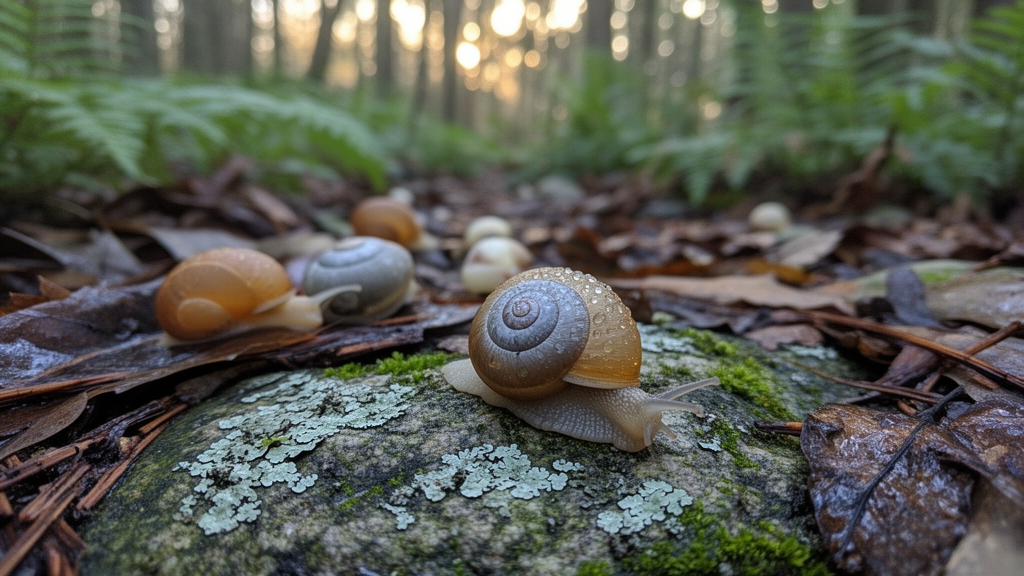
A field survey and taxonomic review of the land-snail family Clausiliidae in Georgia documented 30 species outside Abkhazia and South Ossetia, added georeferenced occurrence records and described a new species, Mucronaria kartvelica, from limestone cliffs near the Kvedi caves. The research combined observations made during two decades of fieldwork with selected published locality records to reassess species distributions, habitats and geographic ranges.
The study covered Georgia’s administrative regions and focused on a family with around 1,300 species across large parts of Eurasia, Africa and tropical America. Only two of its seven extant subfamilies occur in the Caucasus. The authors report that 89 of the 92 clausiliid species in the Caucasus ecoregion are endemic to it, while Georgia contains more than 30% of the regional fauna.
Most new occurrence data came from georeferenced samples collected by the authors over the past two decades. The researchers combined these records with well-defined localities from five earlier publications when preparing distribution maps. For Georgian endemics and near-endemics whose ranges extend only slightly beyond the country, they estimated extent of occurrence using a minimum convex polygon and calculated area of occupancy by summing occupied 2 × 2 km grid cells. An infinity symbol represented areas exceeding 10,000 km².
The principal taxonomic discovery was M. kartvelica, established from material collected at Kvedi 1 Cave, 2.2 km east-southeast of Kvedi village in the Racha-Lechkhumi and Kvemo Svaneti Region at 1,510 m, with additional material from Kvedi 2 Cave at 1,560 m. Its name refers to Sa-kartvelo, a native historic name for Georgia. The holotype and paratypes were collected in 2021, with further material obtained in 2022.
The new species has a slender, brownish, corneous spindle-shaped shell with 12.3–13.5 whorls. Strong, sharp ribs number 25–28 on the last whorl, and the shell measures 12.4–13.9 mm in height, 2.8–3.1 mm in spire width, 2.4–2.6 mm in aperture height and 1.9–2.1 mm in aperture width. Its reduced, diffuse palatal plicae and less elongate shape place it in the subgenus Mucronaria, while its slender, strongly costate shell distinguishes it from other members of that subgenus. Its internal anatomy remains unknown.
Live M. kartvelica were observed on shaded limestone cliffs and among weeds, primarily Hedera helix, growing on the cliffs. They occurred alongside Acrotoma baryshnikovi, Elia derasa, Mentissoidea rupicola and Mucronaria duboisi. The authors also clarified or corrected several distribution and identification records. A shell collected as sea flotsam on Georgia’s Black Sea coast had been reported as the Iranian species Serrulinella senghanensis but was identified as Dobatia goettingi, which does not occur in Georgia. The reported Georgian locality for Armenica griseofusca was considered erroneous because all verified localities are in Trabzon and Rize provinces of Turkey, and a published Adjara record of Inobseratella lindholmi was found to represent Euxinastra hamata.
Of the 30 species recognized in the study area, 23 were classified as forest dwellers and seven as cliff dwellers. Six of the cliff-dwelling species were obligate limestone inhabitants, while Armenica unicristata tolerated other rock types. Twelve species, or 40%, were endemic to Georgia, and 28 of the 30 were endemic to the Caucasus ecoregion; only Mucronaria duboisi and Serrulina serrulata had ranges extending beyond it. The highest species richness occurred in the western regions and decreased toward the east. Sampling was also uneven: Imereti and Kakheti had 95 and 58 georeferenced sampling sites, respectively, compared with 12 in Guria, 13 in Shida Kartli and six in Kvemo Kartli. The correlation between sampling-site numbers and species density across regions was 0.82, indicating that additional targeted sampling could refine distribution estimates.
No Georgian or Caucasian clausiliid had received a formal conservation assessment, and the authors noted that none was protected under a species-specific legal designation. Based on estimated occupied areas, four endemic species had an area of occupancy below 20 km² and might qualify as endangered under International Union for Conservation of Nature criteria; other endemics, except Mucronaria index and Quadriplicata lederi, might qualify as vulnerable. Earlier research cited in the review found that protected areas, covering about 10% of Georgia, could protect at most half of the ranges of endemic clausiliid species. The authors therefore proposed habitat protection, particularly for range-restricted species whose habitats include limestone crevices and forested slopes affected by disturbance, grazing, logging, mining and pollution.
The review has important limitations. Occurrence patterns remain affected by unequal sampling, including the difficulty of searching limestone crevices for subterranean species and accessing steep forest habitats. The report also identified an undescribed Quadriplicata from the upper Alazani River valley in Kakheti, discovered earlier by a Hamburg research team, whose formal description was still expected in a separate publication. These gaps mean that the mapped distributions represent the best current assessment from the available records rather than a complete inventory of every population or habitat in Georgia.
Subject of Research: Taxonomic and geographic assessment of Clausiliidae diversity in Georgia
Article Title: The land snail family Clausiliidae ( Gastropoda , Pulmonata , Stylommatophora ) in Georgia: overview, novel records and a new species
Article References: Mumladze, L., Grego, J., & Szekeres, M. (2023). The land snail family Clausiliidae (Gastropoda, Pulmonata, Stylommatophora) in Georgia: overview, novel records and a new species. Caucasiana, 2, 29-61. https://doi.org/10.3897/caucasiana.2.e101013
Image Credits: AI Generated
DOI: 10.3897/caucasiana.2.e101013
Keywords: Clausiliidae, land snails, Georgia, Mucronaria kartvelica, taxonomy, Caucasus, biodiversity, species distribution, limestone habitats, conservation, land, snail
Cite Scienmag News
Margaret Porter. (October 21, 2026). Field survey and taxonomic review of Georgian Clausiliidae identifies a new Mucronaria species. Scienmag. https://scienmag.com/field-survey-and-taxonomic-review-of-georgian-clausiliidae-identifies-a-new-mucronaria-species/
Margaret Porter. "Field survey and taxonomic review of Georgian Clausiliidae identifies a new Mucronaria species." Scienmag, 21 October 2026, https://scienmag.com/field-survey-and-taxonomic-review-of-georgian-clausiliidae-identifies-a-new-mucronaria-species/. Accessed 21 October 2026.
Margaret Porter. "Field survey and taxonomic review of Georgian Clausiliidae identifies a new Mucronaria species." Scienmag. October 21, 2026. https://scienmag.com/field-survey-and-taxonomic-review-of-georgian-clausiliidae-identifies-a-new-mucronaria-species/


