


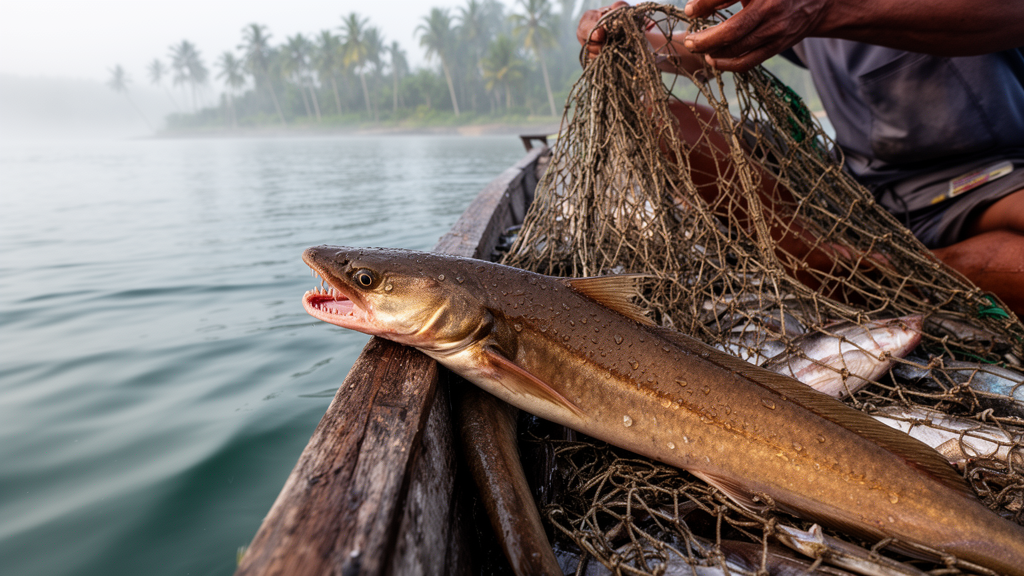
A single 128.3-millimetre specimen of the dorozome lizardfish, Saurida fortis, identified through anatomical examination and mitochondrial DNA barcoding, represents the southernmost confirmed record of the species. The fish was collected off Tanjung Sedili in Johor on the east coast of Peninsular Malaysia, extending the verified distribution into the South China Sea. This was a single-specimen marine ichthyofaunal record rather than a population survey, so the finding does not establish the species’ abundance or habitat distribution across the region.
The specimen, catalogued as KAUM–I. 212397, was caught by bottom trawl on 23 September 2024 during a marine ichthyofaunal survey. The collection depth was not recorded. Its body was silver-grey below the lateral line when fresh, with a dark-brown dorsum of the head, a black line along the upper jaw, an indistinct brownish-black blotch behind the adipose-fin base, and a single row of distinct black spots along the upper margin of the deeply forked caudal fin. The study also proposed conor lumpur as the species’ new standard Malay name.
Saurida fortis was originally described in 2022 from 41 specimens sourced from the Ryukyu Islands of Japan, southern Taiwan and Thailand. The original series included a market-purchased specimen from Thailand whose precise collection locality was treated as unknown. A 2023 study subsequently recorded 21 examples from the northern Gulf of Thailand, while another 2023 report documented the species from the Ogasawara Islands, Japan. The Malaysian individual therefore extends the species’ previously verified southern limit beyond these reported localities.
Counts and measurements followed established procedures, and calipers were used to the nearest 0.1 millimetre. The specimen had 12 dorsal-fin rays, 11 anal-fin rays, 14 pectoral-fin rays, nine pelvic-fin rays, 19 caudal-fin rays, 53 lateral-line scales and 51 vertebrae. Its pelvic girdle measured 8.8% of standard length, and the tip of its pectoral fin just reached the line connecting the pelvic-fin and dorsal-fin origins. These observations were combined with the position of the anteriormost gill raker, four indistinct black spots on the upper caudal-fin margin, and dark-grey stomach and intestines when assigning the fish to S. fortis.
Further diagnostic traits included numerous small, canine-like teeth arranged in four regular rows on the jaws, with the innermost teeth longest, and three vomerine teeth that were entirely separated from one another rather than forming a single cohesive patch. After preservation, the body became pale brown above the lateral line and gradually paler below it. Melanophores below the lateral line were restricted to two scale rows, while the fin pigmentation remained similar to that observed in the fresh specimen.
For molecular analysis, DNA was extracted from muscle tissue preserved in 99.5% ethanol. The researchers amplified, sequenced and aligned a 459-base-pair segment of the mitochondrial cytochrome c oxidase subunit I gene with published S. fortis sequences. Pairwise p-distances calculated in MEGA 11 showed differences of 0.44% between the Malaysian specimen and Japanese specimens, 0.22% between the Malaysian and Taiwanese specimens, and 0.00% between the Malaysian specimen and the locality-unknown market specimen. The authors interpreted the minor genetic differences as reflecting geographically differentiated populations.
The absence of a sequence difference between the Malaysian fish and the market specimen used in the original description led the authors to infer that the latter was likely collected in the southern South China Sea. The market fish had been purchased at a fish market in Samut Sakorn, Thailand, but its place of capture was not recorded. The genetic result does not identify a precise collection site or demonstrate that the market specimen came from Malaysia; it supports only the inference that it may have originated in the same broad marine region as the confirmed Malaysian individual.
The study also re-examined the 2023 report of 21 S. fortis from the Gulf of Thailand. The photographed specimen differed from S. fortis because its pectoral-fin tip did not reach a vertical line from the pelvic-fin origin, whereas the fin in S. fortis reaches or extends beyond that line. Characters cited in the earlier report—including 11 or 12 dorsal-fin rays, 53–56 lateral-line scales and general body coloration—were not sufficient by themselves to distinguish S. fortis from S. micropectoralis.
Additional distinctions included the distribution of abdominal melanophores, the shape of the vomerine tooth patch and the extent to which the lateral-line scales on the caudal peduncle were raised into a keel. On this basis, the authors concluded that the specimens previously reported as S. fortis from the Gulf of Thailand were most likely S. micropectoralis, whose type locality is the Gulf of Thailand, and stated that the earlier specimens require careful re-examination. The Malaysian record supports a southern occurrence of S. fortis in the South China Sea, but the single trawled specimen and unknown collection depth do not reveal its population size, seasonality or full habitat range.
Subject of Research: A single-specimen marine ichthyofaunal record of Saurida fortis in Peninsular Malaysia, supported by morphology and mitochondrial DNA barcoding
Article Title: Southernmost record of Saurida fortis ( Actinopterygii , Aulopiformes , Synodontidae ) from Malaysia
Article References: Furuhashi, R., Seah, Y. G., & Motomura, H. (2025). Southernmost record of Saurida fortis (Actinopterygii, Aulopiformes, Synodontidae) from Malaysia. Acta Ichthyologica et Piscatoria, 55, 211-215. https://doi.org/10.3897/aiep.55.164723
Image Credits: AI Generated
Keywords: Saurida fortis, Synodontidae, Peninsular Malaysia, Johor, South China Sea, marine ichthyofauna, DNA barcoding, species distribution, taxonomic re-examination, Saurida micropectoralis, Southernmost, record
Cite Scienmag News
Juliet Wilcox. (October 21, 2026). Single-specimen marine survey records southernmost Saurida fortis in Malaysia. Scienmag. https://scienmag.com/single-specimen-marine-survey-records-southernmost-saurida-fortis-in-malaysia/
Juliet Wilcox. "Single-specimen marine survey records southernmost Saurida fortis in Malaysia." Scienmag, 21 October 2026, https://scienmag.com/single-specimen-marine-survey-records-southernmost-saurida-fortis-in-malaysia/. Accessed 21 October 2026.
Juliet Wilcox. "Single-specimen marine survey records southernmost Saurida fortis in Malaysia." Scienmag. October 21, 2026. https://scienmag.com/single-specimen-marine-survey-records-southernmost-saurida-fortis-in-malaysia/


