


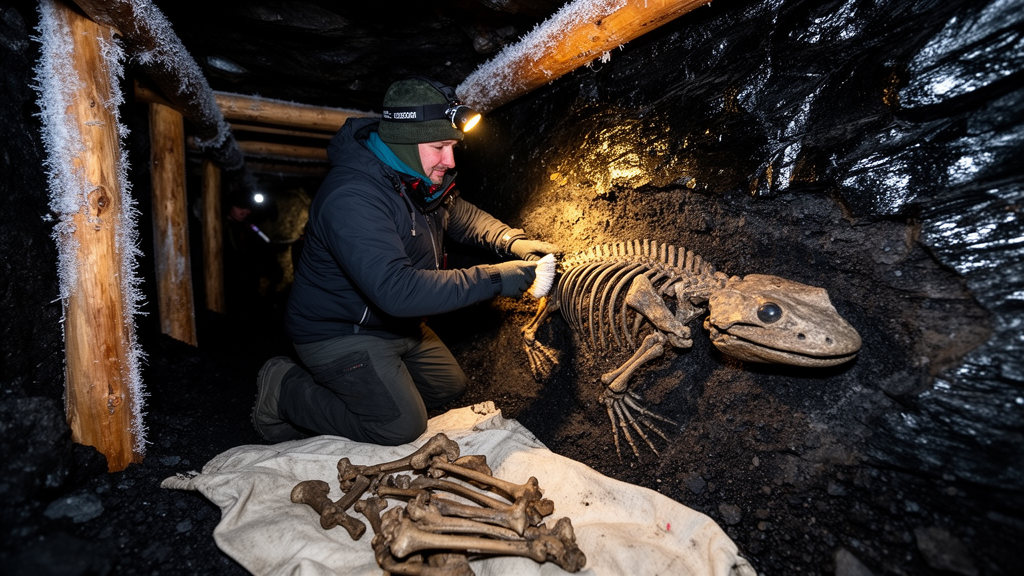
A detailed morphological and phylogenetic revision confirms that three late Kungurian temnospondyl species from Russia’s Pechora Coal Basin are eryopids, including Syndyodosuchus tetricus, which had previously been classified as a basal stereospondylomorph. The revised taxa—Clamorosaurus nocturnus, Clamorosaurus borealis and Syndyodosuchus tetricus—are the geologically youngest known eryopids, extending the family record into the Permian about 274 million years ago.
The study is a fossil redescription based on skulls and limited associated bones held by the Paleontological Institute of the Academy of Sciences in Moscow. It examines the holotypes and referred material of the three species, measures skull proportions, compares anatomical characters, and evaluates phylogenetic relationships through two parsimony analyses. The principal limitation is the uneven and incomplete fossil record: C. borealis is represented by a single skull, Syndyodosuchus has one nearly complete skull plus fragmentary material, and the postcranial skeletons of all three taxa are largely unknown.
All of the specimens come from the Pechora and Inta areas of the Komi Republic in northern European Russia. Clamorosaurus nocturnus was recovered near Pechora on the lower Pechora River from the Sheshminskian Gorizont, whereas C. borealis and Syndyodosuchus came from the Intinskaya Svita, or Inta Formation, near Inta. These horizons belong to the Ufimian regional stage, correlated with the latest Kungurian of the international scale in the Cisuralian Permian.
The redescription found that all three species share four diagnostic eryopid features: an enlarged and medially broad choana, only two or three fangs on the ectopterygoid, palatine and vomer, a lacrimal that reaches the naris or septomaxilla, and an enlarged posterior skull region. Clamorosaurus is distinguished by exceptionally broad interpterygoid vacuities, with the orbits remaining visible in ventral view, and by anterior widening of those vacuities. This combination distinguishes the genus from other eryopids, although the interpterygoid condition resembles that of the stereospondylomorph Intasuchus.
Clamorosaurus borealis has four proposed autapomorphies: six premaxillary tooth loci, 21 maxillary tooth loci, a supratemporal wider than long, and a parasphenoidal cultriform process much shorter than the vomer. The authors consider an ontogenetic explanation for the low tooth counts unlikely because other adult characters indicate a mature animal, but they acknowledge that tooth number can change during temnospondyl development. C. nocturnus has no unique autapomorphy, but the revision identifies a diagnostic combination of 17 characters across its skull roof, palate, dentition and proportions.
Syndyodosuchus tetricus retains three autapomorphies: a tiny tabular, an exceptionally large internarial width and a very narrow postorbital. Its skull is about 16 cm long, has proportionally the smallest orbits among the eryopids considered and the largest internarial width. A second vomerine tooth pit medial to the choana also links it morphologically with the two Clamorosaurus species. The holotype is interpreted as an early adult because of its dense dermal sculpture, ossified quadrate and epipterygoid and small orbits, while incomplete occipital ossification indicates that it had not reached the late-adult stage.
The authors modified an existing published character-taxon matrix, changed the definition of one character and added four new characters, producing a matrix of 28 taxa. In the unweighted analysis, 23 equally parsimonious trees of length 196 were recovered, with a consistency index of 0.4082 and retention index of 0.7041. This analysis supported a monophyletic Eryopidae but left Syndyodosuchus, Actinodon frossardi and Osteophorus roemeri in a basal polytomy. Clamorosaurus was recovered as a monophyletic and relatively derived genus within the family.
A second analysis, using characters reweighted by their rescaled consistency indices, yielded one most parsimonious tree of length 61.2911, with a consistency index of 0.6191 and retention index of 0.8627. In that result, Syndyodosuchus was the basalmost eryopid, while Actinodon fell outside Eryopidae near the base of Stereospondylomorpha. Eryops megacephalus and Clamorosaurus again occupied the most derived positions. The authors note that the character used to place Actinodon outside the family is sensitive to growth, because the interclavicle is proportionally long in larvae and shortens during ontogeny. The differing placement of basal taxa therefore limits confidence in the family’s internal branching order.
The Russian taxa were also reconsidered ecologically. Both Clamorosaurus species occurred in lacustrine limestones, whereas Syndyodosuchus was found with Intasuchus in coal beds that can be interpreted as a coal-swamp lake comparable to the Nýřany locality in the Czech Republic. Earlier workers had classified the Inta fauna as terrestrial, but the revised study reports no direct evidence of terrestrial adaptation. The absence of lateral-line sulci cannot exclude a lateral-line system housed in bone canals or in the skin, and the available dentition is compatible with aquatic feeding. With only fragmentary or unknown postcranial material, however, the authors describe the Russian eryopids as best regarded as semi-aquatic rather than as demonstrably terrestrial animals.
Subject of Research: Revision and phylogenetic placement of late Kungurian eryopid temnospondyls from Russia
Article Title: The last eryopids: Clamorosaurus and Syndyodosuchus from the late Kungurian (Cisuralian, Permian) of Russia revisited
Article References: Werneburg, R., & Witzmann, F. (2024). The last eryopids: Clamorosaurus and Syndyodosuchus from the late Kungurian (Cisuralian, Permian) of Russia revisited. Fossil Record, 27(3), 353-380. https://doi.org/10.3897/fr.27.125460
Image Credits: AI Generated
DOI: 10.3897/fr.27.125460
Keywords: eryopids, temnospondyls, Permian, late Kungurian, Russia, Clamorosaurus, Syndyodosuchus, fossil revision, phylogenetics, last, late, Kungurian
Cite Scienmag News
Ophelia Keating. (October 21, 2026). Morphological revision confirms Permian Russian eryopids and youngest known family members. Scienmag. https://scienmag.com/morphological-revision-confirms-permian-russian-eryopids-and-youngest-known-family-members/
Ophelia Keating. "Morphological revision confirms Permian Russian eryopids and youngest known family members." Scienmag, 21 October 2026, https://scienmag.com/morphological-revision-confirms-permian-russian-eryopids-and-youngest-known-family-members/. Accessed 21 October 2026.
Ophelia Keating. "Morphological revision confirms Permian Russian eryopids and youngest known family members." Scienmag. October 21, 2026. https://scienmag.com/morphological-revision-confirms-permian-russian-eryopids-and-youngest-known-family-members/


