

Tuesday, October 20, 2026
Science
No Result
View All Result
  • Login
  • HOME
  • SCIENCE NEWS
  • CONTACT US
  • HOME
  • SCIENCE NEWS
  • CONTACT US
No Result
View All Result
Scienmag
No Result
View All Result
Home Science News Technology and Engineering

Peptide-modified nanocellulose achieves high organic-load removal in laboratory dairy-wastewater study

October 20, 2026
in Technology and Engineering
Denise Maddox
By Denise Maddox Scienmag Editorial Profile - Mechanical Engineering
Reading Time: 2 mins read
0
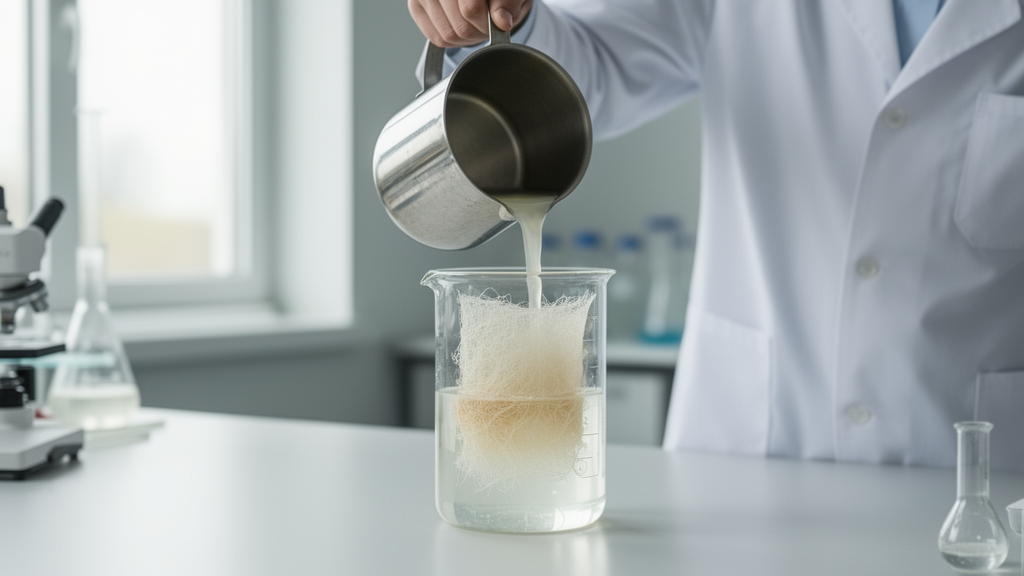
Dairy Waste Turned Into Peptide Nanocellulose That Cleans Dairy Wastewater

Dairy Waste Turned Into Peptide Nanocellulose That Cleans Dairy Wastewater

65
SHARES
587
VIEWS
Share on FacebookShare on Twitter
ADVERTISEMENT

A laboratory study reported that peptide-modified crystalline nanocellulose removed high proportions of organic-load indicators from industrial dairy wastewater under optimized test conditions. The Scientific Reports article abstract reports maximum removal efficiencies of 97.80% for chemical oxygen demand (COD), 93.60% for five-day biochemical oxygen demand (BOD₅) and 96.40% for total organic carbon (TOC) at a dosage of 300 mg L⁻¹, pH 6.5, a contact time of 35 minutes, a peptide-to-cellulose mass ratio of 3:1 and a temperature of 25 °C.

The researchers produced the bio-adsorbent from dairy sludge and crustacean waste. They optimized the tested operating variables—pH from 3 to 10, adsorbent dosage from 100 to 500 mg L⁻¹, contact time from 15 to 55 minutes, peptide-to-cellulose mass ratio from 0.5:1 to 3:1, and temperature from 15 to 55 °C—using response surface methodology based on a central composite design. Field-emission scanning electron microscopy, X-ray diffraction, Fourier-transform infrared spectroscopy, nitrogen adsorption and thermogravimetric analysis were used to characterize peptide functionalization, mesoporous structure and thermal stability.

Analysis of variance identified pH and adsorbent dosage as the most significant factors, each with p-values below 0.0001. The fitted quadratic models had an R² of 0.9519, and experimental validation yielded a relative error below 0.50%. These are model-based optimization results for the laboratory experimental system. In separate reuse testing over five successive adsorption–desorption cycles, the material retained approximately 95% COD removal, 92% BOD₅ removal and 89% TOC removal.

The abstract provides evidence that peptide-modified nanocellulose may function as a bio-based adsorbent for organic-load removal under the reported conditions, while also linking the material to waste valorization. It does not report performance at pilot or full scale, comparisons with other treatment methods, detailed adsorption mechanisms, cost, energy use or the effects of co-occurring wastewater constituents. Consequently, the results should not be taken as proof of broad effectiveness in operating dairy-wastewater treatment facilities.

Subject of Research: Laboratory optimization of peptide-modified nanocellulose for organic-load removal from dairy wastewater

Article Title: Peptide-modified nanocellulose from dairy waste for organic compound removal in dairy wastewater

Article References: Rastgar, S., Hanachi, P., & Walker, T. R. (2026). Peptide-modified nanocellulose from dairy waste for organic compound removal in dairy wastewater. Scientific Reports. https://doi.org/10.1038/s41598-026-76352-9

Image Credits: AI Generated

DOI: 10.1038/s41598-026-76352-9

Keywords: dairy wastewater, nanocellulose, bio-adsorbent, chemical oxygen demand, biochemical oxygen demand, total organic carbon, response surface methodology, waste valorization, adsorption, circular economy, Peptide-modified, dairy

Cite Scienmag News

Denise Maddox. (October 20, 2026). Peptide-modified nanocellulose achieves high organic-load removal in laboratory dairy-wastewater study. Scienmag. https://scienmag.com/peptide-modified-nanocellulose-achieves-high-organic-load-removal-in-laboratory-dairy-wastewater-study/


Denise Maddox. "Peptide-modified nanocellulose achieves high organic-load removal in laboratory dairy-wastewater study." Scienmag, 20 October 2026, https://scienmag.com/peptide-modified-nanocellulose-achieves-high-organic-load-removal-in-laboratory-dairy-wastewater-study/. Accessed 20 October 2026.

Denise Maddox. "Peptide-modified nanocellulose achieves high organic-load removal in laboratory dairy-wastewater study." Scienmag. October 20, 2026. https://scienmag.com/peptide-modified-nanocellulose-achieves-high-organic-load-removal-in-laboratory-dairy-wastewater-study/

Tags: adsorptionbio-adsorbentbio-adsorbent from dairy and crustacean wastebiochemical oxygen demandbiochemical oxygen demand removalchemical oxygen demandchemical oxygen demand reductionCircular economydairydairy wastewaterdairy wastewater treatmenthigh-efficiency pollutant removallaboratory wastewater treatment studymesoporous nanocellulose characterizationnanocelluloseorganic load removalPeptide-modifiedpeptide-modified nanocellulosepH and adsorbent dosage effectsresponse surface methodologyresponse surface methodology optimizationtotal organic carbontotal organic carbon removalwaste valorization
Share26Tweet16
Previous Post

Morphological and mitochondrial analysis identifies new Sphenomorphus skink in central Guangdong

Next Post

Lima broiler survey finds multidrug-resistant ESBL E. coli

Related Posts

Mitochondria‐Targeted Nanotherapeutics: A Promising Strategy in Modulating Mitochondrial Function, Transfer, and Transplantation
Technology and Engineering

Mitochondria‐Targeted Nanotherapeutics: A Promising Strategy in Modulating Mitochondrial Function, Transfer, and Transplantation

October 20, 2026
New moth species discovered in Saudi Arabia’s mountain forests
Biology

Research report: Taxonomic and distributional updates on the Arabian species of the genus Palpita Hübner, 1808 ( Lepidoptera , Crambidae , Spilomelinae )

October 20, 2026
Enhanced TOGI Control Framework Powers Bidirectional Solar EV Charging
Technology and Engineering

Simulation and real-time tests assess enhanced TOGI control for grid-connected solar PV–EV charging

October 20, 2026
Latvia Maps 162,186 Species Records to Rebuild Its Conservation Network
Biology

Latvia data paper documents inputs for national habitat suitability modelling

October 20, 2026
Responsive nanoparticles deliver ARV-771 to tumor cells
Technology and Engineering

Responsive nanoparticles deliver ARV-771 to tumor cells

October 20, 2026
Committee-Based Federated Learning Improves Smart-Grid Attack Detection in Simulated Grids
Technology and Engineering

Committee-Based Federated Learning Improves Smart-Grid Attack Detection in Simulated Grids

October 20, 2026
Next Post
Lima broiler survey finds multidrug-resistant ESBL E. coli

Lima broiler survey finds multidrug-resistant ESBL E. coli

  • Mothers who receive childcare support from maternal grandparents show more optimized

    Mothers who receive childcare support from maternal grandparents show more parental warmth, finds NTU Singapore study

    27656 shares
    Share 11059 Tweet 6912
  • University of Seville Breaks 120-Year-Old Mystery, Revises a Key Einstein Concept

    1061 shares
    Share 424 Tweet 265
  • Bee body mass, pathogens and local climate influence heat tolerance

    682 shares
    Share 273 Tweet 171
  • Researchers record first-ever images and data of a shark experiencing a boat strike

    546 shares
    Share 218 Tweet 137
  • Groundbreaking Clinical Trial Reveals Lubiprostone Enhances Kidney Function

    531 shares
    Share 212 Tweet 133
Science

Embark on a thrilling journey of discovery with Scienmag.com—your ultimate source for cutting-edge breakthroughs. Immerse yourself in a world where curiosity knows no limits and tomorrow’s possibilities become today’s reality!

RECENT NEWS

  • Lima broiler survey finds multidrug-resistant ESBL E. coli
  • Peptide-modified nanocellulose achieves high organic-load removal in laboratory dairy-wastewater study
  • Morphological and mitochondrial analysis identifies new Sphenomorphus skink in central Guangdong
  • Morphological study describes new Moroccan species Metanarsia moroccana

Categories

  • Agriculture
  • Anthropology
  • Archaeology
  • Athmospheric
  • Biology
  • Biotechnology
  • Blog
  • Bussines
  • Cancer
  • Chemistry
  • Climate
  • Earth Science
  • Editorial Policy
  • Marine
  • Mathematics
  • Medicine
  • Pediatry
  • Policy
  • Psychology & Psychiatry
  • Science Education
  • Science News
  • Social Science
  • Space
  • Technology and Engineering

Subscribe to Blog via Email

Enter your email address to subscribe to this blog and receive notifications of new posts by email.

Join 5,150 other subscribers

© 2025 Scienmag - Science Magazine

Welcome Back!

Login to your account below

Forgotten Password?

Retrieve your password

Please enter your username or email address to reset your password.

Log In
No Result
View All Result
  • HOME
  • SCIENCE NEWS
  • CONTACT US

© 2025 Scienmag - Science Magazine

Discover more from Science

Subscribe now to keep reading and get access to the full archive.

Continue reading