


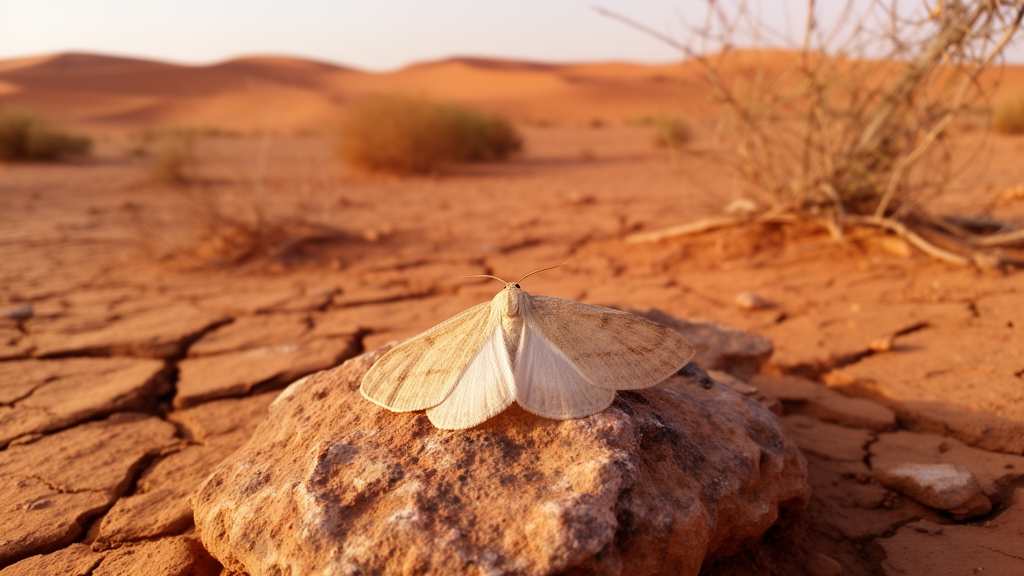
A morphological taxonomic study has identified and formally described a new moth species, Metanarsia moroccana, from eastern Morocco. The description is based on three male specimens collected at light in the Sahara near Erfout and Maadit at 800 metres elevation on 8 October 1996. The holotype and two paratypes were examined through external morphology and dissected male genitalia.
The species has a wingspan of 16.5–23.0 millimetres. Its head, thorax and tegulae range from dark yellow to reddish brown. The forewings are reddish brown with diffuse, lighter reddish-pink transverse fasciae at one quarter and one half of the wing, together with a rounded reddish subapical spot. The hindwings are light grey with light-brown margins, and the fringe is yellowish brown.
One of the clearest external features is the recurved labial palpus. Its second segment is unmodified, while the acute third segment is white to yellowish white, with a light-brown apex. Within Metanarsia, the combination of reddish-brown forewings and recurved labial palps distinguishes M. moroccana from species with comparable wing patterns, which have straight palps, and from species with recurved palps, which differ in forewing colour.
Comparisons with three reddish-brown congeners further separate the new species. Metanarsia kosakewitshi is lighter and uniformly reddish brown, lacks the transverse fasciae and has straight labial palps. Metanarsia guberlica is brighter, has distinct reddish irroration and gently recurved labial palps. Metanarsia dahurica has a pale subdorsal patch around the middle of the forewing and a distinctly broadened, straight second segment of the labial palpus. Male genitalia also distinguish M. moroccana: its phallus is shorter than the valva, whereas these structures are equal in length in the related species.
The male genitalia of M. moroccana include a tongue-shaped uncus, a slender rod-like gnathos and a nearly equilateral triangular tegumen. The digitate valva has a rounded apex and extends to the tip of the uncus. The sacculus is twice as broad in its basal half as in its distal half and bears three short posterior teeth; it is narrower than the sacculus of M. kosakewitshi and shorter than the saccus of M. guberlica. Unlike M. dahurica, the new species has teeth on the sacculus. Female genitalia remain unknown because no female specimens were available.
The authors classified the species within the M. incertella group on the basis of its well-developed apical sacculus teeth and recurved labial palps with an unmodified second segment. M. incertella has a short phallus and a comparatively narrow saccus with three apical teeth, but it differs from M. moroccana in having a deeply apically emarginated uncus, a lateral tooth on the sacculus, a different forewing pattern and much longer labial palps.
Adults were recorded flying in early October, and the authors describe M. moroccana as apparently an obligatorily autumnal species, a timing they consider unique within Metanarsia. This conclusion is based on the reported adult records rather than a multi-season sampling programme. The host plant is unknown. More broadly, the study notes that only M. alphitodes has a known host plant, identified as a species of Nitraria.
The description also revises the context in which Metanarsia is classified. A first revision reviewed and illustrated ten species, five further species were described later, and two originally placed in the genus were subsequently transferred to Catatinagma and Chrysoesthia. The genus currently contains thirteen Palaearctic species, mainly in arid regions extending from northwestern Africa to Mongolia and northern China, although M. moroccana increases that documented total by one.
The study cautions that the current concept of Metanarsia remains tentative and based exclusively on morphological evidence. The genus is considered heterogeneous in external and male genitalic characters, and the placement of M. partilella is described as particularly uncertain. The authors state that additional species may be identified as DNA barcoding and collection specimens become available, and that an integrative revision of the tribe Apatetrini may clarify whether some current members should be transferred to other genera. The present species description itself is limited by its very small, male-only type series and the absence of female and biological data.
Subject of Research: Morphological description of a new Metanarsia moth species from Morocco
Article Title: A new species of Metanarsia Staudinger, 1871 ( Lepidoptera , Gelechiidae ) from Morocco
Article References: Bidzilya, O. V. (2022). A new species of Metanarsia Staudinger, 1871 (Lepidoptera, Gelechiidae) from Morocco. Nota Lepidopterologica, 45, 295-303. https://doi.org/10.3897/nl.45.95198
Image Credits: AI Generated
DOI: 10.3897/nl.45.95198
Keywords: Metanarsia moroccana, new species, taxonomy, Lepidoptera, Gelechiidae, Morocco, male genitalia, species description, species, Metanarsia, Staudinger, scientific research
Cite Scienmag News
Gavin Prescott. (October 20, 2026). Morphological study describes new Moroccan species Metanarsia moroccana. Scienmag. https://scienmag.com/morphological-study-describes-new-moroccan-species-metanarsia-moroccana/
Gavin Prescott. "Morphological study describes new Moroccan species Metanarsia moroccana." Scienmag, 20 October 2026, https://scienmag.com/morphological-study-describes-new-moroccan-species-metanarsia-moroccana/. Accessed 20 October 2026.
Gavin Prescott. "Morphological study describes new Moroccan species Metanarsia moroccana." Scienmag. October 20, 2026. https://scienmag.com/morphological-study-describes-new-moroccan-species-metanarsia-moroccana/


