


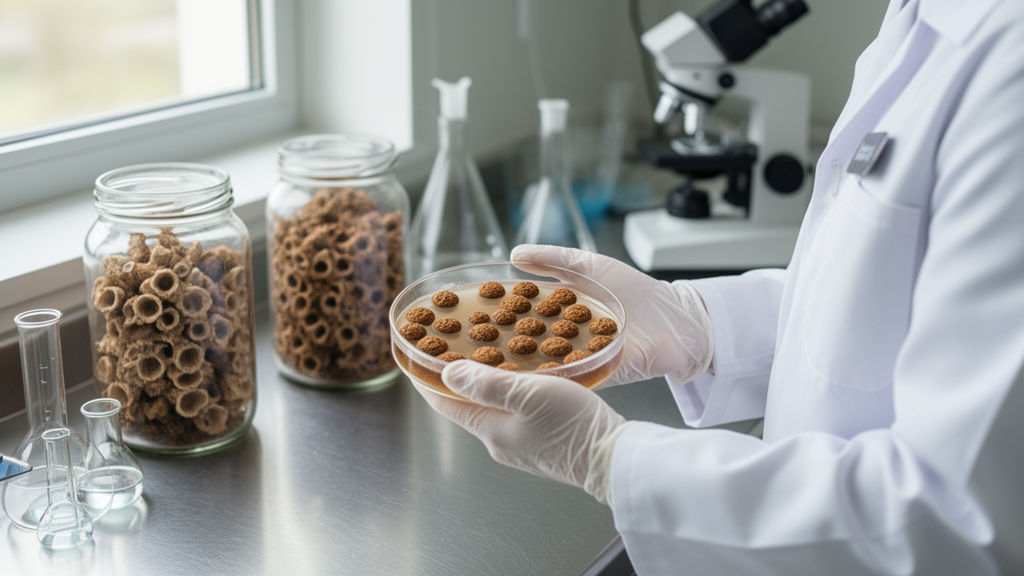
A laboratory study in China found that the termite fungus-garden-associated fungus Xylaria minima can be induced to form small sclerotia in incubated termite combs and cultivated on several laboratory media and substitute substrates. The study also found that its sclerotia contained higher preliminary measurements of four broad chemical classes, L-glutamic acid and γ-aminobutyric acid than did the mycelia analyzed, although the chemical comparison lacked biological replication.
Researchers sampled three colonies each of Macrotermes annandalei and M. gilvus in Xishuangbanna in January 2025. They collected 600 fragments of termite fungus combs, including 300 fresh and 300 mature fragments, with each fragment weighing 2 g. Containers were disinfected with 75% ethanol and exposed to ultraviolet light for 30 minutes before use. The fragments were incubated individually at about 28 °C in darkness, and sclerotia were recorded after 15 days.
Mature combs produced sclerotia more often than fresh combs. The reported induction rate was 7.3% for mature M. annandalei combs and 8% for mature M. gilvus combs, compared with 1.3% for fresh M. gilvus combs; no sclerotia were observed on fresh M. annandalei combs. Two sclerotia appeared in boxes containing fresh M. gilvus combs but were not attached to the comb material. Altogether, 25 sclerotia were observed, and 12 were successfully isolated and cultured.
The researchers identified the isolates using microscopy and a multilocus analysis of the ITS, ACT, TUB2 and RPB2 regions. In the analysis of 87 Xylaria strains, the 12 isolates grouped with the X. minima type strain with 100% maximum-likelihood bootstrap support and a Bayesian posterior probability of 1.00. The isolates formed a separate lineage from the previously recognized massive-sclerotium-forming X. nigripes species group. The authors therefore concluded that the comb-specialized sclerotium-forming habit evolved at least twice, and possibly multiple times, within Xylaria.
The induced sclerotia were spherical, ovoid or irregular and matured from white through gray to black, with a hard outer shell. At 15 days, their mean length was 5.24 ± 1.68 mm, mean height was 4.22 ± 1.34 mm and mean wet weight was 61.65 ± 37.21 mg, based on 25 sclerotia. Most appeared within the first 10 days without a preceding phase of visible vegetative growth. After about 20–30 days at room temperature, an unbranched germinating hypha emerged through the sclerotial surface and sometimes produced conidia.
Using strain Mg-M4, selected from the largest isolated sclerotium, the researchers tested potato dextrose agar, water agar and termite-comb leachate agar containing 10–320 g/L dried comb material. Radial growth differed significantly among media, and strain Mg-M4 grew faster on the leachate media than on the two controls. Sclerotia formed within 15 days on leachate agar at reported concentrations of 5, 10, 20 and 40 g/L, whereas they rarely formed on potato dextrose agar or water agar. Repeated subculture on 40 g/L leachate agar also made sclerotium production more frequent on potato dextrose and oat media.
Sclerotia also developed in substrate-based cultures. Comb material mixed with tissue paper and water produced compact clusters within one month, including an individual sclerotium of 4.262 g. A paper-based agricultural substrate containing wheat grain, corn flour, sawdust, cottonseed hull, wheat bran and tissue paper supported growth and sclerotium formation, with a maximum weight of 3.808 g; the maximum weights on the two substrates were comparable but not equal. Sclerotia reached 1.276 g on a paper-based soil substrate. The researchers observed no extensive vegetative mycelial growth in these substrate systems and noted that the sclerotia appeared potentially capable of repeated harvesting.
Preliminary chemical comparisons used fresh potato-dextrose-agar-grown mycelia and fresh sclerotia produced on the paper-based agricultural substrate. Single measurements without biological replication gave crude polysaccharide contents of 0.240 g/100 g in mycelia and 0.44 g/100 g in sclerotia, total alkaloids of 0.01 and 0.02 g/100 g, total sterols of 0.240 and 0.372 g/100 g, and total triterpenoids of 0.0362 and 0.0757 g/100 g. HILIC–LC–MS/MS measurements were 85.09 versus 576.51 mg/kg for L-glutamic acid and 3.73 versus 11.90 mg/kg for γ-aminobutyric acid in mycelia and sclerotia, respectively.
The results establish laboratory cultivability for the sampled X. minima isolates but remain limited in scope. The field collection involved only two Macrotermes species at one locality, the teleomorph was not observed, and the chemical assays used nonreplicated fresh-weight measurements. The comparison also drew mycelia from potato dextrose agar and sclerotia from an agricultural substrate, so differences cannot be assigned solely to tissue type. The authors note that standardized substrates, dry-weight measurements, broader host and geographic sampling, and investigation of termite responses and volatile organic compounds will be needed to clarify the fungus’s ecological and evolutionary significance.
Subject of Research: Laboratory cultivation and preliminary chemical analysis of termite-associated Xylaria minima sclerotia
Article Title: Cultivation and preliminary chemical analyses of the sclerotium-forming, termite fungus garden-associated Xylaria minima
Article References: Yang, E.-F., Stadler, M., Möllerke, A., Samarakoon, M. C., Chiu, C.-I., Dai, D.-Q., Promputtha, I., Yu, F.-Q., Ali, S., Karunarathna, S. C., Tibpromma, S., & Yang, J.-Y. (2026). Cultivation and preliminary chemical analyses of the sclerotium-forming, termite fungus garden-associated Xylaria minima. MycoKeys, 139, 49-72. https://doi.org/10.3897/mycokeys.139.206447
Image Credits: AI Generated
DOI: 10.3897/mycokeys.139.206447
Keywords: Xylaria minima, sclerotia, termite fungus gardens, Macrotermes, laboratory cultivation, comb leachate agar, chemical profiling, polysaccharides, glutamic acid, GABA, Cultivation, preliminary
Cite Scienmag News
Drew Townsend. (October 20, 2026). Lab study cultivates small sclerotia of termite-associated Xylaria minima. Scienmag. https://scienmag.com/lab-study-cultivates-small-sclerotia-of-termite-associated-xylaria-minima/
Drew Townsend. "Lab study cultivates small sclerotia of termite-associated Xylaria minima." Scienmag, 20 October 2026, https://scienmag.com/lab-study-cultivates-small-sclerotia-of-termite-associated-xylaria-minima/. Accessed 20 October 2026.
Drew Townsend. "Lab study cultivates small sclerotia of termite-associated Xylaria minima." Scienmag. October 20, 2026. https://scienmag.com/lab-study-cultivates-small-sclerotia-of-termite-associated-xylaria-minima/


