


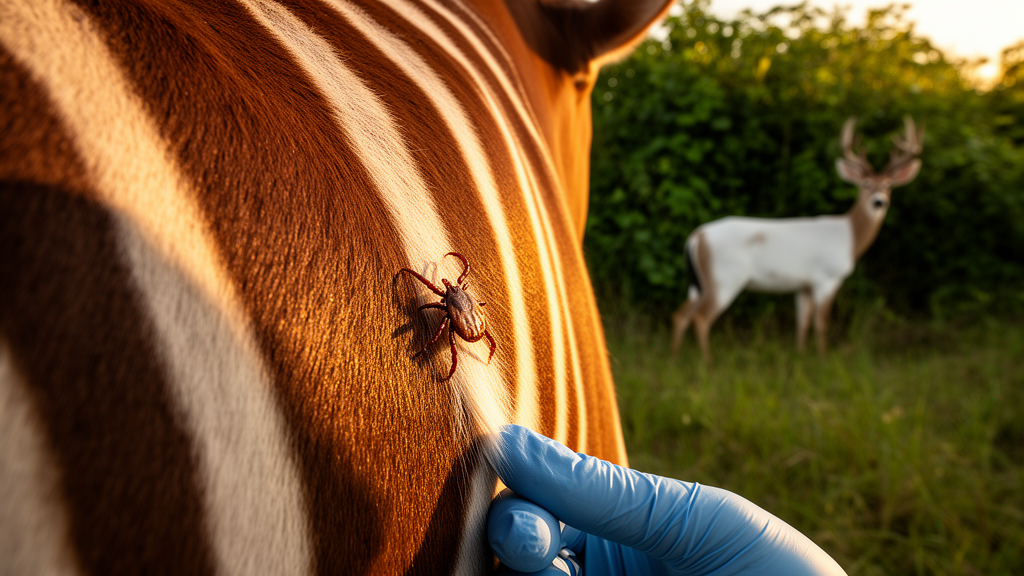
A modeling study of the cattle tick Rhipicephalus (Boophilus) microplus found that combining climatic tolerance limits with the distribution of wild hosts better represented the tick’s potential presence across the Americas than a conventional MaxEnt model evaluated in the same study. The approach estimated a two-dimensional climatic fundamental niche using annual mean temperature and relative humidity, then considered host availability as a proxy for the tick’s access to sites and for movement beyond environmentally suitable areas.
The researchers assembled 838 occurrence records from 1970 to 2018 in the Neotropics. Of these, 478 included life-stage information and were used to fit the niche models, while 360 records without stage information were reserved as evaluation points. The fitting records included 99 observations of eggs, larvae or nymphs and 462 observations of adult ticks; Model 3 combined all stages. Occurrences were spatially thinned with a 22-kilometer filter to reduce spatial autocorrelation.
The models were calibrated in a two-variable environmental space comprising annual mean temperature from WorldClim and relative humidity from Coupled Model Intercomparison Project data. Both layers were downscaled to 0.2-degree resolution, approximately 22 kilometers. The study applied the Bayesian model of Jiménez et al. (2019), which represents the fundamental niche as an ellipse described by a multivariate normal distribution. Its parameters estimate the environmental center of the niche, its orientation and its extent.
Physiological information came from experiments published by Hitchcock in 1955 on an Australian population collected from cattle farms. In tests involving 300 eggs, the reported tolerance range for air temperature was 16.6–36.6 °C, while mean relative humidity ranged from 70% to 99%. These older experimental limits were supplied to the models as prior information, but the authors cautioned that they originated from one population and might not capture differences among populations or between laboratory and field conditions.
The estimated niche centers were similar among the immature-stage, adult-only and all-stage models: annual mean temperature was about 17 °C, and mean relative humidity ranged from 79% to 82%. The 95% confidence ellipse for the immature-stage model was smaller and more elongated along the temperature axis, whereas the adult and combined models had similar shapes and sizes. The combined Model 3 placed 96.11% of the 360 stage-unknown evaluation records within its 95% ellipse; the adult model placed 95.28% inside, and the immature-stage model placed 84.72% inside.
Model 3 identified mostly low climatic suitability across the Americas, with medium to moderate suitability in parts of the United States, Mexico, Central America and South America. High environmental suitability was concentrated in southernmost Brazil, Uruguay and northeastern Argentina. The model also left about 4% of evaluation points outside the estimated fundamental niche. Those outlying tick records occurred in environmental conditions where two abundant wild hosts—white-tailed deer and the cougar, or mountain lion—also had occurrence records, suggesting that host-associated movement could account for some occurrences beyond the climatic niche boundary.
To incorporate biotic information, the researchers compiled occurrence records for 10 wild host species with more than 20 records each and applied a 50-kilometer spatial filter. A kernel-density estimate across the Americas represented host availability. The researchers used the 5% quantile of estimated density values among host-presence sites as the minimum host-density threshold. Combining this binary host map with the 95% ellipse from Model 3 produced four classes: climatically unsuitable sites without hosts, unsuitable sites with hosts, suitable sites without hosts, and sites that were both climatically suitable and had hosts. The resulting map delineated areas potentially prone to infestation by combining environmental suitability with host availability.
For comparison, the team fitted 54 candidate MaxEnt models using the same 478 stage-known occurrences and two climatic variables. A 200-kilometer buffer around occurrence records represented the accessible area. Models were screened using partial ROC, an omission rate of 0.05 and AICc, and the selected configuration combined linear, quadratic and product features. It had an omission rate of 0.048 and an AICc score of 6939.5; the median of 10 bootstrapped versions became the final model.
The selected MaxEnt output did not display the concentric environmental pattern expected from the ellipse model. Its high-suitability region was hyperbolic and divided into two disconnected clusters: one cold and humid and the other hot with low-to-medium humidity. Geographically, it assigned medium to high suitability to much of the continent, including Alaska and Greenland, where the tick has not been documented. Its suitability values were concentrated around 0.5, and few fitting occurrences received high scores. These findings are comparisons within this study and do not establish that MaxEnt is generally unsuitable for distribution modeling. The analysis was also limited to two climatic variables, relied on stage-unknown evaluation records and sparse host data, and did not quantify interactions involving other ticks, fungi, bacteria or invertebrates.
Subject of Research: Modeling the climatic and host-associated potential distribution of the cattle tick Rhipicephalus (Boophilus) microplus in the Americas
Article Title: Integrating biotic factors into niche modeling: a case study with Rhipicephalus ( Boophilus ) microplus in the Americas
Article References: Marques, R., Jiménez, L., Ferreira-Krüger, R., & Jiménez-García, D. (2025). Integrating biotic factors into niche modeling: a case study with Rhipicephalus (Boophilus) microplus in the Americas. Frontiers of Biogeography, 18, Article e152671. https://doi.org/10.21425/fob.18.152671
Image Credits: AI Generated
Keywords: cattle tick, Rhipicephalus microplus, ecological niche modeling, MaxEnt, wild hosts, fundamental niche, realized niche, climate suitability, host density, the Americas, Integrating, biotic
Cite Scienmag News
William Thompson. (October 20, 2026). Niche-modeling study links cattle-tick habitat suitability to climate and wild hosts across the Americas. Scienmag. https://scienmag.com/niche-modeling-study-links-cattle-tick-habitat-suitability-to-climate-and-wild-hosts-across-the-americas/
William Thompson. "Niche-modeling study links cattle-tick habitat suitability to climate and wild hosts across the Americas." Scienmag, 20 October 2026, https://scienmag.com/niche-modeling-study-links-cattle-tick-habitat-suitability-to-climate-and-wild-hosts-across-the-americas/. Accessed 20 October 2026.
William Thompson. "Niche-modeling study links cattle-tick habitat suitability to climate and wild hosts across the Americas." Scienmag. October 20, 2026. https://scienmag.com/niche-modeling-study-links-cattle-tick-habitat-suitability-to-climate-and-wild-hosts-across-the-americas/


