


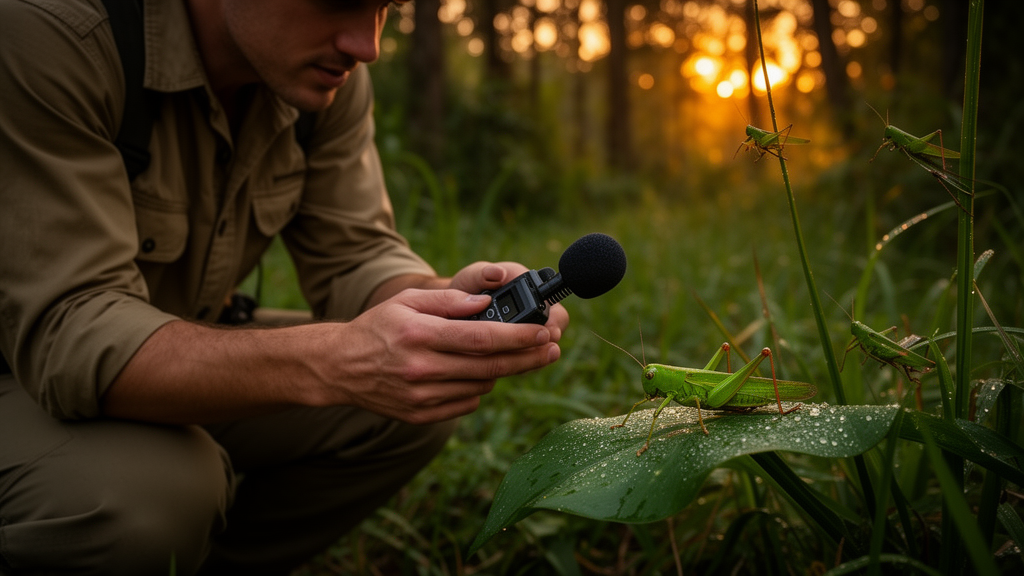
A taxonomic and bioacoustic study of African Eurycorypha katydids described three new species: Eurycorypha paraspicula and E. spicula from Tanzania and E. willschi from West Africa. The researchers combined examination of museum specimens, field observations, laboratory rearing and recordings to characterize the insects’ morphology, distribution, songs and duets. They also described for the first time the male–female duet of the previously named E. binasuta.
Eurycorypha is the most species-rich genus of African Phaneropterinae and currently contains 55 species. Its members generally have green bodies, thin antennae, oval eyes and either elongate or rounded outlines, although the male’s tenth abdominal tergite and cerci provide important diagnostic characters. The genus also has highly diverse songs, while the early nymphs of many species resemble ants. These characters are generally unavailable in preserved collection material, complicating identification of morphologically similar species.
E. paraspicula is known only from the East Usambara Mountains in Tanzania’s Nilo Forest Reserve, where the type specimens were collected in montane forest at about 1,500 metres above sea level. The species has a notably round body, paired spines on the posterior margin of the male’s tenth tergite and robust cerci. No females were found during 19 visits to the locality between 2012 and 2024. The authors consider it likely that the species occurs locally only during warmer periods, as is typical of other montane Orthoptera.
E. spicula was described from the Nguru Mountains of Tanzania at approximately 1,900 metres, where both sexes are known. It is morphologically close to E. paraspicula but is less rounded, has shorter spines on the male’s tenth abdominal tergite and more slender cerci. Females possess a compact form, an upcurved ovipositor and a triangular subgenital plate. First- and second-instar nymphs collected in November 2021 were reared on leaves from trees and bushes near Mount Kilimanjaro; the first adults emerged on 12 January 2022, indicating a development period of about two months from hatching.
E. willschi was named for Achim Willsch, who collected living specimens in Ghana. It is an elongate, predominantly green species recorded from Benin, Burkina Faso, Cameroon, the Central African Republic, Côte d’Ivoire, Ghana, Guinea, Niger and Nigeria, with one additional male record from Niger. Unlike the two geographically restricted Tanzanian species, it is widespread in West Africa. Its first three nymphal stages resemble black ants, and the insects gradually become green and adopt leaf-like camouflage as they develop. The black, oval eggs are laid singly into leaf margins.
The bioacoustic analysis covered approximately 53.3 hours of recordings from 17 specimens of the three newly described species: four males of E. paraspicula, three males and three females of E. spicula, and three males and four females of E. willschi. An additional 13.6 hours of recordings included two males and three females of E. binasuta. Laboratory recordings were made at 20–25°C. Male calling songs were captured with a digital bat detector at a 100 kHz sampling rate, while duets were recorded in stereo at 64 kHz. Song measurements were reported as means with standard deviations, and spectral analysis used overlapping 512-point Hanning windows.
The three new species produced song patterns not previously documented in Eurycorypha. E. paraspicula produced groups of polysyllabic, crescendoing echemes containing 7.7 ± 0.5 syllables at a syllable repetition rate of 41 Hz, with a relatively narrow spectral peak around 13 kHz. E. spicula produced an unusually long initial syllable followed by shorter syllables; the long syllable lasted 38.4–84.4 ms, while the shorter elements were repeated at 32–35 Hz. Females generally responded about 76.5 ± 30 ms after the male echeme ended, although latency varied when several males were singing. In acoustic interactions, a follower placed its echemes immediately after those of a leader, while the leader sometimes produced extended series of short syllables.
E. willschi produced slow echemes composed of syllable pairs at 26–29 Hz and fast echemes of two or three syllables at 45–50 Hz. Females responded only to the fast echemes, 63–86 ms after the beginning of the final and loudest male syllable. Fast-echeme series often began at low amplitude, and the authors suggest that quieter signals may be less conspicuous to rivals, although this remains an interpretation rather than a directly tested outcome. Males also sometimes added short syllables after a female response. The measured E. willschi spermatophore averaged 51.5 mg, or 10.3% of male body mass, within the range reported for the genus.
For E. binasuta, females responded only to the male’s crescendoing syllable group, with latencies of 334–362 ms from the beginning of the echeme and 122–134 ms from the end of the group. Their replies varied in amplitude and typically contained multiple impulses and high-amplitude pulses. The short, pulse-like male syllables that sometimes followed the crescendoing group had a narrow spectrum resembling that of female responses; the female replies themselves were not characterized as narrow-banded. The authors note that the resemblance could reflect biophysical constraints on producing short, high-amplitude sounds, selection favoring spectrally female-like male signals, or both.
The authors propose that past fragmentation and reconnection of African forests contributed to speciation in Eurycorypha, including fully winged species. They associate the restricted, rounder forms E. paraspicula and E. spicula with small montane habitats, while more elongate species such as E. willschi occur across broader lowland and woodland areas. This remains a proposed evolutionary explanation rather than a result directly demonstrated by the present taxonomic and recording work. A survey of European museum collections also indicated that numerous undescribed Eurycorypha species remain to be studied, limiting current estimates of the genus’s diversity and acoustic variation.
Subject of Research: Taxonomy, distribution, biology and bioacoustics of three newly described Eurycorypha katydid species
Article Title: Description and bioacoustics of three new Eurycorypha ( Orthoptera , Tettigonioidea ) species from Tanzania and Ghana, with notes on their biology
Article References: Hemp, C., Massa, B., & Heller, K.-G. (2025). Description and bioacoustics of three new Eurycorypha (Orthoptera, Tettigonioidea) species from Tanzania and Ghana, with notes on their biology. Journal of Orthoptera Research, 34(2), 187-200. https://doi.org/10.3897/jor.34.137613
Image Credits: AI Generated
Keywords: Eurycorypha, katydids, Tettigoniidae, species description, bioacoustics, animal behavior, Tanzania, West Africa, taxonomy, Description, three, Orthoptera
Cite Scienmag News
Arthur Russell. (October 20, 2026). Taxonomic and bioacoustic study describes three new Eurycorypha species. Scienmag. https://scienmag.com/taxonomic-and-bioacoustic-study-describes-three-new-eurycorypha-species/
Arthur Russell. "Taxonomic and bioacoustic study describes three new Eurycorypha species." Scienmag, 20 October 2026, https://scienmag.com/taxonomic-and-bioacoustic-study-describes-three-new-eurycorypha-species/. Accessed 20 October 2026.
Arthur Russell. "Taxonomic and bioacoustic study describes three new Eurycorypha species." Scienmag. October 20, 2026. https://scienmag.com/taxonomic-and-bioacoustic-study-describes-three-new-eurycorypha-species/


