


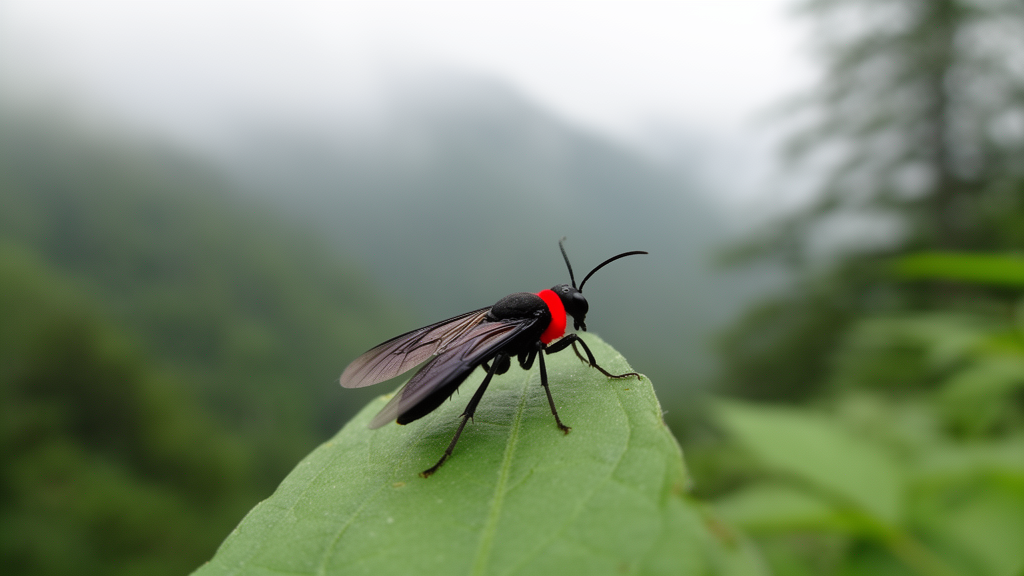
A taxonomic study of the sawfly genus Platycampus formally describes Platycampus rufitegularis as a new species from Zhejiang Province, China, raising the genus’s recognized diversity to 11 species. The identification was supported by adult morphology and a maximum-likelihood analysis of the COI gene; the study separately assembled and reported a partial mitochondrial genome for the new species. Platycampus is a small genus in the sawfly subfamily Nematinae within the family Tenthredinidae.
P. rufitegularis is the third Platycampus species recorded in China. Larvae of the genus feed exclusively on Betulaceae, including birches, alders and hazels, although host plants remain undocumented for all three Chinese species. The study’s formal type series comprised a female holotype and eight paratypes collected during surveys at Mount West Tianmu in Lin’an District, Hangzhou City, Zhejiang.
The female holotype was collected at Xianrending, 30.349° N, 119.424° E and 1,506 m above sea level on 9 May 2021. Other paratypes were collected at Mount West Tianmu between 2012 and 2019. Five additional females preserved in alcohol were listed as voucher specimens rather than members of the formal type series.
Examined material was deposited in the Asian Sawfly Museum in Nanchang, China. The holotype female is approximately 6.5 mm long, while the male is approximately 5.5 mm long. The body is black, the legs are yellowish-white to reddish-brown apart from small black areas at the bases of the coxae, and the tegulae are reddish-brown.
The wings are hyaline, with a yellowish-brown basal portion of forewing vein C and brown to blackish-brown stigma and veins. Diagnostic features of the new species include a clypeal anterior margin incised to one-quarter of the clypeus length, rounded lateral corners, a shallow subcircular middle fovea with a fine longitudinal groove, and a median longitudinal groove in the frontal area. The female lancet has 15 serrulae, with three to four distal denticles on each middle serrula.
In males, the harpes have an inner surface swollen over the basal third, lack the medial tubercle found in P. japonicus, and taper to approximately 0.3 of their basal width. The penis valve’s narrow lobiform process is slightly shorter than its broad process, whose lateral margins converge at 145 degrees. P. rufitegularis resembles P. japonicus but differs in a combination of pronotal, leg, tegular, tarsal, lancet and genital characters.
Among the distinctions, the new species has a black pronotum and reddish-brown tegulae, whereas P. japonicus has yellowish or pale-yellow pronotal lobes and tegulae. The lancet of P. rufitegularis has 15 serrulae, compared with 20 in P. japonicus. For the molecular work, researchers extracted genomic DNA from the muscle of female voucher specimen LSAF-M0126.
Illumina HiSeq 6000 sequencing yielded 27,619,650 raw reads. Assembly and annotation produced a 16,103-base-pair partial mitochondrial genome with an average coverage depth of 106 times. The assembly contained 13 protein-coding genes, 21 transfer RNAs and two ribosomal RNAs, but lacked trnD and the control region; its A+T content was 80.1%.
The sequence and annotation were deposited in GenBank under accession PX129881. For phylogenetic analysis, the researchers aligned COI sequences with MAFFT, selected the GTR+I+G substitution model with jModelTest, and reconstructed a maximum-likelihood tree through IQ-TREE using 1,000 ultrafast bootstrap replicates. The analysis placed P. rufitegularis and P. amurensis as sister species with a bootstrap value of 100.
That pair was sister to P. speciosus with a value of 98, and the combined lineage was sister to P. luridiventris, also with a value of 98. Platycampus was represented as a monophyletic group, although its inferred sister relationship to Dineura had weaker support, with a bootstrap value of 51. The paper also provides a female and male identification key for all known Platycampus species, together with diagnostic illustrations of P. rufitegularis and the two previously described Chinese species.
P. linealis, described in 2024 from Mount Qingliangfeng in Zhejiang, remains known from a single male, while P. xini, described in 2025 from Mount Xiaolong in Gansu, remains known from a single female. Because those species are represented by single specimens, some observed differences could reflect sexual dimorphism or within-species variation rather than fixed species-level distinctions. The authors note that additional specimens are needed to resolve that uncertainty and that the reddish-brown coloration reported for the preserved P. xini specimen may reflect prolonged alcohol storage or a teneral, newly emerged adult.
The larval host of P. rufitegularis remains unknown.
Subject of Research: Taxonomic description and phylogenetic placement of a new Platycampus sawfly species from China
Article Title: A new species of Platycampus ( Hymenoptera , Tenthredinidae ) from China, with an identification key to the world species
Article References: Liu, M.-M., Li, Z.-J., & Wei, M.-C. (2025). A new species of Platycampus (Hymenoptera, Tenthredinidae) from China, with an identification key to the world species. Journal of Hymenoptera Research, 98, 897-914. https://doi.org/10.3897/jhr.98.167841
Image Credits: AI Generated
Keywords: Platycampus, sawfly, new species, Tenthredinidae, Nematinae, taxonomy, morphology, COI phylogeny, mitochondrial genome, China, species, Hymenoptera
Cite Scienmag News
Juliet Wilcox. (October 20, 2026). Morphological and COI-based taxonomic study describes 11th Platycampus sawfly species. Scienmag. https://scienmag.com/morphological-and-coi-based-taxonomic-study-describes-11th-platycampus-sawfly-species/
Juliet Wilcox. "Morphological and COI-based taxonomic study describes 11th Platycampus sawfly species." Scienmag, 20 October 2026, https://scienmag.com/morphological-and-coi-based-taxonomic-study-describes-11th-platycampus-sawfly-species/. Accessed 20 October 2026.
Juliet Wilcox. "Morphological and COI-based taxonomic study describes 11th Platycampus sawfly species." Scienmag. October 20, 2026. https://scienmag.com/morphological-and-coi-based-taxonomic-study-describes-11th-platycampus-sawfly-species/


