


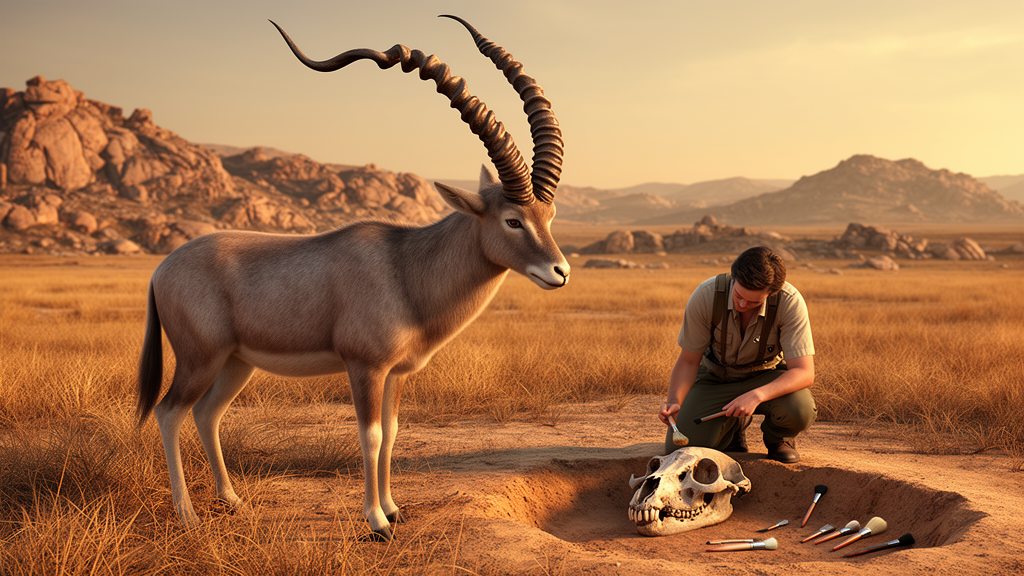
A paleontological study of a single fossil horn core has identified Hypsodontus sinensis, a new species of an extinct bovid, from the Early Miocene of Gansu Province, China. The specimen, catalogued as IVPP V34116, is a nearly complete right horn core with part of the frontal bone. It was recovered from the base of the Dongxiang Formation at the Citan locality, also known as Guanfang, in the Linxia Basin. Magnetostratigraphic work dates the sandstone layer to approximately 17.2 million years ago, making this the earliest known occurrence of the genus Hypsodontus and the first definitive record from China.
Before this discovery, all recognized Hypsodontus species were restricted to Middle Miocene deposits, principally in Turkey, with additional records from Serbia and the North Caucasus. The Chinese specimen therefore extends the known temporal range of the genus and adds a substantially earlier East Asian occurrence. The authors interpret this timing as suggesting a possible origin of Hypsodontus in China, followed by westward dispersal, although the geographic interpretation remains a hypothesis rather than a directly demonstrated migration history.
The holotype was excavated from a sandstone layer that also produces the Shinanu mammalian fauna. This assemblage includes proboscideans, carnivores, horses, chalicotheres, peccaries and numerous small mammals, and is assigned to the Early to Middle Miocene, approximately 17–15 million years ago, broadly corresponding to the upper MN4 to MN5 interval. The horn core is stored at the Institute of Vertebrate Paleontology and Paleoanthropology in China. Comparative specimens held by other institutions were examined as three-dimensional models in MeshLab, and the researchers used established cranial, horn-core and dental terminology to conduct measurements and morphological comparisons.
IVPP V34116 measures approximately 126.4 mm in length. It is elongated and evenly tapered toward the tip, producing an overall cylindrical profile, and is inserted uprightly above the orbit with a slight backward inclination. The tip curves anteriorly. Its basal cross-section is nearly circular, with an anteroposterior diameter of 31.1 mm and a transverse diameter of 27.3 mm, corresponding to a transverse-to-anteroposterior diameter ratio of approximately 87.8%. The surface is relatively smooth, with faint longitudinal grooves and a short anterior rib near the tip, while the preserved pedicle measures about 18.2 mm.
The most prominent diagnostic feature is pronounced homonymous twisting. The right horn core twists by more than one-third but less than one-half of a full circle. Two sinuses are preserved at its base, including a large, deep lateral sinus and a smaller, shallow medial sinus; extension of the frontal sinus into the horn core is described as an advanced bovid feature. The combination of a nearly circular base, even upward tapering, pronounced torsion and a comparatively smooth surface distinguishes the specimen from other hypsodontine genera and supports assignment to Hypsodontus.
Comparisons with named Hypsodontus species indicate that the fossil is most similar to H. pronaticornis, the best-documented species in the genus. Both have broadly comparable cross-sectional shapes and degrees of upward tapering. The Chinese horn core is, however, shorter than adult examples of H. pronaticornis, less strongly inclined medially and lacks the younger growth ring consistently reported for that species. Its well-developed basal sinuses also distinguish it from juvenile H. pronaticornis, for which the growth pattern and proportional length can otherwise be comparable. These differences support recognition of H. sinensis as a separate species, while its closest morphological affinity remains H. pronaticornis.
Additional comparisons place the fossil outside Turcocerus and Kubanotragus. Turcocerus horn cores are generally shorter and thicker, taper more sharply toward the tip, show less twisting and commonly carry prominent longitudinal grooves. Kubanotragus has more slender horn cores with weaker homonymous twisting; its type species, K. sokolovi, also has a symmetrically elliptical basal cross-section with transverse compression. The new specimen is longer and more strongly twisted than typical Turcocerus and more strongly twisted and nearly circular in cross-section than Kubanotragus. Because the Chinese material consists of one horn core without associated teeth or a complete skull, its wider anatomical and evolutionary placement remains constrained by the available characters.
The authors interpret the evolution of Hypsodontinae partly through variation in horn-core torsion. Hypsodontus, Turcocerus and Kubanotragus all possess homonymously twisted horn cores, but the amount differs: Hypsodontus has the strongest twisting, Turcocerus is intermediate, and Kubanotragus has the weakest. They propose that slight twisting in Kubanotragus is ancestral within the subfamily, while the more intense torsion in Hypsodontus and Turcocerus is derived. They also suggest that poorly studied fossils from Xishuigou in Gansu and the Halamagai Formation in Xinjiang may represent an early form of Kubanotragus, potentially near the ancestral condition from which the two more derived genera emerged.
For the proposed China-to-westward-dispersal scenario, the study links tectonic and climatic change to the timing. Uplift of the Tibetan Plateau during the Cenozoic Himalayan orogeny is associated with Early Miocene aridification in northwestern China, which the authors suggest may have favored a grazing bovid with high-crowned teeth in a semi-arid, savanna-like ecosystem. Westward movement may subsequently have been aided by a mid-latitude arid belt and land connections around the Mediterranean and Paratethys, although the authors note that these connections were disrupted and re-established at different times. The proposed route therefore remains an informed evolutionary and paleobiogeographic model, not a directly observed migration event.
Subject of Research: Description of an Early Miocene Hypsodontus horn core from Gansu, China
Article Title: The first discovery of Hypsodontus ( Artiodactyla , Bovidae ) from the Early Miocene of Linxia Basin, Gansu Province, China
Article References: Jin, Y.-Q., Jiangzuo, Q., & Wang, S.-Q. (2025). The first discovery of Hypsodontus (Artiodactyla, Bovidae) from the Early Miocene of Linxia Basin, Gansu Province, China. Fossil Record, 28(2), 231-239. https://doi.org/10.3897/fr.28.156566
Image Credits: AI Generated
DOI: 10.3897/fr.28.156566
Keywords: Hypsodontus, Hypsodontinae, Bovidae, paleontology, Early Miocene, Linxia Basin, Gansu Province, fossil horn core, new species, bovid evolution, first, discovery
Cite Scienmag News
Gavin Prescott. (October 20, 2026). Early Miocene horn core documents first Hypsodontus found in China. Scienmag. https://scienmag.com/early-miocene-horn-core-documents-first-hypsodontus-found-in-china/
Gavin Prescott. "Early Miocene horn core documents first Hypsodontus found in China." Scienmag, 20 October 2026, https://scienmag.com/early-miocene-horn-core-documents-first-hypsodontus-found-in-china/. Accessed 20 October 2026.
Gavin Prescott. "Early Miocene horn core documents first Hypsodontus found in China." Scienmag. October 20, 2026. https://scienmag.com/early-miocene-horn-core-documents-first-hypsodontus-found-in-china/


